
Adult therapy
Blood Clot Warning Signs Every Post-Surgical Patient Should Know
Post-surgical patients face higher DVT risk. Learn the deep vein thrombosis warning signs, pulmonary embolism red flags, and how to lower your risk.
- Plain Language
- Patient Focused
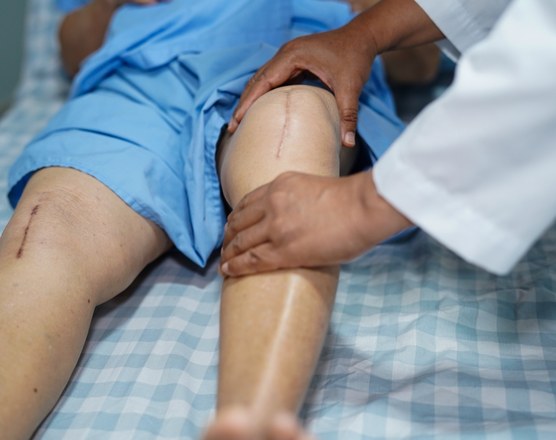
Deep vein thrombosis, or DVT, is a blood clot that forms in one of the deep veins of the body, most commonly in the leg. It can develop quietly, with symptoms that are easy to dismiss as normal post-surgical soreness. Left undetected, a DVT can break free and travel to the lungs, causing a potentially life-threatening condition called a pulmonary embolism. As a board-certified vascular surgeon, I see patients every week who wish they had known the warning signs sooner. Dr. David Fox, MD, FACS, RPVI, here — and my goal with this article is to make sure you do.
You made it through surgery. The joint has been replaced, the ligament repaired, the spine stabilized. Your physical therapist has a plan and recovery is underway. But there is one complication that deserves your attention in those early weeks — and too many patients only learn about it after something goes wrong.
Why Surgical Patients Face a Higher Risk
Your body is remarkably good at forming blood clots. Under normal circumstances, that is a lifesaving ability — it stops bleeding at wound sites and begins the healing process. The trouble comes when clotting happens where it should not, deep inside a vein where blood flow has slowed or the vessel wall has been damaged.
Orthopedic surgery checks several boxes that raise DVT risk significantly. First, the procedure itself can cause direct trauma to blood vessels near the surgical site, especially in the hip, knee, and spine. Second, general anesthesia and the period of immobility that follows — lying in a hospital bed, keeping weight off a leg, resting on the couch for days — allows blood to pool and stagnate. Third, the body’s inflammatory response to surgery naturally increases the tendency for blood to clot.
Certain procedures carry an especially elevated risk. Total knee replacement and total hip replacement are among the highest-risk orthopedic surgeries for DVT, partly because of how close the operative field sits to major deep veins. Spinal surgery, ACL reconstruction, and ankle fracture repair also fall in that higher-risk category. If you have additional factors like a family history of blood clots, obesity, or a known clotting disorder, your risk goes up further.
The Warning Signs You Should Not Ignore
Here is the challenge with DVT: the early symptoms can look a lot like the normal aftermath of surgery. Your leg is swollen, sore, and stiff — of course it is, you just had a procedure. But certain patterns should raise a red flag and prompt you to contact your doctor right away.
Watch for these DVT warning signs:
- Swelling in one leg that is noticeably worse than the other, or new swelling that develops days or weeks after surgery
- Pain or tenderness in the calf or thigh that feels different from your surgical pain — often described as a deep ache or cramping
- Warmth in the affected area, where the skin feels hot to the touch compared to the other leg
- Redness or discoloration of the skin, sometimes with a bluish or purplish tint
- A heavy, full, or tight feeling in the leg that was not there before
The key word is asymmetry. After bilateral surgery, both legs will be swollen and sore. But if one leg suddenly looks or feels markedly different from the other — larger, warmer, more painful — that warrants immediate attention. Even after a single-joint procedure, new or worsening swelling several days into recovery is something to take seriously rather than chalk up to “just part of healing.”
A leg that looks fine is not proof. About half of people who have a DVT have no symptoms at all, according to the CDC — which makes the list above a set of reasons to act rather than a checklist you have to meet before you are allowed to worry.4 A clot can also announce itself at the lungs first: it is possible to have a pulmonary embolism without ever having had any symptom of a DVT.4 That is why the prevention steps further down this page matter even through a recovery that feels completely uneventful, and why the emergency signs in the next section are worth reading before you need them.
When a Blood Clot Becomes an Emergency
The most dangerous scenario is when a DVT dislodges and travels through the bloodstream to the lungs. This is a pulmonary embolism, and it is a medical emergency. The CDC estimates that 60,000 to 100,000 Americans die each year of venous thromboembolism — that is DVT and pulmonary embolism together, not PE alone — and post-surgical patients are among those at greatest risk.1
Call 911 or go to the nearest emergency room immediately if you experience any of these symptoms:
- Sudden, unexplained shortness of breath
- Chest pain that worsens with deep breathing or coughing
- A rapid or irregular heartbeat that comes on without exertion
- Coughing up blood, even a small amount
- Feeling lightheaded, dizzy, or like you might pass out
These symptoms can appear suddenly. You do not need to have noticed a DVT in your leg beforehand — sometimes the first sign of a clot is the pulmonary embolism itself. If something feels wrong, trust that instinct and get help.
Reducing Your Risk During Recovery
The good news is that DVT is largely preventable, and your surgical and rehabilitation team will already have a plan in place.2,3 Your job is to stay engaged with that plan and take the following precautions seriously.
Move as early and as often as your care team allows. This is one of the most important reasons your physical therapist encourages early mobilization after surgery. Getting up, walking short distances, and performing ankle pump exercises all help keep blood circulating through the deep veins of your legs. Even if it is uncomfortable, that early movement matters — it is not just about rebuilding strength, it is about protecting your vascular health.
Wear compression stockings if prescribed. Graduated compression garments apply gentle pressure to your lower legs and help blood move upward toward the heart. They may not be glamorous, but they are effective. Your surgeon or therapist will let you know when and how long to wear them.
Take blood-thinning medication as directed. Many orthopedic surgeons prescribe anticoagulants after joint replacement or spinal surgery. These medications reduce the blood’s ability to clot and are one of the most reliable tools for DVT prevention. Do not skip doses, and talk to your doctor before stopping them — even if you are feeling great.
Stay hydrated. Dehydration thickens your blood and makes clotting more likely. Keep a water bottle within reach and sip throughout the day, especially if pain medication is affecting your appetite or fluid intake.
Know your personal risk factors. If you have a history of blood clots, a family member who has had DVT or pulmonary embolism, or a known clotting disorder, make sure every member of your care team is aware. That information can change the type and duration of preventive treatment you receive.
When to See a Vascular Specialist
Your orthopedic surgeon and physical therapist are focused on your musculoskeletal recovery, and they are the right people to guide that process. If you suspect a clot, call your surgical team the same day — or go straight to emergency care if you have any of the symptoms above. A suspected post-operative clot is assessed by whoever you reach first, and the duplex ultrasound that confirms it is ordered by the clinician who suspects it, so nothing is gained by waiting for a referral. A vascular specialist is one of the physicians trained to diagnose and manage venous clots, and may be involved in treating one.
At Fox Vein & Vascular, Dr. Fox uses duplex ultrasound — a non-invasive imaging study that combines traditional ultrasound with Doppler technology — to visualize blood flow and identify clots in the deep veins. The test is painless, requires no needles or contrast dye, and provides real-time results. It is considered the gold standard for diagnosing and evaluating deep vein thrombosis.
If a clot is confirmed, Dr. Fox develops a treatment plan tailored to the clot’s size and location, your overall health, and your surgical recovery timeline. Treatment typically involves anticoagulation therapy, close monitoring, and in more complex cases, minimally invasive interventions to restore healthy blood flow.
Staying Informed, Staying Safe
Recovery from orthopedic surgery takes patience, consistency, and trust in your rehabilitation team. Adding one more thing to worry about is the last thing you need — but being informed about DVT is not about worrying. It is about knowing what to look for so you can act quickly if something does not feel right.
Most post-surgical blood clots are preventable, and many that do develop are treatable when caught early. The patients who do best are the ones who stay active within their recovery guidelines, follow their medication protocols, and speak up the moment something seems off.
If you are recovering from surgery and have questions about your vascular health — or if you have noticed any of the warning signs described here — do not wait to see if things improve on their own. Reach out to a vascular specialist who can give you answers and, if needed, a clear path forward. Your recovery is too important to leave anything to chance.
Sources
- Centers for Disease Control and Prevention. "Data and Statistics on Venous Thromboembolism." The source for the figure above, and for the range rather than a single number: an estimated 60,000 to 100,000 Americans die each year of VTE, with as many as 900,000 affected. www.cdc.gov/blood-clots/data-research/facts-stats/index.html
- Falck-Ytter Y, Francis CW, Johanson NA, et al. "Prevention of VTE in Orthopedic Surgery Patients: Antithrombotic Therapy and Prevention of Thrombosis, 9th ed: American College of Chest Physicians Evidence-Based Clinical Practice Guidelines." Chest, 2012. Why this page says your surgical team already has a prophylaxis plan: for orthopedic surgery it is guideline-directed care, not something a patient has to ask for. doi.org/10.1378/chest.11-2404
- Anderson DR, Morgano GP, Bennett C, et al. "American Society of Hematology 2019 guidelines for management of venous thromboembolism: prevention of venous thromboembolism in surgical hospitalized patients." Blood Advances, 2019. The current guideline for prophylaxis in surgical inpatients. doi.org/10.1182/bloodadvances.2019000975
- Centers for Disease Control and Prevention. “About Venous Thromboembolism (Blood Clots).” The source for both statements above, in the CDC’s own signs-and-symptoms section: “About half of people with DVT have no symptoms at all” and “You can have a PE without any symptoms of a DVT.” www.cdc.gov/blood-clots/about/index.html
Medical disclaimer. This page is for general educational purposes and does not constitute medical advice, diagnosis, or treatment.