
Dental and oral development
Why Kids Drool in Their Sleep: What's Normal at Each Age
Usually nothing on its own — and the combination that makes it worth mentioning to a doctor.
- Expert Reviewed
- Evidence Based
- Patient Focused
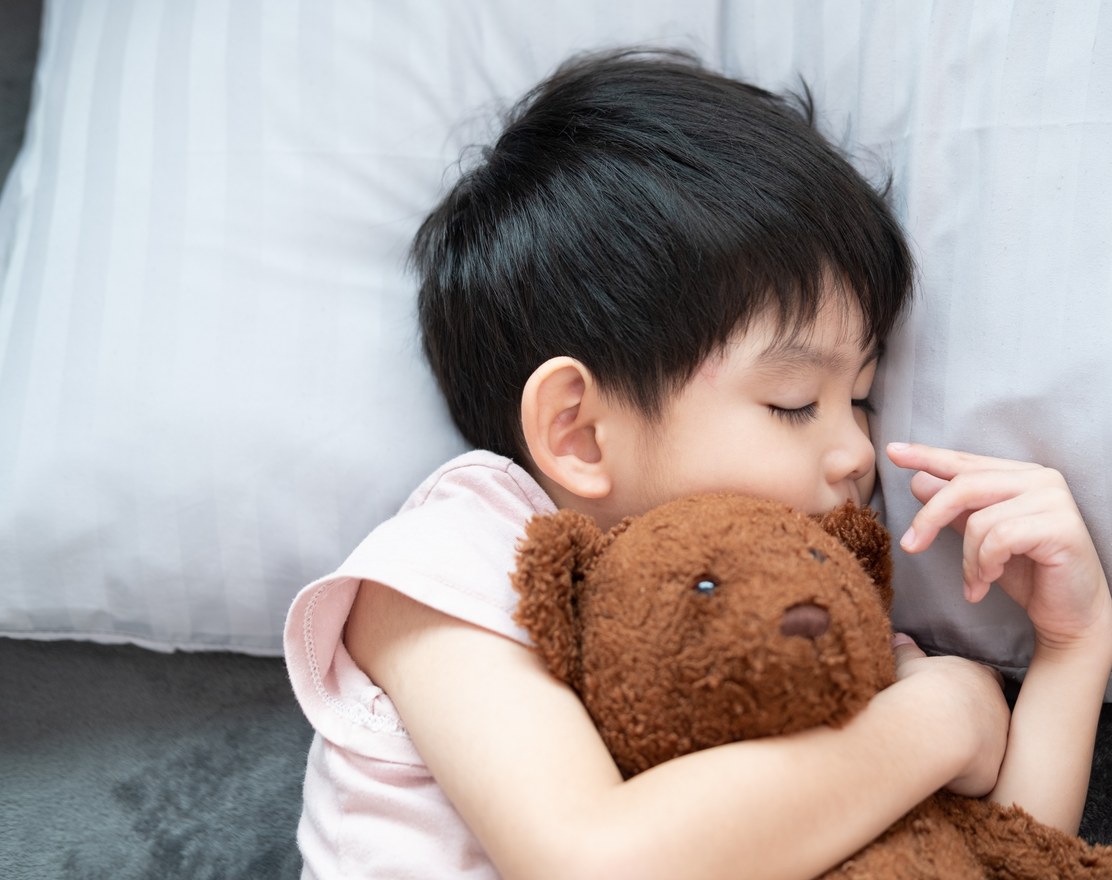
Occasional drooling during sleep is common in babies, toddlers, and young children and usually harmless — it happens when the mouth falls open and swallowing slows, which is normal during deep sleep. The more useful question is why the mouth is open. Persistent nighttime drooling often points to mouth breathing, which can be caused by nasal congestion, allergies, or enlarged tonsils and adenoids. That matters because chronic mouth breathing during sleep can be a sign of sleep-disordered breathing, which affects sleep quality and can produce daytime irritability, poor concentration, and behavior that looks like inattention. Drooling is worth discussing with a doctor if it persists past around age four, if it started suddenly, if it affects only one side, or if it comes with snoring, pauses in breathing, or difficulty swallowing.
Why children drool in their sleep
Saliva production continues through the night. Swallowing slows during deep sleep. If the mouth is closed, saliva is managed automatically. If the mouth is open, it runs out.
So nighttime drooling is usually a downstream sign rather than a problem in itself. The question worth asking is what's keeping the mouth open.
Sleeping position. Side and stomach sleeping let gravity do the rest. If the drool is only ever on one side and matches how your child sleeps, that's often all it is.
A blocked nose. A child who can't breathe comfortably through their nose will breathe through their mouth. Colds, allergies, chronic rhinitis, and a deviated septum all do this.
Enlarged tonsils or adenoids. One of the most common causes of chronic mouth breathing in children. Adenoids sit behind the nose and aren't visible when you look in the mouth — which is why this is often missed at home.
Oral motor differences. Lower muscle tone around the lips, cheeks, and tongue can make it harder to keep the mouth closed and manage saliva. This is more common in children with hypotonia or motor coordination differences.
Sensory differences. Some children have reduced awareness of the sensation of saliva in the mouth — an interoceptive difference — so the swallow that would normally happen automatically doesn't get triggered.
Tongue tie. A restricted tongue can affect resting tongue position, which affects both mouth closure and swallowing. See tongue ties and tongue tie symptoms in infants.
Teething, in younger children, temporarily increases saliva production.
Reflux. Increased saliva can be a response to acid.
Some medications, including certain seizure and behavioral medications.
What's normal at what age
A rough guide — variation is wide.
- Birth to around 18 months — drooling is entirely expected. Swallowing coordination is still developing, and teething adds to it.
- 18 months to about 2 years — usually decreasing, still common during teething or concentration.
- Around 2 to 4 years — most children have largely stopped daytime drooling. Occasional nighttime drooling remains common.
- Past age 4 — persistent drooling, day or night, is worth mentioning to a doctor or dentist. Not an emergency, and not something to keep waiting out either.
Occasional nighttime drooling at any age can be entirely normal, including in adults. Frequency and pattern matter more than the fact of it.
The mouth breathing connection
This is the part most articles skip, and it's the useful part.
If your child's pillow is regularly damp, they've most likely been sleeping with their mouth open. Occasionally, that's nothing. Consistently, it's worth a look — because chronic mouth breathing has effects well beyond the drool.
Other signs your child is mouth breathing at night:
- Snoring, particularly loud or nightly
- Waking with a dry mouth, chapped lips, or a sore throat
- Restless sleep, frequent position changes, kicking off covers
- Waking tired despite adequate hours
- Dark circles under the eyes
- Teeth grinding
- Bedwetting past the expected age
- Mouth resting open during the day, especially while concentrating
Why it matters:
Sleep quality
Mouth breathing is associated with more fragmented, less restorative sleep, even without full obstructive sleep apnea.
Dental and facial development
Long-term mouth breathing has been associated with a narrower palate, a long-face growth pattern sometimes called "adenoid facies," and a higher rate of dental problems. Airway obstruction is described as potentially leading to dentofacial dysmorphogenesis, with how much depending on the child's age, how long it lasted and how complete it was.5 One proposed mechanism is that the resting position of the tongue influences how the upper jaw develops — but a direct causal link isn't established, and genetics, allergies, and oral habits all play a part.
And it is not necessarily permanent
A study that recalled 57 people an average of 13 years after treatment for airway obstruction — some who had an adenoidectomy, some treated with medication — found significant long-term improvement in both groups across several facial measurements, including jaw angle, facial convexity and facial height.5 Treating the obstruction is the point, not the drooling.
This is a reason to involve a dentist
Sleep-disordered breathing is under-recognized and under-diagnosed in children, and a scoping review of 34 studies makes the case that routine dental appointments are a practical place to screen for it.6 A pediatric dentist sees the inside of your child's mouth on a schedule and can spot these patterns well before a parent would.3
Daytime function
Poor sleep affects mood, attention, and behavior. More on this below.
Recurrent infections
Nasal breathing filters and humidifies air. Mouth breathing doesn't.
Sleep-disordered breathing, and the attention question
Habitual snoring is common enough that it is worth asking about: in a community pediatrics sample of 866 children aged 2 to 14, 16% snored habitually.2 The American Academy of Pediatrics' guideline on childhood obstructive sleep apnea is built around the two usual causes — enlarged tonsils and adenoids, and obesity — in an otherwise healthy child.4 In young children the adenotonsillar route is the common one; in older children and adolescents, obesity becomes a leading contributor.
Signs that go beyond ordinary mouth breathing:
- Loud snoring most nights
- Pauses in breathing, gasping, or choking sounds during sleep
- Sleeping in unusual positions — neck extended, propped up
- Sweating heavily during sleep
- Bedwetting that returns after a dry period
- Very restless sleep
- Difficulty waking, or excessive daytime sleepiness
The AAP guideline's first recommendation is that all children and adolescents should be screened for snoring, and that a child who snores and has other signs of obstructive sleep apnea should have a sleep study.4 If you've noticed pauses in your child's breathing during sleep, say so specifically. That's the detail that changes the conversation, and parents often don't think to raise it.
The attention question, handled carefully
Poor sleep affects children differently from adults. Where an adult becomes visibly tired, a child more often becomes irritable, hyperactive, impulsive, and unable to concentrate — a presentation that overlaps substantially with ADHD.
A population-based study followed around 11,000 British children, with parents reporting snoring, mouth breathing and witnessed pauses from 6 months onward and behavior measured at 4 and 7 years. Sleep-disordered breathing patterns predicted roughly 20% to 100% higher odds of behavioral difficulty, after controlling for fifteen potential confounders — and, strikingly, children whose symptoms peaked before 18 months and then resolved still showed 40% to 50% higher odds at age 7.1
A separate clinic study found hyperactivity roughly twice as common among children who snored habitually as among those who did not — 22% against 12%, an odds ratio of 2.2.2 That is an association between two things measured at the same time, not evidence that one caused the other. What it supports is narrower and more useful: asking about snoring belongs in any assessment for attention or behavior.
What that does mean: sleep is worth evaluating as part of any assessment for attention or behavior difficulties. Asking about snoring, mouth breathing, and sleep quality is reasonable, inexpensive, and easy to skip.
What it doesn't mean: that ADHD is usually misdiagnosed sleep apnea. That claim circulates widely and overstates the evidence. ADHD is a well-established condition, the two frequently co-occur, and treating a breathing problem doesn't mean the ADHD wasn't real.
The practical version: if your child has attention difficulties and snores, mouth breathes, or drools at night, mention the sleep signs during assessment. It's information the clinician needs and may not think to ask for.
When to get it checked
Book an appointment if your child:
- Still drools regularly past around age four
- Snores most nights
- Mouth breathes during the day as well as at night
- Wakes unrefreshed despite enough sleep
- Has attention or behavior difficulties alongside any of the above
- Has ongoing nasal congestion with no clear cause
Contact a doctor promptly if:
- Drooling started suddenly in a child who wasn't drooling before
- It affects only one side of the mouth, or you notice one-sided facial weakness
- It comes with difficulty swallowing, coughing, or choking during meals
- Your child has lost skills they previously had
- You've noticed pauses in breathing during sleep
- There's unexplained weight loss or feeding difficulty
Sudden onset and one-sided drooling are the two that warrant prompt attention rather than a routine appointment. Both can indicate a neurological cause that needs assessing.
Who to see, and for what
Your pediatrician — the right first stop. They can examine, assess for allergies and infection, and refer onward.
A pediatric dentist — can assess palate shape, bite, tongue position, and the dental signs of mouth breathing. Often the first professional to notice an airway pattern, because the changes show up in the mouth before they show up anywhere else.
ENT (ear, nose and throat) — for suspected enlarged tonsils or adenoids, chronic congestion, or suspected sleep apnea. Adenoids can't be seen by looking in the mouth, so this usually needs a specialist.
A speech-language pathologist — for oral motor difficulty, swallowing, tongue tie effects, and myofunctional concerns.
An occupational therapist — where sensory awareness of saliva or oral sensory differences are part of the picture.
A sleep specialist — where obstructive sleep apnea is suspected. A sleep study is the definitive assessment.
Browse pediatric providers by city and state.
Browse the DrSensory Therapy Directory →What you can do at home
Supportive, not a substitute for assessment.
- Treat congestion. If allergies or a blocked nose are the cause, addressing that often resolves the drooling. Discuss with your doctor.
- Try side or back positioning if your child sleeps face-down.
- Keep the bedroom air comfortable. Dry air worsens congestion.
- Protect the mattress, and let it be a non-issue. Children made to feel embarrassed about drooling don't stop drooling. They just feel worse about it.
- Note the pattern — which nights, which positions, whether snoring accompanies it. Useful at the appointment.
- Record the sound if there's snoring or you've noticed breathing pauses. A phone recording of a child's night breathing is genuinely useful to a clinician and hard to describe otherwise.
One thing not to do: don't tape your child's mouth closed
Mouth taping circulates online as a remedy for mouth breathing and isn't appropriate for children. If a child breathes through their mouth because they can't breathe comfortably through their nose, closing the mouth doesn't address the obstruction — it needs assessing.
Frequently Asked Questions
When is drooling a red flag?
Sudden onset in a child who was not drooling before, drooling on only one side, difficulty swallowing or choking during meals, loss of previously acquired skills, or observed pauses in breathing during sleep. Any of these warrants prompt medical attention.
At what age should a child stop drooling?
Most children largely stop daytime drooling between two and four years old. Occasional nighttime drooling stays common at any age, including in adults. Persistent drooling past four is worth mentioning to a doctor or dentist.
Does drooling mean my child has sleep apnea?
Not on its own. Drooling usually means mouth breathing, which has many causes including a simple blocked nose. Sleep apnea is more likely if there is also loud snoring most nights, pauses in breathing, gasping, restless sleep, or daytime sleepiness. Mention those specifically to your doctor.
Should I tape my child's mouth shut at night?
No. Mouth taping circulates online as a remedy and is not appropriate for children. If a child is mouth breathing because they cannot breathe comfortably through their nose, the obstruction needs assessing. Closing the mouth does not address it.
Is it normal for kids to drool in their sleep?
Occasional nighttime drooling is common and usually harmless — it happens when the mouth falls open and swallowing slows during deep sleep. It is worth checking if it persists past around age four, or comes with snoring, mouth breathing, or breathing pauses.
Why does my child drool at night but not during the day?
Swallowing slows during sleep and the mouth is more likely to fall open, particularly when sleeping on the side or front. If it happens most nights, the usual reason is that your child is breathing through their mouth while asleep.
Can mouth breathing affect my child's teeth or face shape?
Long-term mouth breathing has been associated with changes in palate and facial development and with a higher rate of dental problems. One proposed explanation is that resting tongue position affects how the upper jaw grows, though a direct causal link is not established and factors like genetics and allergies also contribute. A pediatric dentist can assess this.
Could my child's attention problems be caused by poor sleep?
Poor sleep can produce irritability, hyperactivity, and difficulty concentrating in children, which overlaps with ADHD. That does not mean attention difficulties are usually a sleep problem — but if your child snores or mouth breathes, mention it during any assessment. It is relevant information a clinician may not think to ask for.
Popular next reads
Sources
- Bonuck K, Freeman K, Chervin RD, Xu L. Sleep-disordered breathing in a population-based cohort: behavioral outcomes at 4 and 7 years. Pediatrics. 2012;129(4):e857–e865. PMID 22392181.
- Chervin RD, Archbold KH, Dillon JE, Panahi P, Pituch KJ, Dahl RE, Guilleminault C. Inattention, hyperactivity, and symptoms of sleep-disordered breathing. Pediatrics. 2002;109(3):449–456. PMID 11875140.
- American Academy of Pediatric Dentistry. The Reference Manual of Pediatric Dentistry. Checked August 19, 2026.
- Marcus CL, Brooks LJ, Draper KA, et al.; American Academy of Pediatrics. Diagnosis and management of childhood obstructive sleep apnea syndrome. Pediatrics. 2012;130(3):576–584. PMID 22926173 (doi:10.1542/peds.2012-1671). Checked August 25, 2026.
- Macari AT, Babakhanian A, Karam I, Ghafari JG. Long-term (>10 years) effects of medical and surgical airway obstruction treatment on dentofacial morphology. Diagnostics. 2025;15(23):3079. PMID 41374460. Checked August 25, 2026.
- Baskar R, Vandeleur M, Trinh E, Silva M. Screening for paediatric sleep disordered breathing in the dental setting: a scoping review. Sleep and Breathing. 2026;30. PMID 41857391. Checked August 25, 2026.
Medical disclaimer. This page is for general educational purposes and does not constitute medical advice, diagnosis, or treatment. If your child's drooling started suddenly, affects one side, comes with difficulty swallowing, or you've noticed pauses in their breathing during sleep, contact their doctor promptly.