
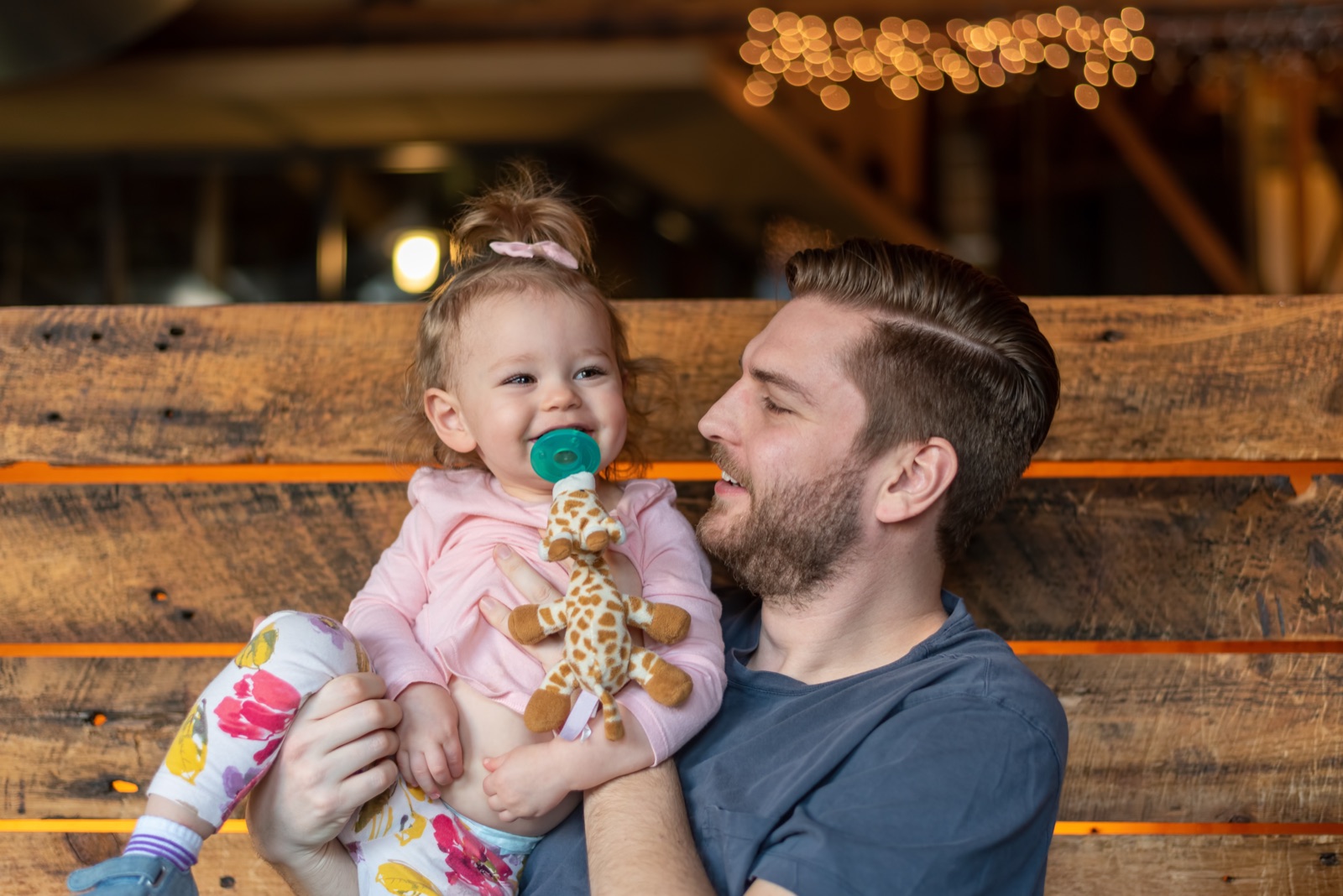
The pacifier is the only piece of baby gear I have been warned about by four different people for four contradictory reasons. It will ruin her teeth. It will ruin breastfeeding. It will give her ear infections. She will still have it at kindergarten. All of that gets said with total confidence, usually while the baby in question is screaming in a checkout line.
So I went and read what the evidence actually says, because the gap between the warnings and the research turned out to be wide. Some of what you get told is well supported. Some of it was settled years ago in the opposite direction. And the single thing that matters most is not which pacifier you buy — it is how long you keep using it.
Key takeaways
- There are two deadlines, not one. Around 18 months is when reducing use starts to matter for the bite; three years is the point past which the effect on the front teeth is clear.
- Children who used a pacifier for 36 months or longer had a significantly higher rate of anterior open bite.
- Duration matters more than frequency. Months of use drives the effect more than hours in the day.
- To limit posterior crossbite, the AAPD points at discontinuing or limiting use around the time the canines come in, roughly 18 months.
- The shield should be at least 1.5 inches across, firm, and vented, so it cannot pass into the mouth.
- One-piece construction matters because the parts are the choking risk.
- No cords, straps or attachments around the neck. The CPSC prohibits these outright on pacifiers.
- Never dip a pacifier in anything. Honey-filled pacifiers were tied to infant botulism cases in Texas, and honey is unsafe under a year in any form.
The short version
If you want the whole thing in five lines:
- Offering a pacifier at naps and bedtime is recommended for safer sleep, not merely tolerated.1
- The breastfeeding warning did not hold up. A Cochrane review found no effect on how long healthy, full-term babies breastfed.2
- Teeth are a real issue, and it is duration that drives it. Stopping before three changes the picture substantially.3
- The ear-infection link is real but modest, and the evidence behind it is weak.4
- The speech worry is usually explained wrong, which makes it sound scarier than it is.
Should you offer one at all?
This is the part that surprised me most. The American Academy of Pediatrics does not merely permit pacifiers at sleep — it recommends offering one at nap time and bedtime as part of reducing the risk of sleep-related infant death.1 It sits in the same set of recommendations as back-sleeping and a firm, flat surface.
Two practical notes that come with it. If the pacifier falls out once your baby is asleep, you do not need to go back in and replace it. And if your baby simply refuses one, that is fine — nobody is asking you to force it.
The breastfeeding warning
Here is where the advice you will hear is genuinely out of date. The concern was nipple confusion: that a pacifier in the early weeks would interfere with latch and cut breastfeeding short. The AAP's own guidance still errs on the cautious side and suggests waiting until breastfeeding is established before introducing one.1
But when the question was tested directly, the effect did not appear. A Cochrane systematic review of healthy, full-term breastfed infants found that pacifier use — whether started at birth or after lactation was established — did not significantly change the proportion of babies exclusively or partially breastfed at three or four months.2 The American Academy of Pediatric Dentistry notes the same contrast in its own policy: the AAP advises delay, and the Cochrane evidence did not find the harm that advice is guarding against.3
What the review could not tell us is just as worth knowing. It did not measure total breastfeeding duration, and it did not settle the short-term feeding difficulties some mothers report. So the honest position is not "pacifiers are proven harmless for feeding" — it is "the specific claim that they shorten breastfeeding was tested and did not hold up."
If breastfeeding is going well, this is not something to lose sleep over. If it is not going well, a pacifier is not the first thing I would look at, and a lactation consultant will get you further than removing it.
Teeth: the number that actually matters
This is the one where the warnings are broadly right, and where the detail matters more than the headline.
Children who used a pacifier for 36 months or longer had a significantly higher rate of anterior open bite — the gap that stays between the top and bottom front teeth when the back teeth are closed.3 And the encouraging half of that same finding: an anterior open bite associated with pacifier use improves after the pacifier is eliminated before age three.3
Two further points from the AAPD's policy that changed how I think about it:
- Duration matters more than frequency. Months of use drives the effect more than hours in the day. A pacifier at sleep for eighteen months is a different exposure from one in the mouth all day for four years.3
- Crossbite has an earlier clock. To limit posterior crossbite, discontinuing or limiting use around the time the canines come in — roughly 18 months — has been recommended.3
So there are really two deadlines, not one. Around 18 months is when reducing use starts to matter for the bite; three years is the point past which an open bite is much less likely to correct on its own.
We have a longer piece on the mechanics of this, including whether an orthodontic shape genuinely helps: Pacifier use, teeth, and speech.
Ear infections
The association is real, and it is smaller than it sounds. A 2025 systematic review and meta-analysis found children who used a pacifier were about 1.17 times as likely to develop otitis media, and 1.54 times as likely to develop acute otitis media, than children who did not.4
Two caveats that belong in the same breath. The lower bound of the first estimate sits essentially at 1.00, meaning "no difference" was not excluded. And the review's authors rated the certainty of the evidence as very low.4 That is their assessment, not my hedging.
The practical version, from the dental policy: if ear infections are a recurring problem for your child, the incidence of acute otitis media may be reduced by cutting back or stopping pacifier use in the second six months of life.3 That is a targeted piece of advice for a specific situation, not a reason for everyone to throw the pacifier away at six months.
Speech, explained properly
This one gets stated as though a pacifier physically damages speech. It does not. The AAPD's position is blunter than you might expect: a speech-related justification against pacifier use is not evident in the literature.3
Where an association does show up, the likely mechanism is simply time. A pacifier in the mouth is time not spent babbling and practicing sounds, and babbling is how the practice happens. That is an argument for a pacifier having a place — the crib, the car seat — rather than living in the mouth through the hours your toddler would otherwise be talking at you.
Buying one: which specifications are safety
Most pacifier marketing is about shape and color. A short list of the features that are actually about safety, drawn from AAP guidance and the US Consumer Product Safety Commission:3
- A shield at least 1.5 inches across, firm, with vent holes — large enough that it cannot pass into the mouth.
- One-piece construction. A pacifier molded in a single piece is less likely to come apart, and the parts are the choking risk.
- No cords, straps or attachments around the neck. The CPSC prohibits these outright on pacifiers. Clip-on holders that fasten to clothing are a different product; a cord long enough to reach a neck is not.
- Inspect it regularly. Rubber perishes. Check for tears, stickiness and thinning at the base of the teat, and replace rather than nurse one along.
- Never dip it in anything. Honey-filled pacifiers were tied to cases of infant botulism in Texas. Honey is unsafe under a year in any form.3
Keeping it clean
Pacifiers are a reservoir for microbes, and their use is linked to oral yeast infections.3 The AAPD names two methods that work: boiling in water for 15 minutes, or an antimicrobial spray.3
The thing not on that list is the one every parent has done — cleaning a dropped pacifier in your own mouth. It moves your oral bacteria to your baby, including the ones implicated in tooth decay. On a park bench with no alternative I am not going to pretend I have never done it. It is simply worth knowing it is the worst of the available options, not a folk remedy.
Weaning without a war
Knowing the deadline is easy. Hitting it is not, because by then the pacifier is not a habit, it is a coping strategy.
What worked for us, and what the timeline above suggests, is to start narrowing long before you plan to stop. Reduce the hours before you remove the object. Make it a place rather than a permission — the pacifier lives in the crib, so it is available at sleep and not in the stroller. Replace the function rather than deleting it, because the need it meets is real. And pick a calm week: not the week of a house move, a new sibling or the first day of daycare.
Our step-by-step version, written with the dental timeline in mind, is in the clinical guide.
What I would actually do
Offer one at sleep from the start, and take the AAP's cautious line on breastfeeding if feeding is still finding its feet — not because the Cochrane evidence demands it, but because it costs nothing to wait a few weeks and it removes one variable from an already hard couple of weeks.
Then set two dates rather than agonizing daily. Around 18 months, start pulling it back to sleep only. Before the third birthday, finish. Between those two points, stop worrying about it — you are inside the window where the evidence says the effects are reversible, and the daily anxiety is doing more for your stress levels than for your child's bite.
Need more than an article?
Gear can only do so much. If something about how your child eats, moves, or talks has been on your mind, a pediatric therapist is the person who assesses it. Every state lets families go to a physical therapist without a referral, though some limit treatment without one;5 the rules for occupational and speech therapy vary by state, and some insurance plans ask for a referral before they pay, so check with yours when you call.
Find a therapist near you →Related DrParenting guides
All DrParenting guides →More from DrSensory
DrParenting covers the gear. DrSensory covers the development behind it, written and reviewed by clinicians.
Sources
- Moon RY, et al. Sleep-Related Infant Deaths: Updated 2022 Recommendations for Reducing Infant Deaths in the Sleep Environment. Pediatrics. 2022;150(1):e2022057990. doi:10.1542/peds.2022-057990
- Jaafar SH, et al. Effect of restricted pacifier use in breastfeeding term infants for increasing duration of breastfeeding. Cochrane Database of Systematic Reviews. 2016;(8):CD007202. doi:10.1002/14651858.CD007202.pub4
- American Academy of Pediatric Dentistry. Policy on Pacifiers. Revised 2024. aapd.org. Checked August 25, 2026.
- Castro-Cunha AC, et al. Influence of potentially harmful sucking habits on otitis media in children: a systematic review and meta-analysis. Brazilian Oral Research. 2025;39:e115. doi:10.1590/1807-3107bor-2025.vol39.115
- American Physical Therapy Association. Direct Access Advocacy. All 50 states, the District of Columbia and the U.S. Virgin Islands “have either provisional or unrestricted direct access to physical therapist services for evaluation and treatment,” though some states still attach provisions to treatment without a referral. Checked October 6, 2026.
Medical disclaimer. This page is for general educational purposes and does not constitute medical advice, diagnosis, or treatment. Always consult a qualified healthcare provider about your child. Product information is checked against the manufacturer at the date shown and can change without notice — confirm weight and age limits on the product itself before you rely on them. Talk to your pediatrician about your own child.