

Affiliate disclosure. Some links in this guide are Amazon affiliate links: we earn a small commission if you buy through one, at no extra cost to you. It does not change which products we include or what we say about them.
Prices are the maker’s own list prices, checked October 5, 2026, and may have changed since.
Quick answer. Our top pick is the Nanit Smart Baby Monitor System with its wall mount and 8-inch Home Display ($399), an overhead Wi-Fi camera you can watch on the display or your phone; breathing-motion tracking comes with it, and sleep tracking needs a paid Insights plan after a three-month trial. If you would rather keep the camera off the internet, our pick is the Infant Optics DXR-8 PRO ($199.99), which talks only to its own 5-inch parent unit, with no Wi-Fi, app or account.1,2
A baby monitor answers one question without opening the nursery door: is the baby all right? Every other choice follows from a first one, whether the camera joins your home Wi-Fi. Wi-Fi buys you a view from anywhere and the smart features; staying off it buys you privacy, no subscription and no account. This guide sets out what to look for, reviews our two picks against the maker’s own specifications, and ends with the safety rules that matter more than any feature.
Key takeaways
- Wi-Fi or not is the first decision, and it is mostly a privacy decision.
- A non-Wi-Fi monitor (FHSS or DECT) links the camera to its own parent unit, with no internet connection or account to get into. Its limit is range.
- Quoted ranges are open-air maximums. Infant Optics rates the DXR-8 PRO at up to 1,000 feet line of sight and says walls, interference and layout cut it.3
- On a Wi-Fi monitor, use a unique password and two-factor sign-in. Nanit makes multi-factor sign-in mandatory.1
- Keep every monitor and its cord at least three feet from any part of the crib, bassinet or play yard.4
- Breathing and movement trackers are not medical devices, and the AAP says there is no evidence that home monitors lower the risk of SIDS.5
What to Look for When Buying a Baby Monitor
Five questions settle most of the choice. Answer them in this order and the shortlist is usually down to two or three monitors.
Do you need a Wi-Fi baby monitor?
Only if you want to watch from outside the house or want app features such as sleep tracking and clips. A Wi-Fi monitor streams to an app on your phone, so a partner at work or a grandparent can look in, and it can analyze what the camera sees. It also puts a camera on your home network, depends on your internet connection, and often sells its best features by subscription. A non-Wi-Fi monitor uses a closed radio link (FHSS or DECT) from camera to parent unit: nothing online to sign into, nothing to subscribe to, and it keeps working when the internet is down.
How much range do you need?
Enough to reach the rooms you actually use, through the walls between them. Range on the box is measured in open air: Infant Optics gives the DXR-8 PRO up to 1,000 feet line of sight and says the real figure depends on walls, interference and the layout of your home.3 Before the return window closes, carry the parent unit to the kitchen, the far bedroom and the yard and see where the picture drops. A Wi-Fi monitor has no range limit while the camera is online, and none at all when it is not.
What video and audio quality is enough?
A picture clear enough in the dark to see your baby’s chest move, and sound without constant static. Judge a monitor by its night picture, not its daytime photos. Resolution matters less than it looks on the box: an overhead camera close to the crib shows more than a sharper camera across the room. Two-way talk lets you soothe from another room, and noise reduction matters if a fan, purifier or sound machine runs in the nursery: the DXR-8 PRO filters those out so the speaker can stay turned up.2
Which smart features are worth paying for?
Room temperature and humidity readings, sound and motion alerts, and pan, tilt and zoom are the ones parents keep using. Sleep tracking and breathing-motion tracking are comfort features: Nanit states its products are not medical devices and are not FDA-approved,1 and the AAP advises against relying on any home monitor to reduce the risk of SIDS.5 If a feature needs a subscription, price the monitor with a year of it before you compare.
Are baby monitors over $250 worth it?
They are if you will use what the extra money buys: an overhead view, sleep data, watching from anywhere, or several cameras on one screen. A monitor at about $200 without Wi-Fi does the core job, a clear picture and sound in the next room, and has no subscription to keep paying. Our two picks are a fair test of that question: $399 against $199.99.1,2
Best Baby Monitors: Top-Rated Reviews
Each pick below was checked against its maker’s own product page on October 5, 2026: what is in the box, what needs a subscription, and the price. Neither has a recall listed with the CPSC.6
| Monitor | Connection | Where you watch | Range | Subscription | Price |
|---|---|---|---|---|---|
| Nanit Smart Baby Monitor System | Wi-Fi (2.4 GHz) | 8-inch Home Display (in this kit) and the Nanit app | Anywhere with internet | Optional; sleep tracking and highlights need an Insights plan | $399 |
| Infant Optics DXR-8 PRO | FHSS radio, no Wi-Fi | 5-inch parent unit | Up to 1,000 ft line of sight | None | $199.99 |
1. Best Overall: Nanit Smart Baby Monitor System with Wall Mount and Display
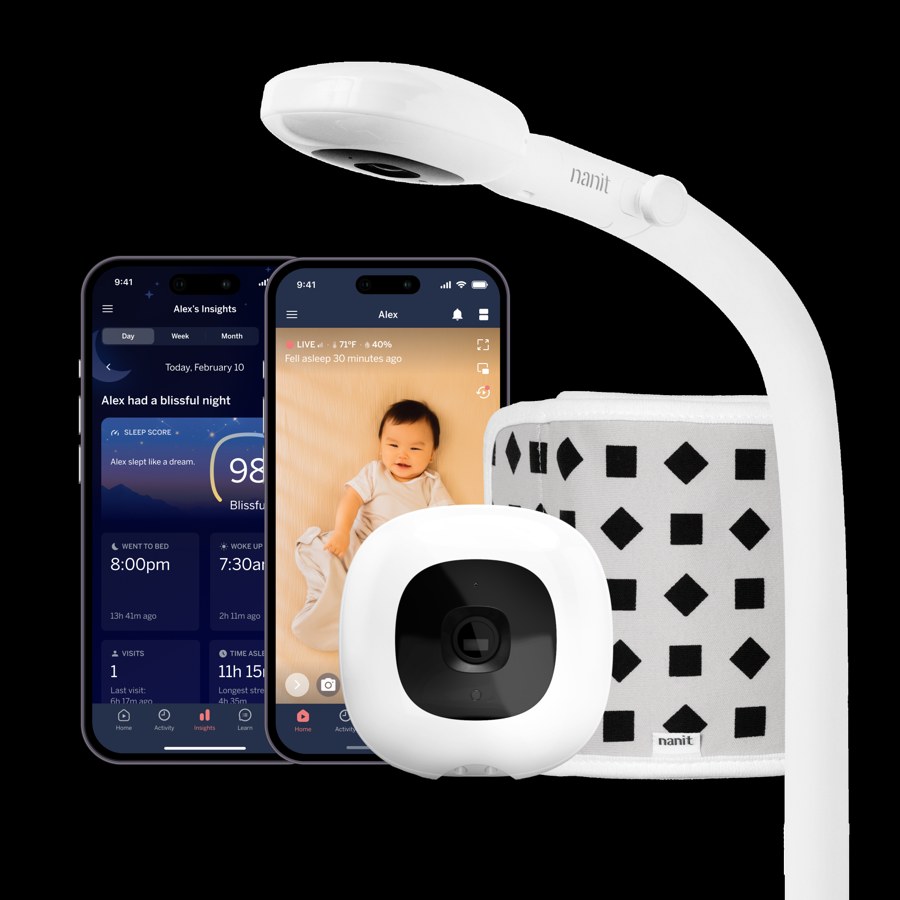
Who it is for: Parents who want to see the whole crib from above, check in from anywhere, and have the data on how their baby sleeps.
The camera mounts on the wall over the crib and looks straight down, so it sees the whole mattress however your baby turns. This kit adds Nanit’s 8-inch Home Display, a touchscreen for the bedside, so the phone is not the only way to watch. Without any subscription you get live video from anywhere, sound and motion alerts, two-way audio, room temperature and humidity, and white noise.1 Breathing-motion tracking is included too: the camera reads a printed pattern on Nanit’s Breathing Wear, and a 0–3 month Breathing Band comes in the box.1,7
Sleep tracking, highlight reels and sleep coaching are Insights features. The kit includes a three-month trial of the Sleep Plan; after that Nanit lists it at $9 a month, billed annually.1
What it does well
- Overhead view of the whole crib, which a camera on a shelf cannot give you.
- A dedicated 8-inch display in this kit, plus the app for anyone you share access with.1
- Breathing-motion tracking without a subscription, using wear with no electronics in it.7
- End-to-end encrypted video and mandatory multi-factor sign-in.1
The spec that decides it: home Wi-Fi. Nanit needs a 2.4 GHz network and the internet for everything it does, so if your Wi-Fi is unreliable or you do not want a camera on it, choose the DXR-8 PRO.1
2. Best Non-Wi-Fi Monitor: Infant Optics DXR-8 PRO
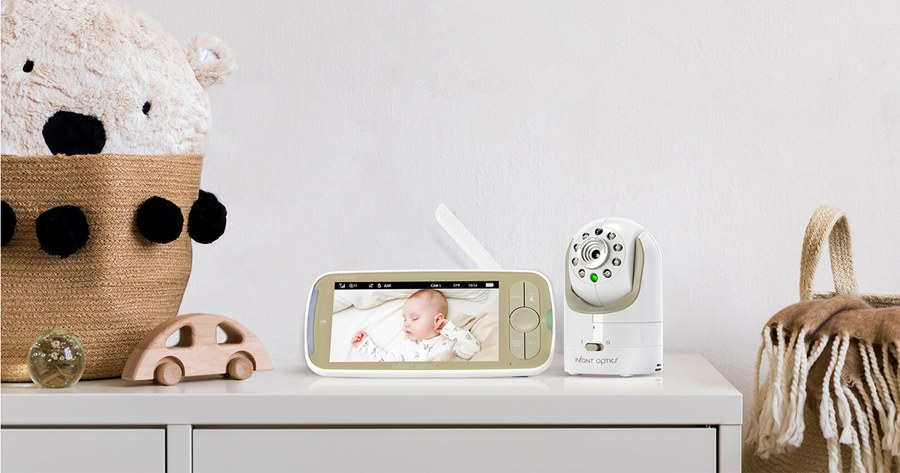
Who it is for: Parents who want a monitor that never touches the internet, with its own screen and nothing to subscribe to.
The camera talks to a 5-inch parent unit over a private FHSS radio link: no app, no Wi-Fi, no cloud.2 You can pan, tilt and zoom from the parent unit, and change lenses: the standard and optical zoom lenses come in the box, and a wide-angle lens is sold separately.2,8 Active noise reduction filters out fans, air purifiers and heaters, so you can keep the volume up and still hear your baby rather than the sound machine.8
The parent unit runs on a rechargeable battery you can replace yourself when it wears out, and the system takes up to four cameras.2
What it does well
What it does not
- You cannot check in from outside the house.
- 720p video, softer than the sharpest Wi-Fi cameras.8
- No sleep or breathing tracking.
The spec that decides it: range. Up to 1,000 feet line of sight, cut by walls and interference, so test it from the rooms you use before the return window closes.3
Baby Monitor Safety
A monitor is only as safe as where you put it. The CPSC and the industry’s safety association ask parents to keep monitor cords out of reach, to place them at least three feet from any part of the crib, bassinet or play yard, and never to put a monitor inside or on the edge of a crib.4 A wall-mounted camera like the Nanit puts the camera out of reach, but its cord still runs down the wall, so route it exactly as the maker’s instructions show.
No monitor makes a sleep space safer. The AAP’s advice is to place your baby on their back, on a firm, flat surface with nothing else in it, in your room but not your bed.9 It also says not to use home cardiorespiratory monitors as a way to reduce the risk of SIDS: consumer heart-rate, breathing and pulse-oximetry devices do not have to meet the requirements medical devices do, there is no evidence they lower the risk, and one is fine to use only if it is never a substitute for safe sleep.5
Making Your Final Decision
- If you want the overhead view, sleep data and the option to look in from anywhere, choose the Nanit, and budget for the Insights plan if you want sleep tracking past the trial.
- If you want privacy, no subscription and a screen of its own, choose the Infant Optics DXR-8 PRO, and test its range in your home.
Whichever you choose, register it with the maker so you hear about any recall, and set it up three feet from the crib.4
Frequently asked questions
What is the best baby monitor?
Our top pick is the Nanit Smart Baby Monitor System with its wall mount and 8-inch display, an overhead Wi-Fi camera you can watch on the display or your phone; sleep tracking needs a paid plan after the three-month trial.1 If you would rather keep the camera off the internet, our pick is the Infant Optics DXR-8 PRO, a non-Wi-Fi monitor with its own 5-inch parent unit.2
What should I look for in a baby monitor?
Decide first whether you want Wi-Fi, which is mostly a privacy decision: a Wi-Fi monitor lets you watch from anywhere but puts a camera on your home network, while a DECT or FHSS monitor uses a closed link with no internet connection. Then check range through your own walls, clear night vision and audio, and on a Wi-Fi model, encryption, two-factor sign-in and what needs a subscription.
Which is more secure, a Wi-Fi or a non-Wi-Fi baby monitor?
A non-Wi-Fi monitor: a DECT or FHSS link has no internet connection and no account, so there is nothing online to break into. Its limit is range, and quoted ranges are open-air figures that walls cut. If you choose Wi-Fi instead, use a unique password and two-factor sign-in.3
Which baby monitor do pediatricians recommend?
The AAP does not recommend a brand. Its advice is about how a monitor is used: do not rely on a home breathing or heart-rate monitor to reduce the risk of SIDS, and never let one stand in for safe sleep: back to sleep, a firm flat surface with nothing else in it, in your room but not your bed.5
Do I need a subscription for a baby monitor?
Not for a basic one. A non-Wi-Fi monitor such as the DXR-8 PRO has no subscription at all.2 Nanit works without one for live video, alerts, two-way audio and breathing motion; sleep tracking, highlights and coaching need an Insights plan after the three-month trial.1
Where should a baby monitor go?
At least three feet from any part of the crib, bassinet or play yard, cord included, and never inside or on the edge of the crib.4 A wall mount above the crib, with the cord routed as the maker shows, keeps the camera out of reach and gives the clearest view.
When to ask a professional: A monitor shows you a pattern, not its cause. If it keeps showing broken sleep, loud snoring or mouth breathing, raise it with your pediatrician; nighttime drooling and breathing in children explains when it is worth a closer look.
Need more than an article?
Gear can only do so much. If something about how your child eats, moves, or talks has been on your mind, a pediatric therapist is the person who assesses it — and most families do not need a referral to ask.
Find a therapist near you →Related DrParenting guides
All DrParenting guides →More from DrSensory
DrParenting covers the gear. DrSensory covers the development behind it, written and reviewed by clinicians.
Sources
- Nanit. Nanit Smart Video Baby Monitor | HD Video & Sleep Tracking. nanit.com. What is in the box with the wall mount and 8-inch display, the 2.4 GHz Wi-Fi requirement, the subscription terms, encryption and multi-factor sign-in, and the list price. Checked October 5, 2026.
- Infant Optics. DXR-8 PRO Non-WiFi Baby Monitor | Active Noise Reduction. infantoptics.com. FHSS link, 5-inch parent unit, range, lenses included, replaceable battery, up to four cameras, and the list price. Checked October 5, 2026.
- Infant Optics. FAQ — No WiFi Baby Monitors, Trade-offs Answered. infantoptics.com. “Up to 1000 feet in open air. Actual range depends on walls, interference, and home layout.” Checked October 5, 2026.
- U.S. Consumer Product Safety Commission and Juvenile Products Manufacturers Association. Infants and Toddlers Can Strangle in Baby Monitor Cords. cpsc.gov. Checked October 5, 2026.
- American Academy of Pediatrics. How to Keep Your Sleeping Baby Safe: AAP Policy Explained. HealthyChildren.org, last updated September 11, 2026. healthychildren.org. Checked October 5, 2026.
- U.S. Consumer Product Safety Commission. Recalls & Product Safety Warnings. cpsc.gov. Checked October 5, 2026.
- Nanit. Breathing Motion Monitoring | Sensor-Free Baby Wear | Nanit. nanit.com. Checked October 5, 2026.
- Infant Optics. DXR-8 PRO — manufacturer specification, as listed at amazon.com. 720p video; standard and zoom lenses included, wide-angle sold separately. Checked October 5, 2026.
- Moon RY, et al. Sleep-Related Infant Deaths: Updated 2022 Recommendations for Reducing Infant Deaths in the Sleep Environment. Pediatrics. 2022; 150(1). doi:10.1542/peds.2022-057990
Medical disclaimer. This page is for general educational purposes and does not constitute medical advice, diagnosis, or treatment. Always consult a qualified healthcare provider about your child. Product information is checked against the manufacturer at the date shown and can change without notice — confirm weight and age limits on the product itself before you rely on them. Talk to your pediatrician about your own child.
Affiliate disclosure. Some links on this page are affiliate links, and we may earn a commission if you buy through one, at no extra cost to you. Where a placement is paid, it is labeled on the page.