
Preschoolers
Physical Therapy for Preschoolers
What physical therapy looks like for three to five — what a session involves, and what to ask for.
- Expert Reviewed
- Evidence Based
- Patient Focused
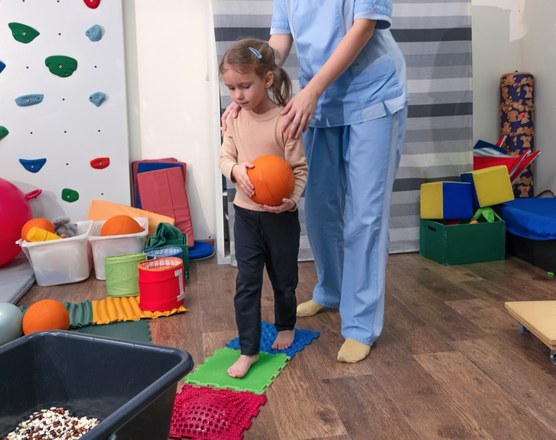
Physical therapy for children aged 3 to 5 is about what your child is actually trying to do and what is getting in the way of them doing it. A physical therapist assesses that, then changes the task, the setting, or the approach until it works — and keeps changing it as your child gets better at it. At this age most of the useful work happens outside the session, which is why a good therapist spends time on what happens at home and at preschool. Evaluation through your school district is free, and you request it in writing rather than needing a doctor to refer you.
What physical therapy does at this age
At three to five, physical therapy is about keeping up. Running, jumping, climbing, managing stairs, and doing all of it in a playground alongside children the same age.
Keeping up is usually where a parent first notices. Not a milestone in a book, but a birthday party where their child is doing something visibly different from everyone else.
The work is capacity, not correction. Strength, balance, coordination, and endurance, built through activity rather than exercises.
Signs physical therapy for preschoolers might help
- They tire much faster than other children their age
- Running or jumping looks different from their peers
- Stairs still need a rail or two feet per step
- They avoid the playground, or stay at the edge of it
- They fall more than you would expect
- They sit in a W shape and resist sitting any other way
- They complain their legs hurt after ordinary activity
None of these means something is wrong on its own. What prompts an assessment is a pattern that is affecting daily life, or one thing that concerns you enough to ask.
What a session looks like
Where does physical therapy for preschoolers happen?
Most often at preschool or a clinic. School-based sessions have the advantage of happening where the difficulty happens; clinic sessions usually allow more time and more equipment. Many children have both at different points.
What does the therapist actually do?
They work out what your child is trying to do and what is getting in the way, then change the task, the environment, or the approach until it works — and then make it harder again.
A session that looks like play is usually a session that is working. The skill has to transfer out of the room, and things practiced in isolation tend not to.
What am I supposed to be doing?
Less than when they were small, and still more than nothing. You are the person who sees the other 167 hours of the week. The therapist sees one. What you notice about when it goes well and when it does not is the most useful information in the room.
Why so much of physical therapy happens through you
An hour a week changes very little on its own. What changes things is what happens in the rest of the week, which is why a good therapist spends part of every session making sure the people around your child know what to do.
That includes school. A strategy that only exists in a therapy room helps for one hour a week. The same strategy known to a teacher works all day, and getting it there is part of the job rather than an extra.
It also means the plan has to fit your life. A program that requires twenty minutes of a specific activity every evening will not happen in most households, and a therapist who does not ask about that is designing something that will fail quietly.
What is different about this age
Early intervention ends at three, and something different takes its place. Under three, services come through your state's early intervention program and are delivered mostly at home. From three, they come through the public school system, and they are tied to whether the difficulty affects your child's access to education.
That is a real change in the question being asked. Early intervention asks whether a child has a developmental delay. School services ask whether a disability affects their ability to learn alongside their peers. A child can qualify under one and not the other, and being told they no longer qualify does not mean the difficulty went away.
Therapy also starts shifting toward working with the child directly. A three-year-old can follow an instruction, take a turn, and tell you something is hard. Sessions still involve you substantially, but they are no longer entirely coaching.
Groups become an option, and for some goals they are better than individual work — a child practicing turn-taking needs someone to take turns with.
And school readiness becomes the frame. Not academics, but the things school assumes: separating from a parent, sitting with a group, following a two-step instruction, managing a bathroom trip, asking for help.
Keeping up with peers, and why that is the real measure
A preschooler does not need to run efficiently. They need to run with everyone else. Participation is the thing that decides whether they get the practice, the friendships, and the confidence — and a child who cannot keep up drops out of the activity that would have built the capacity.
That loop is the reason to act rather than wait. The gap widens on its own.
Playground participation
A playground asks for climbing, balancing, hanging, dropping, and negotiating all at once. It is also where children this age do most of their physical learning.
Therapy at this age frequently targets a playground skill directly, because the skill unlocks hours of practice nobody has to supervise.
W-sitting
W-sitting is common and is not, on its own, a problem. It becomes worth looking at when a child sits that way because they cannot hold themselves up any other way.
Toe walking
Persistent toe walking past the point where most children stop is worth assessing, both to check the calf muscles have not shortened and to rule out other causes.
How to get started
Do I need a referral?
Not for a school evaluation. Request one from your school district in writing — that starts a legal timeline that a phone call does not. Keep a copy and note the date.
School services are tied to educational access, not to a diagnosis. The case is made in terms of what is happening in preschool, which is why examples matter more than labels.
Your child's doctor can refer for outpatient therapy at any age, and some private practices accept self-referral. That route runs in parallel with school services rather than replacing them.
What does physical therapy for preschoolers cost?
School district services are free where a child qualifies.
Private therapy varies, and insurance coverage varies more. Worth checking before you start: whether the therapy is covered, whether a referral is needed for coverage, how many sessions are authorized, and what happens when they run out.
What progress looks like
Not a score. Something they can do that they could not do before, in real life, without being set up for it.
Progress is usually uneven. Long flat stretches, then several things at once. A plateau is not a failure and it is not automatically a reason to stop, though it is a reason to ask what changes next.
Ask for the plan in those terms. What is being worked on, what you should expect to see change first, and roughly when you will both know whether it is working. A therapist who cannot answer that is worth pressing.
Goals worth setting
A goal you can picture happening is worth more than a goal written in clinical language. The second kind is impossible to disagree with and impossible to check.
Keep up with the group at the park
Climb the playground frame without help
Manage the preschool stairs one foot per step
Ride a balance bike
Last a whole birthday party without being carried home
Improve gross motor skills
Increase core strength
Improve balance
Each of these could be true while nothing has changed for your child.
Questions worth asking
- What exactly are we working on, and who chose it?
- What should I expect to see change first?
- What should I be doing between sessions, realistically?
- How will we know this is working, and when do we change course?
- How does this connect to what happens at preschool?
- What happens when the goal is met, and what comes after it?
Frequently Asked Questions
How long does physical therapy take for a preschooler?
It varies enough that any number would be misleading. What is more useful is asking the therapist what they expect to change first and how you will both know it has.
Is preschool physical therapy just exercises?
Mostly not at this age. A four-year-old will not do a home program, so the work is built into play, obstacle courses, and the activities they already want to do.
Should I worry if my preschooler W-sits?
Not on its own — it is common and most children who do it are fine. It is worth looking at when a child sits that way because they cannot maintain another position, or when they resist all alternatives.
My preschooler is clumsy. Is that a problem?
It depends whether it is limiting them. Clumsiness that keeps a child out of the playground matters more than clumsiness that does not, because participation is what builds the capacity.
What happens to physical therapy when my child turns 3?
The funding and the route change, not the need. Birth-to-three early intervention ends at the third birthday and responsibility moves to the school district under IDEA Part B, which means a new evaluation and a different plan. The transition is supposed to be planned in advance rather than discovered, so ask about it several months before the birthday.
My preschooler says their legs hurt. Is it growing pains?
Possibly, and it is worth mentioning to your doctor rather than assuming. Pain that wakes a child, affects one leg only, or comes with limping or swelling needs looking at.
How do I get physical therapy for a 3-year-old?
Through your school district, requested in writing. School-based physical therapy is tied to educational access, so it is framed around getting around school and taking part rather than around the diagnosis.
My child still toe walks at four. Does that need treating?
It is worth an assessment. Most toe walking is idiopathic and settles, but persistent toe walking can shorten the calf muscles over time and occasionally points to something else.
Sources
- Individuals with Disabilities Education Act — Part B, services for children aged 3 to 21, and the transition planning requirement from age 16. sites.ed.gov/idea
- US Department of Education, Office of Special Education Programs — evaluation requests and timelines.
Disclaimer. This page is for general educational purposes and does not constitute medical advice, diagnosis, or treatment.