
Sensory processing
Sensory Integration Therapy: What the Research Actually Shows
Ayres Sensory Integration delivered with fidelity, versus the loose techniques sold under the same name.
- Expert Reviewed
- Evidence Based
- Patient Focused
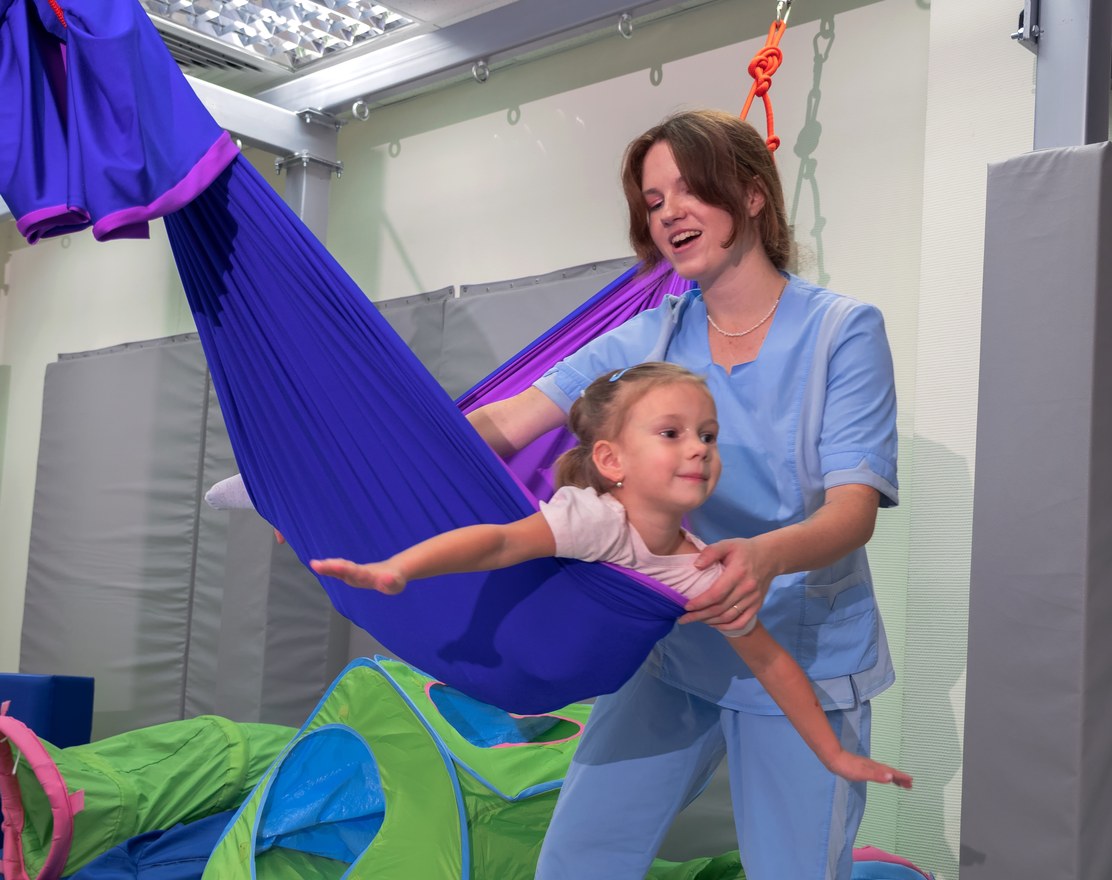
Sensory integration therapy is an occupational therapy approach developed by A. Jean Ayres, designed to help the nervous system process and organize sensory information more effectively. The research distinguishes between two things often sold under the same name. Ayres Sensory Integration (ASI) — the manualized version, delivered with measurable fidelity by a trained occupational therapist — has moderate-quality evidence and met Council for Exceptional Children criteria as an evidence-based practice for autistic children in a 2019 systematic review.1 Individual sensory-based techniques such as weighted vests, brushing protocols, and sound therapies have weak or no supporting evidence, and several have been found to have no effect. If a provider offers "sensory integration therapy," it is worth asking which of these they mean.
The distinction that matters most
Nearly every page on this topic treats "sensory integration therapy" as one thing. The research doesn't — and the difference determines whether it's likely to help.
| Ayres Sensory Integration (ASI) | Sensory-based interventions (SBIs) | |
|---|---|---|
| What it is | A manualized intervention with measurable fidelity criteria, delivered by a trained OT in a specialized setting | Discrete techniques: weighted vests, brushing protocols, therapy-ball seating, sound therapies |
| What it targets | Long-term change in how sensory information is processed | Immediate behavioral regulation |
| Delivery | Individualized, child-led, play-based, high dosage | Applied to the child, often on a schedule |
| Evidence | Moderate quality; meets CEC criteria as evidence-based for autistic children | Weak to none, and negative for several specific techniques |
A family being sold "sensory integration therapy" may be receiving either. The branded, manualized version has real support. The loose collection of techniques sold under the same name mostly doesn't.
What sensory integration therapy is
A. Jean Ayres, an occupational therapist and educational psychologist, developed sensory integration theory in the 1960s and 70s, setting it out most fully in Sensory Integration and the Child in 1979.6 Her proposal was that difficulties organizing sensory information could underlie problems with learning, coordination, and behavior — and that carefully designed sensory-motor experiences could improve how the nervous system processes that information.
What a genuine ASI session looks like
- A specialized space with suspended equipment — swings, climbing structures, crash mats, tactile materials
- Child-led play, with the therapist shaping challenges rather than directing exercises
- Activities calibrated to be achievable but demanding — the "just-right challenge"
- Individualized to the child's assessed sensory profile, not a standard protocol
- Delivered at meaningful intensity — typically multiple sessions weekly over months
- Goals tied to daily life: tolerating a haircut, sitting through a meal, getting dressed
What it is not: a child wearing a weighted vest in class, being brushed on a schedule, or sitting on a therapy ball. Those are sensory-based interventions. They may appear inside a broader OT plan, but they are not ASI, and they don't carry ASI's evidence.
What the evidence shows
Where the support is strongest
A 2019 systematic review in Autism Research by Schoen, Lane, Mailloux, May-Benson, Parham, Smith Roley and Schaaf evaluated effectiveness research from 2006 to 2017 against the Council for Exceptional Children's standards for evidence-based practices in special education. The review concluded that ASI met the criteria as an evidence-based practice for autistic children. Other systematic reviews reach compatible conclusions. Watling and Hauer (2015) found moderate evidence for ASI while evidence for generic sensory-based interventions was mixed or insufficient, and Case-Smith and colleagues (2015) separated clinic-based, individualized sensory integration therapy — which showed positive effects — from single-technique interventions applied in classrooms, which mostly did not. Across this work, the factors associated with effectiveness are specific: high-intensity dosage, fidelity to the protocol, and targeting the individual child's factors rather than the environment. The evidence supports the intensive, individualized, manualized version — not a diluted one.
What "meets criteria" means in practice. A review of 19 studies found two randomized trials reporting positive effects for sensory integration therapy on Goal Attainment Scaling, with effect sizes of 0.72 to 1.62.3 A more recent review of nine trials that used the ASI fidelity measure found improvement in children's individualized functional goals — and no benefit for behaviors of concern such as irritability, which it explicitly does not recommend ASI for.4
Where the support is weak or absent
- Weighted vests — reviewed repeatedly and found not to be an evidence-based practice for the behavior and attention outcomes claimed.
- Weighted blankets — weak, mixed evidence overall; some recent studies suggest a modest benefit for anxiety, but reliable sleep or regulation benefits are not established.
- Sound and auditory integration therapies — little to no significant impact on occupational performance.
- Brushing protocols (the Wilbarger protocol and similar)5 — no adequate supporting evidence.
- Therapy-ball and alternative seating — a 2025 systematic review of 21 higher-level studies found moderate evidence that it did not improve attention.7
What a more recent review found. A 2025 systematic review of 21 higher-level studies reported moderate evidence that alternative seating did not improve attention, and a lack of evidence either way on sensory environmental modifications. What it did find strong evidence for was deep pressure tactile input, and training caregivers in how to use sensory strategies.7
Reducing sensory load is still worth doing — it is cheap, low-risk and often obviously helpful for a particular child. That is a different argument from it being the best-evidenced option, which is what this page previously implied.
What's genuinely uncertain
The literature has real limitations any honest page should name: small sample sizes, a shortage of high-quality designs, inconsistent outcome measures, and studies that didn't verify participants actually had sensory-motor difficulties before treating them for sensory-motor difficulties. Evidence outside autism is thinner — support for ASI in ADHD, learning differences, and adults is more limited.
How to hold all this. ASI is a reasonable, evidence-supported option for an autistic child with assessed sensory difficulties, delivered properly by a trained therapist. It is not a cure, not a treatment for autism itself, and not established for every population it's marketed to — and several techniques sold under its name have been tested and found not to work.
"Sensory integration disorder" — a note on the term
You'll encounter this phrase, particularly in older material. It was Ayres' original term for the difficulty she described. Current usage is sensory processing disorder (SPD), and that term is itself contested — SPD does not appear in the DSM-5 or ICD-11 as a standalone diagnosis. It is widely used in occupational therapy practice and well recognized clinically, but a child cannot receive it as a formal psychiatric diagnosis, and sensory differences are frequently assessed within an autism or ADHD evaluation instead. Sensory features appear in both current autism manuals: the DSM-5 added hyper- or hyporeactivity to sensory input in 2013, and ICD-11 followed in 2022.
Questions worth asking a provider
- Do you deliver Ayres Sensory Integration specifically, and are you trained in it? Fidelity is one of the factors associated with effectiveness.
- What did the assessment find? ASI is individualized to an assessed sensory profile. If nobody assessed one, ask what the plan is based on.
- What are the goals, in daily-life terms? "Tolerate a haircut" is a goal. "Improve sensory integration" isn't.
- How will we know whether it's working, and by when?
- What's the dosage, and why that dosage?
- What would make you change or stop the approach?
- If weighted vests, brushing, or listening programs are recommended — what's the evidence for those specifically?
Signals worth attention: a provider who can describe the limits of the evidence, who assesses before treating, who sets functional goals, and who involves you in the work. Signals worth questioning: claims that the therapy treats autism itself; packages sold in long blocks before any assessment; heavy reliance on techniques with weak evidence; or an unwillingness to say what would count as it not working.
Browse pediatric and adult OT providers by city and state.
Browse the DrSensory Therapy Directory →Frequently Asked Questions
Do weighted vests work?
The research has repeatedly found little to no effect on the outcomes typically claimed. They aren't harmful, but a child may find one comforting without it producing the regulation or attention benefits often advertised.
Does the brushing protocol work?
There is no adequate evidence supporting brushing protocols such as the Wilbarger protocol. If one is recommended, it's reasonable to ask what the evidence is.
How long does it take to see results?
Effectiveness is associated with high-intensity dosage over months rather than weeks. Your therapist should set functional goals and a timeframe for reviewing them at the outset — and if they haven't, ask.
Does sensory integration therapy work?
Ayres Sensory Integration — the manualized version delivered by a trained OT — has moderate-quality evidence and met Council for Exceptional Children criteria as an evidence-based practice for autistic children in a 2019 systematic review.1 Individual sensory-based techniques like weighted vests and brushing protocols have weak or no evidence.
Can I do sensory integration therapy at home?
Not the therapy itself. High-fidelity Ayres Sensory Integration requires a trained OT and a clinic equipped with suspended equipment and other specialized tools, so it can't be fully replicated at home. An OT can give you carryover activities to support daily routines, but those are a complement to the therapy, not a substitute for it.
Is sensory integration therapy evidence-based?
For autistic children, ASI delivered with fidelity meets recognized evidence-based practice criteria. A separate review of 23 studies rated the evidence for ASI moderate, and found results for sensory-BASED methods mixed — the distinction this page keeps drawing.2
Evidence in other populations is more limited, and the broader literature has real limitations including small samples and inconsistent outcome measures.
Is sensory integration therapy only for children?
Most of the evidence — limited to begin with — comes from studies of autistic children. The adult evidence base is thinner still. Adults are sometimes offered sensory-based strategies, but there's little research on how well the therapy itself works outside childhood.
Is sensory integration therapy covered by insurance?
Coverage varies by plan. It’s usually billed as occupational therapy, which many plans cover when it’s medically necessary and tied to functional goals. Because SPD is not a standalone diagnosis, claims often hinge on an underlying condition such as autism, and coverage can depend on how the service is coded. Ask the clinic what they bill under, whether they are in network, and what a course typically costs if they are not — before starting rather than after.
Is sensory integration therapy a treatment for autism?
No. It targets sensory processing difficulties, which are common in autistic people but are not autism itself. Any provider describing it as a treatment for autism is overstating what it does.
What's the difference between ASI and sensory-based interventions?
ASI is a manualized intervention with fidelity criteria, individualized to an assessed sensory profile, aimed at long-term change in sensory processing. Sensory-based interventions are discrete techniques targeting immediate behavioral regulation. They are frequently sold under the same name and have very different evidence.
How is sensory integration therapy different from just playing on a playground?
A playground is unstructured free play. Ayres Sensory Integration is individualized to a child's assessed sensory profile and delivered by a trained occupational therapist who follows a manual, sets specific functional goals, and controls the dosage. The activities can look playful, but the structure, fidelity, and clinical reasoning behind them are what separate the therapy from a trip to the park.
Sources
- Schoen SA, Lane SJ, Mailloux Z, May-Benson T, Parham LD, Smith Roley S, Schaaf RC. A systematic review of Ayres Sensory Integration intervention for children with autism. Autism Research. 2019;12(1):6–19. doi:10.1002/aur.2046 (PMID 30548827)
- Watling R, Hauer S. Effectiveness of Ayres Sensory Integration® and sensory-based interventions for people with autism spectrum disorder: a systematic review. American Journal of Occupational Therapy. 2015;69(5):604–616. doi:10.5014/ajot.2015.018051
- Case-Smith J, Weaver LL, Fristad MA. A systematic review of sensory processing interventions for children with autism spectrum disorders. Autism. 2015;19(2):133–148. doi:10.1177/1362361313517762 (PMID 24477447)
- Acuña C, Gallegos-Berrios S, Barfoot J, Meredith P, et al. Ayres Sensory Integration® with children ages 0 to 12: a systematic review of randomized controlled trials. American Journal of Occupational Therapy. 2025;79(3):7903205180. doi:10.5014/ajot.2025.051023 (PMID 40193295)
- Section on Complementary and Integrative Medicine; Council on Children with Disabilities; American Academy of Pediatrics. Sensory integration therapies for children with developmental and behavioral disorders. Pediatrics. 2012;129(6):1186–1189. doi:10.1542/peds.2012-0876 (PMID 22641765)
- Ayres AJ. Sensory Integration and the Child. Western Psychological Services; 1979.
- Piller A, McHugh Conlin J, Glennon TJ, Andelin L, Auld-Wright K, Teng K, Tarver T. Systematic review of sensory-based interventions for children and youth (2015–2024). Frontiers in Pediatrics. 2025;13. doi:10.3389/fped.2025.1720179 (PMID 41321460). Checked August 26, 2026.
Medical disclaimer. This page is for general educational purposes and does not constitute medical advice, diagnosis, or treatment. It does not discourage seeking occupational therapy support. Always consult a qualified healthcare provider about your child.