
Sensory processing
Sensory Diets: Activities, Evidence, and How to Build One
What a sensory diet is, what the evidence honestly supports, and how to build one that is worth trying and adjusting.
- Expert Reviewed
- Evidence Based
- Patient Focused
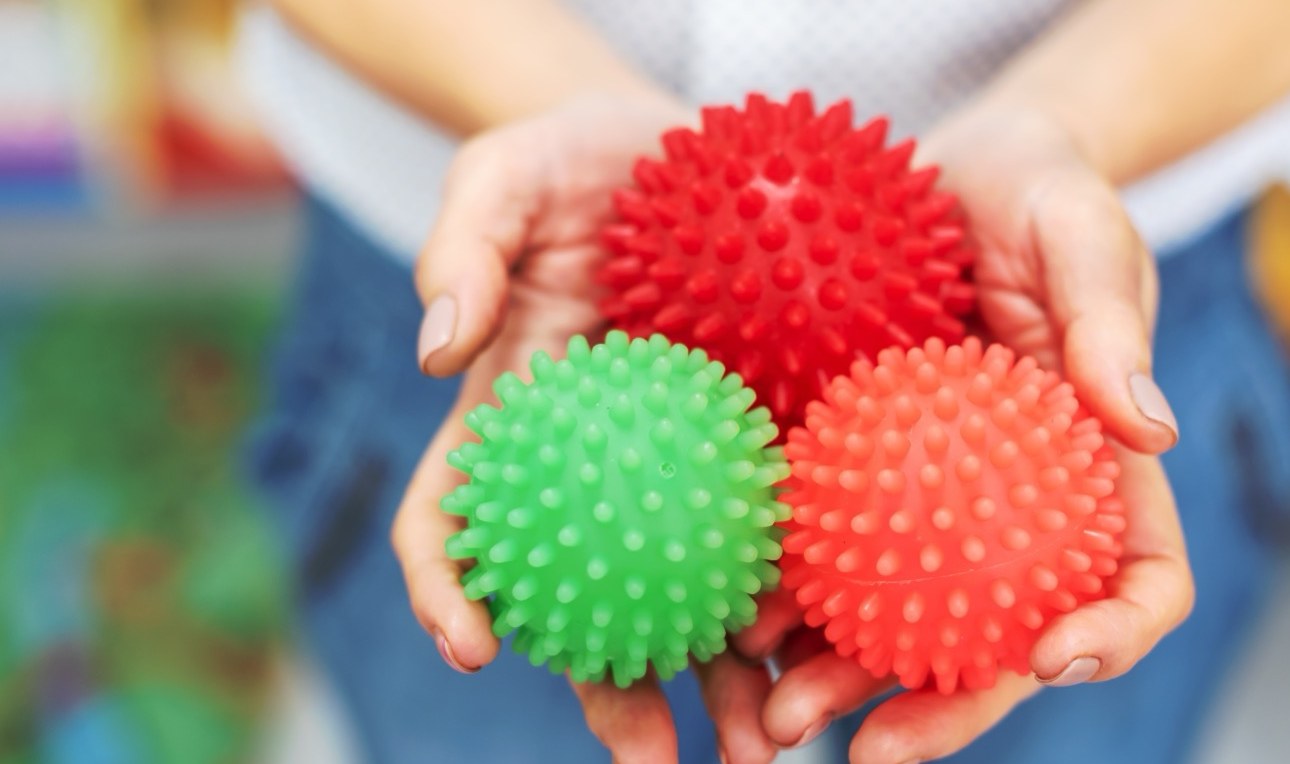
A sensory diet is a planned set of sensory activities scheduled through the day to help a child stay regulated. Despite the name, it has nothing to do with food — the term borrows the idea of regular nourishment rather than referring to eating. Typical activities include movement, deep pressure, and heavy work such as carrying, pushing, or climbing. Sensory diets fall under sensory-based interventions, which have weaker evidence than Ayres Sensory Integration, the manualized approach delivered by a trained occupational therapist. Many families find them helpful in practice, and they are best understood as a low-risk, individualized strategy rather than an established treatment.
A sensory diet is a planned set of sensory activities scheduled through the day to help a child stay regulated. Despite the name, it has nothing to do with food. The evidence is mixed but more encouraging than it is usually presented: deep pressure tactile input and caregiver training in sensory strategies both have strong support,1 plans overall are low-risk and individualized rather than established, and some popular components have been reviewed and not supported. A plan that actually happens beats a better plan that does not.
Key takeaways
- Two components have strong evidence behind them. A systematic review of 21 level I and II studies found strong strength of evidence for deep pressure tactile input, and for caregiver training on the use of sensory strategies — which is close to a description of what building a plan with a therapist is.1
- One tool is not a plan. The same review found moderate evidence that targeting a variety of sensory systems beats targeting only one.1
- Two popular components have not held up. Alternative seating had moderate evidence of no effect on attention,1 and weighted vests have been reviewed repeatedly and found ineffective.4
- Reducing load has fared better in review than adding input, and it is the thing most families try last.3
- Most of the plan has to happen at school, where the demands are. A plan that only runs at home is doing a fraction of the work.
- A plan that is too big is a plan that stops. Three activities that actually happen beat ten that do not.
- If it is not helping after a fair trial, change it rather than doing it harder.
Is a sensory diet about food?
First thing on the page, because it causes real confusion: a sensory diet is not about food. The term borrows the idea of regular nourishment spread through the day. Many occupational therapists now say “sensory activities” or “sensory plan” instead, and this page uses those words throughout.
What is a sensory diet and what does it include?
A mix chosen for the individual child: movement, deep pressure, heavy work, and tactile, oral or calming and alerting input depending on need.
It is individualized. An activity that regulates one child dysregulates another, which is why a generic list rarely works as well as a plan built around one child. Working out which pattern you are seeing comes first.
Do sensory diets actually work? What the evidence shows
This is where most sensory-diet content either overclaims or gives up. The real picture is more granular than either.
| Evidence | What that means | |
|---|---|---|
| Deep pressure tactile input | Strong | A systematic review of 21 level I and II studies found strong strength of evidence supporting it1 |
| Caregiver training in sensory strategies | Strong | Same review, same strength — and this is essentially what building a plan with a therapist is1 |
| Targeting several sensory systems rather than one | Moderate | Moderate strength of evidence that a variety beats a single system1 |
| Modifying the environment | Moderate | Moderate evidence for sensory modifications to a clinical setting3 |
| Sensory plans as a whole | Not established | Low-risk and individualized rather than proven. Many families report benefit |
| Alternative seating | Moderate evidence of no effect | Wobble stools, ball chairs, bouncy bands — moderate strength of evidence that they did not improve attention1 |
| Weighted vests | Reviewed and not supported | Seven studies reviewed; on balance ineffective, and not recommended for clinical application4 |
What has strong support
A systematic review searching six databases — Medline, CINAHL Complete, PsycINFO, OTSeeker, Cochrane Reviews and ERIC — for level I and II studies of children and young people aged 0 to 21 with sensory processing challenges, published between May 2015 and January 2024, included 21 studies. It found strong strength of evidence supporting deep pressure tactile input, and strong strength of evidence supporting caregiver training on the use of sensory strategies.1
Both findings matter here. Deep pressure is one of the core categories in almost every sensory plan. And caregiver training in the use of sensory strategies is a fair description of what building a plan with an occupational therapist actually is — the therapist does not apply the plan, you do. So the page’s central recommendation is better supported than a broad “sensory-based interventions have weak evidence” framing suggests.
Where plans sit overall
Sensory plans are sensory-based interventions. For comparison, Ayres Sensory Integration — the manualized approach delivered by a trained therapist under a fidelity measure — was reviewed across nine randomized controlled trials with 344 participants. Strong evidence from five trials indicates it supports autistic children in meeting their individualized goals; moderate evidence from three trials indicates no benefit for behaviors of concern such as noncompliance or irritability; and the authors state that more research is needed to determine benefits for other child populations.2 Individual techniques applied outside that structure have weaker evidence than the structured program does.
Modifying the environment has fared better in review than applying sensory input to a child. A systematic review found moderate evidence for sensory modifications to a clinical setting, and only limited evidence for weighted vests.3 Worth knowing, because reducing load is usually cheaper and easier than adding activities — and it is the thing most families try last.
What has not held up
Weighted vests have repeatedly been found not to produce the outcomes claimed for them. A review of seven studies concluded that, on balance, the indications are that they are ineffective and cannot be recommended for clinical application.4
Alternative seating — wobble stools, ball chairs, bouncy bands — had moderate strength of evidence that it did not improve attention.1
How to hold all of this
Low-risk, individualized, with two components that have real support and at least two popular tools that do not. Many families report benefit. If a plan is not helping after a fair trial, change it rather than doing it harder.
How to build a sensory diet with an occupational therapist
This is the page’s main recommendation, and the evidence now supports it more specifically than it used to.1
- Assessment first
A standardized questionnaire, direct observation, and a functional interview about your actual daily routines — not a template.
- Functional goals, stated observably
Not “improve regulation,” but “sits through a meal,” “gets through drop-off without a meltdown,” “completes homework without three breakdowns.”
- Realistic scheduling
Built around what already happens in your day rather than added on top of it.
- Caregiver training
The component with strong evidence behind it.1 You should leave knowing not just what to do but why, so you can adapt when things change.
- A review point, with a date
Written down, so it happens.
Other useful questions: How will we measure this? What do I do when it stops working? How does this get into school? What is the plan for when my child outgrows it?
Our cost and insurance guides cover funding, and you can find a pediatric occupational therapist or browse by state.
How to start a sensory diet at home without an OT
- Movement breaks before demanding tasks — prevention, not reaction
- Heavy work before transitions
- Noticing what precedes dysregulation, and adjusting the environment
- Building activities into existing routines rather than adding separate sessions
- Reducing load before adding input — the environment-modification finding suggests starting here3
- Deep pressure, the one category with strong evidence behind it1 and the one that needs no equipment: firm squeezes, bear hugs, burrowing under cushions
For children under three, you can refer directly to your state’s early intervention program without a physician referral, and the evaluation is free.
Oral sensory input: chew tools, not food
Oral sensory input is a real part of sensory activity work. This is not eating advice.
Reasonable to use: chewable jewelry and appropriate chew tools, and drinking through a straw. Oral seeking is common, and a chew tool is usually a better answer than food.
Not a regulation plan for eating
This page does not recommend specific foods, amounts, portions, timings, or “crunchy and chewy snacks” as regulation tools. If a child has a restricted diet, difficulty with textures, or distress at mealtimes, that is a feeding assessment question for a speech-language pathologist or an occupational therapist — not something to address with a sensory activity plan.
Feeding and sensory assessment for children. Browse providers by city and state.
Browse the DrSensory therapy directory →Sensory diet example: what a realistic day looks like
Plans fail more often from being too ambitious than from being wrong. If you have not yet built one with an occupational therapist, the shape below is still worth borrowing. A workable plan is short, attached to things that already happen, and mostly invisible to everyone else. This is an illustration rather than a prescription — the point is the shape, not the specific activities.
| When | What | How long |
|---|---|---|
| Before school | Heavy work while everyone else is getting ready: carrying the recycling out, pushing a laundry basket down the hall, ten wall pushes at the door | 5 min |
| The journey | Noise-reducing headphones in the bag, and the walk itself if there is one. Movement on the way in does more than movement after arrival | As long as it takes |
| Mid-morning, at school | An errand that involves carrying something to another classroom. Teachers usually agree to this because it costs them nothing | 2 min |
| After school | The hardest hour of the day for many children. Physical input before anything is asked of them — the trampoline, the climbing frame, the swing — before homework, before questions about the day | 10 min |
| Before bed | Deep pressure rather than movement: a firm squeeze, burrowing under cushions, a bath. Movement close to bedtime wakes some children and settles others, which is worth finding out deliberately | 5 min |
Five entries, none longer than ten minutes, all attached to something that was happening anyway. A plan with fifteen items scheduled at fixed times is a plan that will be abandoned within two weeks.
Sensory breaks at school: what to ask for and how
Most of this needs to happen at school, where the demands are. A plan that only operates at home is doing a fraction of the work — and it is the most common reason a plan that worked at first fades.
What to ask for
- Movement breaks scheduled proactively — not offered in response to dysregulation, and never withdrawn as a consequence
- An errand that involves carrying — the single easiest ask, because it costs the teacher nothing and looks like helping
- Access to a quiet space without having to ask each time — the requirement to ask is itself a barrier at the moment it is most needed
- An agreed private signal between child and teacher
- Seating away from doors, vents and high-traffic routes
- Advance warning of assemblies, fire drills, substitutes and schedule changes
- A footrest where feet do not reach the floor — free, and it does more than most equipment
How to ask
Frame requests by what they enable, not by a label. “He needs sensory breaks” invites debate. “A two-minute errand mid-morning means he can sit through the rest of the lesson” is a proposal a teacher can act on.
Put it in writing in the IEP or the 504 plan. You do not need an SPD diagnosis for a 504 — documented functional impact is the requirement.
Our sensory tools in the classroom page and teacher resources include material you can hand over directly.
Sensory diet activities by type: heavy work, movement, deep pressure
Choosing by category rather than from a list makes it much easier to swap things out when a child gets bored, which they will.
- Heavy work (proprioceptive)
Carrying, pushing, pulling, climbing, animal walks, wheelbarrow walking, kneading dough, opening heavy doors, carrying groceries, pushing a laundry basket, wall pushes. The most reliably useful category and the least conspicuous — most of it looks like helping. See vestibular and proprioceptive processing.
- Movement (vestibular)
Swinging, spinning, rocking, jumping, hanging upside down, rolling. Powerful and easy to overdo: spinning in particular can produce a delayed reaction some time later, so be cautious the first few times.
- Deep pressure
Firm squeezes, bear hugs, burrowing under cushions, a snug sleeping bag, being rolled in a blanket while awake and supervised, lying under a couch cushion. This is the category with strong evidence behind it,1 it requires no equipment, and it is the one to reach for first.
- Tactile
Sand, water, dough, rice bins, textured brushes, finger paint. Offer rather than impose — a child who is over-responsive to touch will not be desensitized by being made to endure it.
- Oral
Chew jewelry and chew tools for children who chew clothing, and drinking through a narrow straw. See the caution above on food.
- Calming against alerting
Slow, rhythmic, predictable input tends to calm; fast, irregular, unpredictable input tends to alert. Both are useful. A child who is under-responsive before a lesson may need alerting input, not calming.
Which of these helps depends on the child’s profile rather than on the activity. A sensory-seeking child and an over-responsive child can need opposite things at the same moment, which is the single most common reason a generic list disappoints.
Weighted blankets and vests: safety rules and what the evidence says
Weighted blankets, vests and lap pads are the most bought and least understood part of this. Three things are worth being straight about.
Never for a baby, and never in a sleep space
The American Academy of Pediatrics is unambiguous: “Don’t use weighted blankets, sleepers, swaddles or other weighted objects on or near your baby,” and separately, “Don’t use weighted swaddle blankets or weighted objects like rice bags inside the swaddle.”5 That is a suffocation risk, not a comfort preference.
- The child must be able to remove it themselves, every time
If they cannot lift it off, get out from under it, or tell you they want it off, it should not be on them. That rules weighted items out entirely for some children, and it is the line that matters most.
- The ten percent of body weight figure is a convention, not a finding
It gets repeated as though it came from a trial. It did not. Ask an occupational therapist who has met your child rather than following a number off a product page.
On effectiveness. Weighted vests have been reviewed and found ineffective, and not recommended for clinical application.4 Weighted blankets have been tested directly: in a randomized placebo-controlled crossover trial of 73 autistic children aged 5 to 16 with severe sleep problems, the weighted blanket did not increase total sleep time, and there were no group differences on any other objective or subjective measure of sleep or behavior, compared with an identical usual-weight control blanket. Children and parents favored the weighted blanket, and it was well tolerated.6
Many families still find a lap pad useful for sitting through a meal. Both of those can be true at once, and the second is not a reason to spend a great deal of money. See are weighted blankets safe for infants.
How to tell if a sensory diet is working
This addresses the third failure mode below — nobody defined what should change.
| Log this | Why |
|---|---|
| The date | So a pattern across a week is visible |
| What happened immediately before | The trigger is usually in the ten minutes before, not in the moment |
| What you tried | Including doing nothing, which is a legitimate entry |
| How long recovery took | Shorter recovery is progress even when the number of incidents is unchanged |
| Whether it helped | Yes, no, or unclear. Unclear is a real answer and worth recording |
What you are looking for is not perfection but a trend — fewer incidents, shorter recovery, or the same number of incidents at lower intensity. Any of those is progress. Three weeks of this tells a clinician more than any single appointment.
Why sensory diets stop working — and how to fix it
| What happened | What it looks like |
|---|---|
| It was too big | Fifteen scheduled activities is a second job. Three that actually happen beat ten that do not |
| It was used as a reaction instead of a routine | The value is mostly preventive — input before the hard thing. Deploying it during a meltdown is usually too late, and can make it worse |
| Nobody defined what should change | Without an agreed observable goal there is no way to tell whether it is working, so it drifts on unexamined |
| The child was not asked | Children over about six usually know what helps, and a plan they had no say in is one they will resist |
| It stopped being adjusted | What works at five does not work at nine. Plans need revisiting, particularly after a change of school or class |
| It only ran at home | The quiet one, and common. See the school section above |
| Load increased rather than the plan failing | Sensory tolerance depletes across a day, a week and a semester. A plan that stops working in November may be a plan meeting more demand. See living with sensory differences |
| It became the whole explanation | If nothing is improving, the answer may not be more sensory input. Sleep, anxiety, hearing, vision and attention are all worth revisiting |
Sensory diets by age: toddlers, school age, teens
| Stage | What the plan becomes |
|---|---|
| Toddlers and preschool | Almost entirely play, built into what is already happening. Nothing scheduled, nothing that looks like therapy |
| Primary school age | The classic version: heavy work before demands, movement breaks, an agreed signal with the teacher |
| Older children and teenagers | The plan has to become theirs or it stops. The goal shifts from doing activities to recognizing their own state and choosing — a more useful skill than any schedule, and the thing that carries into adulthood |
| Adults | The same logic, self-directed: environment design, job and housing choices, and knowing what costs you. See sensory processing in adults |
If a child loses skills they previously had, contact their doctor
Regression is a medical question rather than a sensory one, and it warrants evaluation regardless of anything else on this page.
Frequently Asked Questions
What is a sensory diet?
A planned set of sensory activities — movement, deep pressure, heavy work — scheduled through the day to help a child stay regulated. Despite the name, it has nothing to do with food.
Do sensory diets work?
The picture is more granular than yes or no. A systematic review of 21 level I and II studies found strong evidence supporting deep pressure tactile input and caregiver training in the use of sensory strategies, two components central to most plans, and moderate evidence that targeting a variety of sensory systems beats targeting only one. Plans overall remain a low-risk, individualized strategy rather than an established treatment, and some popular components such as alternative seating and weighted vests have been reviewed and not supported. Worth trying and adjusting; if a plan is not helping after a fair trial, change it rather than doing it harder.1,4
Does a sensory diet have anything to do with food?
No. The term borrows the idea of regular nourishment through the day, not eating. Many occupational therapists now say sensory activities or sensory plan to avoid the confusion. If eating itself is a concern — a restricted diet, texture difficulty or mealtime distress — that is a feeding assessment question for a speech-language pathologist or an occupational therapist.
Do weighted vests help?
A review of seven studies concluded that, on balance, the indications are that weighted vests are ineffective and cannot be recommended for clinical application. They are among the more studied sensory-based tools, and the evidence is not supportive.4
Do weighted blankets help?
Not as a sleep treatment. In a randomized placebo-controlled crossover trial of 73 autistic children with severe sleep problems, weighted blankets did not increase total sleep time and there were no group differences on any other objective or subjective measure, compared with an identical control blanket. Children and parents did prefer them and they were well tolerated. Treat one as a comfort item, follow safety guidance on weight and age, and never use weighted items on or near a baby or in a sleep space.5,6
Can we do this without an occupational therapist?
You can build helpful routines — movement breaks before demanding tasks, heavy work before transitions, deep pressure, and adjusting the environment. Note that caregiver training in sensory strategies is itself one of the components with strong evidence, so an assessment adds most where regulation is a significant daily challenge.1
How do I make one for my child?
Ideally with an occupational therapist, starting from an assessment of what your child actually responds to, because an activity that regulates one child dysregulates another. Between appointments, build movement and heavy-work breaks into existing routines rather than adding separate sessions.
How do I start at home without overwhelming my child?
Start small — one or two activities rather than a full schedule — and keep them consistent between home and school, which a shared log helps with. Lean on low-cost everyday options: carrying groceries, pushing a laundry basket, short movement breaks, firm squeezes. Three activities that actually happen beat ten that do not.
How long should a sensory break be?
Short. In the example day on this page, no entry runs longer than ten minutes and several are under five. Length matters far less than timing — input before the demanding thing is where the value is.
How long before we see a difference?
It varies and there is no fixed timeline. Track for two weeks and look for a trend — fewer incidents, shorter recovery, or the same number at lower intensity. If a plan is not helping after a fair trial, that is information; change it.
Our plan stopped working. Why?
Common causes: it was too big to sustain, it was used reactively instead of preventively, nobody defined what should change, the child was not consulted, it was never adjusted as they grew, it only ran at home, or overall load increased rather than the plan failing. Go back to tracking for two weeks before changing anything.
How do I get sensory breaks into school?
Frame requests by what they enable rather than by a label — a two-minute errand mid-morning meaning he can sit through the rest of the lesson lands better than he needs sensory breaks. Put it in the IEP or 504 plan in writing. You do not need an SPD diagnosis for a 504; documented functional impact is the requirement.
What about teenagers?
The plan has to become theirs or it stops. The goal shifts from performing activities to recognizing their own state and choosing what to do about it, which is the skill that carries into adulthood.
Sources
- Piller A, McHugh Conlin J, Glennon TJ, et al. Systematic review of sensory-based interventions for children and youth. Frontiers in Pediatrics. 2025;13:1720179. PMID 41321460. Searches of Medline (OVID), CINAHL Complete, PsycINFO, OTSeeker, Cochrane Reviews and ERIC; studies published in English between May 2015 and January 2024; participants aged 0 to 21 with sensory integration or processing challenges; level I and II studies by the Johns Hopkins Nursing Evidence-Based Practice Model; PRISMA-guided. Twenty-one studies included. Strong strength of evidence supported use of deep pressure tactile input and caregiver training on the use of sensory strategies. Moderate strength of evidence supported that alternative seating did not improve attention, and that targeting a variety of sensory systems is more effective than targeting only one. There is a lack of evidence on the impact of sensory environmental modifications.
- Acuña C, Gallegos-Berrios S, Barfoot J, Meredith P, Hill J. Ayres Sensory Integration® with children ages 0 to 12: a systematic review of randomized controlled trials. American Journal of Occupational Therapy. 2025;79(3):7903205180. PMID 40193295. Nine randomized controlled trials, 344 participants, six with autistic children and three with other child populations; restricted to trials implementing Ayres Sensory Integration with its Fidelity Measure. Strong evidence from five trials indicates it supports autistic children in meeting their individualized goals related to occupational performance, function and participation. Moderate evidence from three trials indicates no benefit for behaviors of concern such as noncompliance or irritability. More research is needed to determine benefits for other child populations, and bias concerns persist among included studies.
- Bodison SC, Parham LD. Specific sensory techniques and sensory environmental modifications for children and youth with sensory integration difficulties: a systematic review. American Journal of Occupational Therapy. 2018;72(1):7201190040. PMID 29280714. Moderate evidence for sensory modifications to a clinical setting; limited evidence for weighted vests.
- Stephenson J, Carter M. The use of weighted vests with children with autism spectrum disorders and other disabilities. Journal of Autism and Developmental Disorders. 2009;39(1):105–114. PMID 18592366. Seven studies reviewed. “While there is only a limited body of research and a number of methodological weaknesses, on balance, indications are that weighted vests are ineffective… weighted vests cannot be recommended for clinical application at this point.”
- American Academy of Pediatrics. A parent’s guide to safe sleep. HealthyChildren.org. “Don’t use weighted blankets, sleepers, swaddles or other weighted objects on or near your baby.” And, on swaddling: “Don’t use weighted swaddle blankets or weighted objects like rice bags inside the swaddle.”
- Gringras P, Green D, Wright B, et al. Weighted blankets and sleep in autistic children — a randomized controlled trial. Pediatrics. 2014;134(2):298–306. PMID 25022743. Phase III randomized placebo-controlled crossover trial; 73 children aged 5 to 16 years 10 months with confirmed autism and severe sleep problems refractory to community intervention, 67 analyzed. Compared with an identical usual-weight control blanket, the weighted blanket did not increase total sleep time measured by actigraphy, and there were no group differences on any other objective or subjective measure of sleep or behavior. Parents and children favored the weighted blanket on preference measures and it was well tolerated.
Medical disclaimer. This page is for general educational purposes and does not constitute medical advice, diagnosis, or treatment. Sensory processing concerns are best assessed by an occupational therapist who can evaluate your individual child.