
Dental and oral development
Why Does My Child Grind Their Teeth at Night?
Stress is the usual explanation and often not the main one — what the airway has to do with it.
- Expert Reviewed
- Evidence Based
- Patient Focused
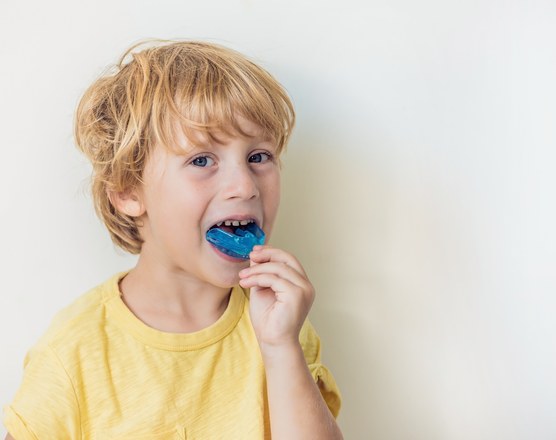
Teeth grinding during sleep — sleep bruxism — is common in children and frequently resolves as they grow. Stress is a widely cited cause and is genuinely documented, but it isn't the only one and often isn't the main one. Research in school-age children has found that impaired nasal breathing, mouth breathing while awake or asleep, restricted tongue mobility, and enlarged tonsils are all significant risk factors for probable sleep bruxism, with a combined effect when more than one is present. Most children who grind need no specific treatment. What matters is identifying whether something addressable — particularly an airway issue — is contributing, and monitoring for tooth wear.
Sleep grinding and awake grinding are different
Worth establishing first, because they're frequently discussed as one thing.
Sleep bruxism happens during sleep, involves rhythmic grinding, and the child has no awareness of it. It's usually a parent who notices — either the sound or the tooth wear.
Awake bruxism is clenching or grinding while awake, usually during concentration or tension. It's a different phenomenon with different associations. → Daytime teeth grinding
This page covers sleep bruxism.
The airway connection
This is the part most parents haven't been told, and it's better supported than the stress explanation.
A study of school-age children in the mixed dentition stage found that around a quarter met the criteria for probable sleep bruxism. It identified four significant risk factors:
- Impaired nasal breathing
- Mouth breathing, whether awake or asleep
- Restricted tongue mobility
- Enlarged tonsils
The study also found a synergistic effect — children with more than one of these were at considerably higher risk than the additive effect would predict. Among children with none of those findings, the rate of probable sleep bruxism was around 9 percent; among those with all of them, it was substantially higher.
Children with probable sleep bruxism also scored significantly higher on a validated measure of sleep disturbance.
An important caveat, stated honestly: the direction of the relationship isn't settled. It's difficult to say whether sleep-disordered breathing causes grinding, whether grinding is a response to it, or whether both share a common cause — and some recent reviews question how consistent the association is. What the research supports is the association, and the practical value of checking, not a proven mechanism.
What to do with it: if your child grinds their teeth at night, mention whether they also snore, breathe through their mouth, sleep restlessly, or wake unrefreshed. That combination changes what should be investigated.
Other contributing factors
Stress and anxiety — genuinely documented, and children with anxiety show higher rates. Everyday changes count: a new school year, a house move, a change at home. But treating stress as the default explanation means airway factors get missed, which is why it's second on this list rather than first.
Teething and eruption — a common cause of transient grinding in younger children.
Bite and alignment — sometimes contributory, less often than traditionally assumed.
Neurodevelopmental conditions — children with autism or ADHD may experience both sleep and awake bruxism at higher rates.
Some medications, including certain ADHD medications. Worth mentioning to the prescriber rather than stopping anything.
Gastro-esophageal reflux.
What to watch for
Usually no cause for concern:
- Occasional grinding sounds with no tooth wear
- Grinding during teething or a period of change, which settles
- No pain, no headaches, no daytime symptoms
Worth mentioning at a dental appointment:
- Visible flattening or wear on the teeth
- Grinding most nights over months
- Morning jaw discomfort or headaches
- Tooth sensitivity
- Chipped teeth
Worth raising promptly, and mentioning the sleep symptoms specifically:
- Grinding plus snoring most nights
- Grinding plus mouth breathing
- Observed pauses in breathing during sleep
- Excessive daytime sleepiness, or difficulty waking
- Restless sleep, or sleeping in unusual positions
That last group is the reason this page exists. Grinding on its own is usually unremarkable. Grinding alongside disturbed breathing is worth investigating.
Treatment
Most children need no specific treatment. Sleep bruxism frequently reduces or resolves as the dentition develops.
Monitoring tooth wear at routine dental visits. This is the main reason grinding gets attention — protecting the teeth, not stopping the grinding.
Addressing contributing factors. If nasal breathing, tonsils, or tongue mobility are involved, treating those is more useful than managing the grinding directly. This may mean an ENT referral.
Managing stress, where it's a contributor — wind-down routines, addressing a specific worry, and attention to sleep hygiene generally.
On nightguards. Occlusal appliances are used in adults, and their role in children is more limited. A growing dentition changes continuously, appliances need frequent adjustment, and the evidence in children is thinner than the confidence with which they're sometimes recommended.
This is a conversation with your child's dentist rather than a default. If one is recommended, reasonable questions are: what are we protecting against, what's the evidence in children specifically, how will it be adjusted as the teeth change, and have airway factors been considered first?
Frequently Asked Questions
Is teeth grinding in children normal?
It's common, and it frequently resolves as children grow. Occasional grinding without tooth wear or other symptoms usually needs no treatment beyond routine dental monitoring.
Does teeth grinding mean my child is stressed?
Not necessarily. Stress is a documented contributor, but research has found impaired nasal breathing, mouth breathing, restricted tongue mobility, and enlarged tonsils are all significant risk factors. Treating stress as the automatic explanation means airway causes get missed.
Is grinding related to sleep apnea?
There's a documented association between sleep bruxism and sleep-disordered breathing in children, though the direction of the relationship isn't settled and some reviews question its consistency. If your child grinds and also snores, mouth breathes, or sleeps restlessly, mention all of it to your doctor or dentist.
Does my child need a nightguard?
Not usually as a first step. Appliances are used more in adults, and a growing dentition complicates their use. Discuss with your dentist, and ask whether airway factors have been considered first.
Will it damage their teeth?
It can cause wear, and that's the main reason it's monitored. Routine dental visits will pick up significant wear, and most children don't develop it.
Will they grow out of it?
Frequently, yes. Sleep bruxism often reduces as the dentition develops. Where it persists alongside other symptoms, it's worth investigating rather than waiting.
Sources
- Oh JS, Zaghi S, Ghodousi N, Peterson C, Silva D, Lavigne GJ, Yoon AJ. Determinants of probable sleep bruxism in a pediatric mixed dentition population: a multivariate analysis of mouth vs. nasal breathing, tongue mobility, and tonsil size. Sleep Medicine. 2021;77:7–13. doi:10.1016/j.sleep.2020.11.007 (PMID 33291022)
- Lobbezoo F, Ahlberg J, Raphael KG, Wetselaar P, Glaros AG, Kato T, et al. International consensus on the assessment of bruxism: report of a work in progress. Journal of Oral Rehabilitation. 2018;45(11):837–844. doi:10.1111/joor.12663
- Błaszczyk B, Waliszewska-Prosół M, Więckiewicz M, et al. Sleep bruxism (SB) may be not associated with obstructive sleep apnea (OSA): a comprehensive systematic review. Sleep Medicine Reviews. 2024;78:101994. doi:10.1016/j.smrv.2024.101994
- American Academy of Pediatric Dentistry. The Reference Manual of Pediatric Dentistry. Checked August 19, 2026.
Medical disclaimer. This page is for general educational purposes and does not constitute medical or dental advice, diagnosis, or treatment. Concerns about your child's teeth or jaw should be assessed by a dentist.