
Sensory processing
Postural Difficulties in Children: Signs and Support
Difficulty holding the body steady against gravity — slumping, leaning, propping — and why it is a stability problem rather than a motivation one.
- Expert Reviewed
- Evidence Based
- Patient Focused
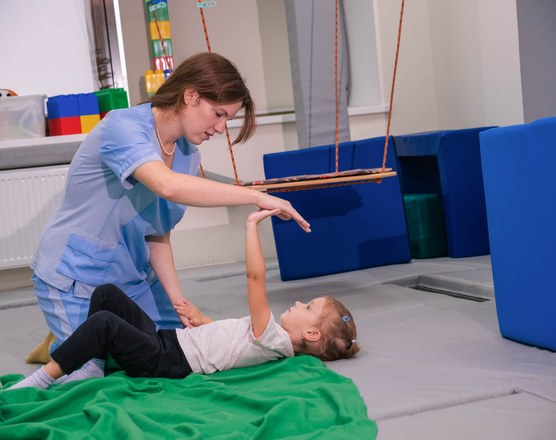
Postural difficulties describe reduced core stability, balance, and endurance for holding the body against gravity. A child may slump at a desk, prop their head on a hand, lean on furniture, tire quickly during physical activity, avoid climbing, or sit in positions that provide extra stability. It is frequently mistaken for laziness or poor attention, because a child working hard to stay upright has less capacity available for listening or writing. Support focuses on building strength and stability through play, and on adjusting seating and positioning so that staying upright costs less.
What postural difficulties in children is
Staying upright and stable against gravity should be close to automatic, freeing attention for everything else. When postural control is harder, a child spends real effort just holding their body — and that effort has to come from somewhere.1
What postural difficulties in children looks like
Slumping at a desk, propping the head on a hand, leaning on walls and furniture, tiring quickly in physical activity, avoiding climbing and playground equipment, W-sitting or wrapping legs around chair legs for extra stability, and generally seeming "floppy" or low-energy. See W-sitting and hypotonia.
What postural difficulties in children is often mistaken for
Laziness, poor attention, slouching as a bad habit, or disinterest. The reframe that matters: postural work competes with attention. A child spending effort staying upright has less left for the lesson — so what looks like not listening may be a body working hard to sit still.
What helps with postural difficulties in children
Support builds strength and stability through play — climbing, animal walks, heavy work — and adjusts seating and positioning so staying upright costs less (supportive chairs, footrests, movement breaks). The goal is participation, not "core strength" as an end in itself.
What therapy can and cannot change
Postural difficulty is usually addressed alongside coordination difficulty, and the evidence base sits mostly under developmental coordination disorder.
A meta-analysis of 32 studies of motor-based intervention in DCD found a large improvement in standardized motor test scores and in what children could do, and no improvement in participation or in psychosocial outcomes.2 Task-oriented approaches — practicing the actual activity rather than training the underlying component — performed best on motor skills and balance.
The practical read for postural difficulty. Working directly on sitting at a desk, or carrying a tray, or staying upright through a lesson, has better support than exercises aimed at "core strength" in the abstract and hoping it carries over into the school day.
This is not solved by getting stronger
Holding the body steady against gravity is a control problem, not a power problem. A child can be strong and still slump, because the difficulty is in the continuous, automatic adjusting rather than in the muscle.
When to seek assessment
Consider an occupational therapy assessment if the pattern interferes with daily life — school, friendships, self-care, or family routines — or if you're unsure what you're seeing. You don't need to be certain something is wrong to ask; that's what the assessment is for. If a child loses skills they previously had, contact their doctor promptly — regression warrants medical evaluation regardless of anything else.
Frequently Asked Questions
Why does my child W-sit?
W-sitting gives a wide, stable base that requires less core control. It's common with postural difficulties. See the W-sitting page for whether and when it matters.
Is slumping just a bad habit?
Not always. If staying upright is genuinely effortful, slumping is the body conserving energy — and telling a child to sit up straight doesn't address the underlying difficulty.
What causes postural difficulties?
Reduced core stability, low muscle tone, and differences in how movement and balance information is used can all contribute. An OT or PT can assess the specific picture.
Is poor posture the same as being lazy or slouchy?
No, and reading it that way is the most common mistake. Holding the body upright against gravity takes continuous muscular work, and a child who finds that work harder will look for something to lean on. Telling them to sit up straight asks for more of the thing that is already difficult.
Sources
- Blank R, Barnett AL, Cairney J, et al. International clinical practice recommendations on the definition, diagnosis, assessment, intervention, and psychosocial aspects of developmental coordination disorder. Developmental Medicine & Child Neurology. 2019;61(3):242–285. doi:10.1111/dmcn.14132 (PMID 30671947)
- Gao J, Yang Y, Xu X, Huang D, Wu Y. Motor-based interventions in children with developmental coordination disorder: a systematic review and meta-analysis. Sports Medicine – Open. 2025;11. doi:10.1186/s40798-025-00833-w (PMID 40419841). DOI verified at Crossref; abstract read at Europe PMC.
Medical disclaimer. This page is for general educational purposes and does not constitute medical advice, diagnosis, or treatment. Sensory and motor concerns are best assessed by an occupational or physical therapist who can evaluate your individual child.