
Orthopedic and movement
Toe Walking in Children
Common in young children and usually outgrown — what changes that, and why idiopathic is a diagnosis of exclusion.
- Expert Reviewed
- Evidence Based
- Patient Focused
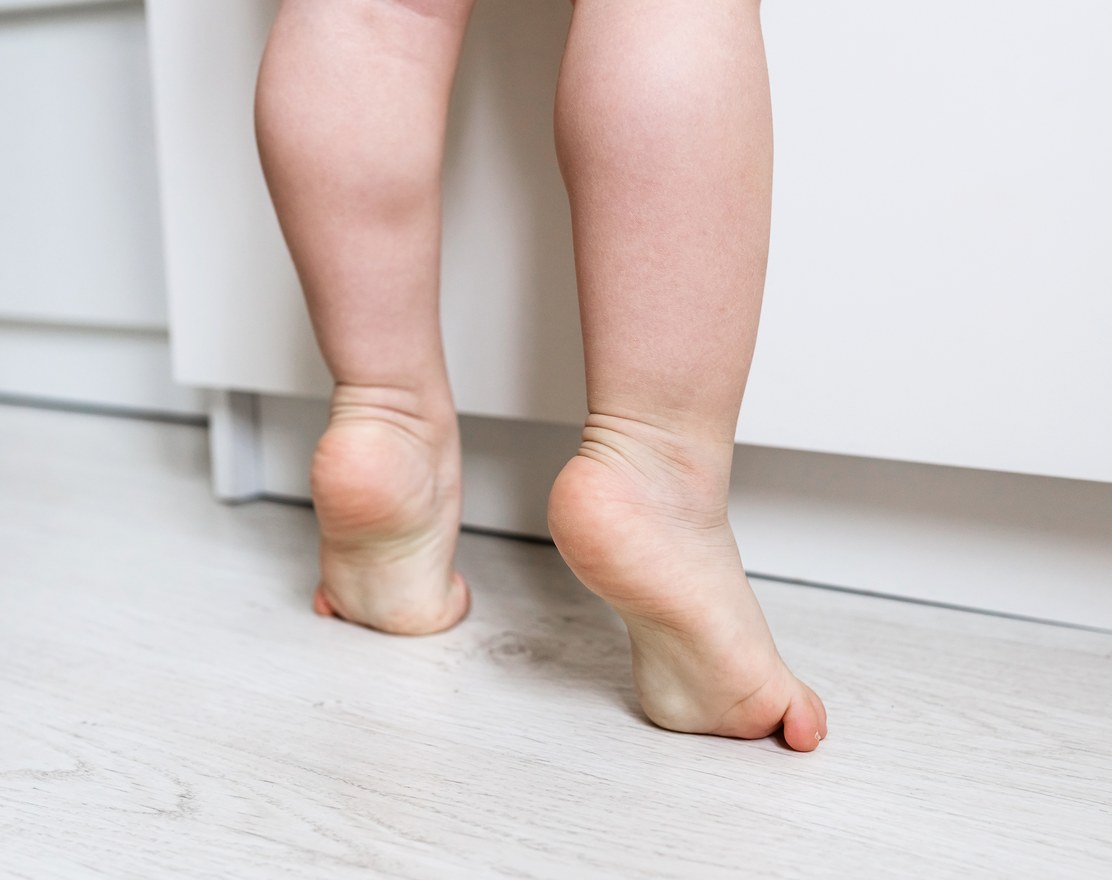
Toe walking is common in children who have recently started walking, and most grow out of it without treatment. It becomes worth assessing when it persists past about age two, when a child cannot get their heels down, when it appears after a period of walking normally, or when it comes alongside other developmental differences. The term "idiopathic toe walking" means no cause was found — and it is a diagnosis of exclusion, meaning it should only be given after other possibilities have been considered. That matters, because several conditions cause toe walking and are treated completely differently. A child who has always toe walked and is otherwise developing typically has a very different picture from one who started recently.
1 · What toe walking is, and how common it is
Toe walking means walking on the balls of the feet, with the heels not making contact with the ground. It is common in children who have recently started walking, and in that group it is usually a phase rather than a problem.
What changes the picture is time and company. A child who is still toe walking well past their second birthday, or who toe walks alongside other developmental differences, is in a different situation from a new walker experimenting with how their feet work.
The single most useful thing to notice at home: can your child put their heels flat on the floor when they stand still, and can they walk flat when you ask them to? A child who can but usually does not is in a different position from a child who cannot.
2 · When toe walking needs assessment
- Difficulty rising from the floor
- Using the hands to push up the legs when standing
- Frequent falls, or balance that is getting worse
- Calves that look unusually large
- Loss of a skill your child previously had
- Onset after a period of walking normally
- Changes in bladder or bowel control
- A birthmark, dimple, or tuft of hair over the lower spine
Most toe walking is not caused by any of the conditions below. These are the features that mean it should be looked at rather than watched.
3 · What else can cause toe walking
Toe walking can be an early sign of conditions that need identifying, and they are treated completely differently from one another.
Cerebral palsy — particularly where muscle tone is increased. → Cerebral palsy
Tethered cord — sometimes with changes in bladder control, or a mark, dimple or tuft of hair over the lower back.
Leg length difference or structural foot differences — where the mechanics of standing flat are simply different on one side.
Autism and sensory processing differences — a recognized association. Toe walking is more common in autistic children, and also common in children who are not autistic, so on its own it indicates nothing. → Autism · Sensory processing
4 · Why "idiopathic" is a diagnosis of exclusion
Idiopathic toe walking means no cause was found. That is a conclusion, not a starting point.
The distinction matters in practice. A label applied early, before the other possibilities have been considered, can close down the assessment that would have found something treatable — and the conditions above are managed in entirely different ways.
A reasonable question to ask: "what have we ruled out before calling it idiopathic?"
5 · The autism and sensory connection
Some children toe walk for reasons connected to how they process sensory information — the feel of the floor, the input through the balls of the feet, or the movement and balance information that comes with being up on the toes.
This is a real explanation, and it is also not a reason to skip an assessment. A sensory explanation and a medical one are not mutually exclusive, and the point of assessment is to know which you are dealing with.
6 · What assessment involves
A physical therapist assesses how far the ankle moves — specifically whether the foot can be brought up past neutral with the knee straight and bent, which tells you whether the calf muscle or the Achilles tendon is the limiting factor — along with walking pattern, muscle strength and tone, reflexes, motor development, and whether the child can walk flat on request.
Where the history or examination suggests one of the conditions above, that leads to further assessment rather than straight to treatment.
Under three in the US, early intervention is free in most states and a parent can refer their own child — no doctor's referral, no diagnosis needed. Your pediatrician can also refer directly.
7 · What treatment involves
Treatment follows the assessment, and it depends on how much movement the ankle has lost.
- Stretching and physical therapy where the ankle still moves reasonably well — lengthening the calf, strengthening the muscles that lift the foot, and practicing a heel-to-toe pattern.
- Serial casting where the ankle has become tight — a series of casts, each holding a little more length than the last.
- Orthoses — braces worn in the shoe to hold a position and encourage a flatter step.
- Surgery is considered only where the tendon is genuinely short and other approaches have not worked.
8 · What parents notice, and what is worth tracking
- Whether they can stand with heels flat, and whether that is changing
- Whether they can walk flat when asked, even briefly
- Whether it is both feet or one — one-sided toe walking is worth mentioning specifically
- When it happens — all the time, when excited, when barefoot, on certain surfaces
- Falls, and whether they are becoming more frequent
- Anything they used to do and no longer do
A short video of your child walking barefoot at home is genuinely useful at an appointment, because children frequently walk differently in an unfamiliar room.
Frequently Asked Questions
What is idiopathic toe walking?
It means toe walking for which no cause was found. It is a diagnosis of exclusion, which means it should be given after other possibilities have been considered rather than as a first label.
Is toe walking a sign of autism?
Toe walking is more common in autistic children than in the general population, and it is also common in children who are not autistic. On its own it indicates nothing. It is one of several things a clinician takes into account alongside communication, play, and sensory differences.
Does toe walking need treatment?
Not always. Where treatment is needed it usually starts with stretching and physical therapy, and may include serial casting or orthoses depending on how tight the ankle has become. The plan follows the assessment rather than the other way round.
Is toe walking normal in toddlers?
It is common in children who have recently started walking, and most stop on their own. It becomes worth assessing when it persists past about age two, when a child cannot get their heels flat, or when it appears alongside other developmental differences.
Will my child grow out of toe walking?
Many children do. What predicts the need for treatment is less about age alone and more about whether the ankle still moves freely, whether the child can walk flat when asked, and whether anything else is going on.
Which professional should we see first?
A physical therapist can assess ankle movement, gait and motor development, and in the US a parent of a child under three can refer their own child to early intervention without a doctor's referral. Your pediatrician can also refer directly, and should be involved if any of the red flags above are present.
When should I be concerned about toe walking?
When it starts after a period of walking normally, when your child cannot bring their heels to the floor, when they are falling more or losing skills they had, when their calves look unusually large, or when they push up their legs with their hands to stand. Any of those is a reason to be seen promptly.
What does it mean if my child pushes up their legs with their hands to stand?
Using the hands to climb up the legs when rising from the floor is a recognized sign of muscle weakness around the hips and thighs, and it is one of the features associated with muscular dystrophy. It should be assessed rather than watched.
Sources
- Engström P, Tedroff K. Idiopathic toe-walking: prevalence and natural history from birth to ten years of age. Journal of Bone and Joint Surgery (American). 2018;100(8):640–647. doi:10.2106/JBJS.17.00851 (PMID 29664850)
- Engström P, Tedroff K. The prevalence and course of idiopathic toe-walking in 5-year-old children. Pediatrics. 2012;130(2):279–284. doi:10.1542/peds.2012-0225 (PMID 22826572)
- Leyden J, Fung L, Frick S. Autism and toe-walking: are they related? Trends and treatment patterns between 2005 and 2016. Journal of Children’s Orthopaedics. 2019;13(4):340–345. doi:10.1302/1863-2548.13.180160 (PMID 31489038)
- van Kuijk AA, Kosters R, Vugts M, Geurts AC. Treatment for idiopathic toe walking: a systematic review of the literature. Journal of Rehabilitation Medicine. 2014;46(10):945–957. doi:10.2340/16501977-1881 (PMID 25223807)
Medical disclaimer. This page is for general educational purposes and does not constitute medical advice, diagnosis, or treatment. Always consult a qualified healthcare provider about your individual situation.