
Speech and language
How Physical, Occupational, and Speech Therapy Help With Developmental Milestones
Understanding and supporting your child's developmental milestones is crucial for their growth and overall well-being.
- Editorially Reviewed
- Plain Language
- Patient Focused
Quick answer. A child who is behind on one milestone usually does not need therapy; a child who is behind on several, or who has lost a skill, or whose delay is getting wider, usually does. Physical therapy covers how a child moves through the world, occupational therapy covers how they use their hands and manage daily tasks, and speech-language therapy covers how they understand, communicate, and eat. In the US any parent can refer their own child under three for a free evaluation through their state’s early intervention program — no doctor’s referral required — and the program has 45 days to complete it. Early therapy works best when it starts before a gap becomes a pattern, so the rule is refer, do not wait.
Key takeaways
- Milestone checklists are screening tools, not pass-or-fail tests. The CDC’s 2022 revision lists the age by which at least 75% of children do something, specifically so that missing one is a reason to look closer.
- The three therapies divide the child roughly by what they are doing: moving (PT), using their hands and managing daily tasks (OT), and understanding, communicating and eating (speech-language pathology).
- Under IDEA Part C any parent can refer their own child under three. No doctor’s referral is needed, services are provided at no cost subject to a state system of payments, and the program has 45 days from referral to complete the evaluation and hold the planning meeting.
- Loss of a skill the child previously had is never wait-and-see. Contact their doctor.
- Early intervention has its best evidence when it starts early and involves the parent in the daily routine, not just the weekly session.
- Most of the work of pediatric therapy happens between sessions. The therapist’s job is to work out what to practice; the family’s job is to build it into the day.
My child is behind on a milestone. Does that mean they need therapy?
Not by itself. Milestone ages are ranges, and a child who is not walking at 14 months is inside the range for a skill most children have by 15. What the checklists are for is spotting the child who is outside the range, behind in more than one area, or drifting further behind rather than catching up.
In 2022 the CDC and the American Academy of Pediatrics revised the milestone checklists so that each milestone sits at the age by which at least 75% of children are expected to demonstrate it, rather than the age when about half do. The stated goal was to discourage a wait-and-see response: on the old lists, missing a milestone meant being behind half your peers, which is unremarkable. On the revised lists it means being behind three-quarters, which is worth a closer look. In the same revision crawling was dropped as a milestone, because plenty of typically developing children skip it, and walking alone moved from 12 months to 15.1
So the useful question is not “did my child hit the milestone” but “what is the pattern.” One skill late, everything else on track, and progress week to week: keep watching. Two or more areas late, a skill lost, a delay that is growing, or a persistent feeling that something is off: get an evaluation. The full age-by-age list is on the developmental milestones page, and the milestone tracker lets you check off what your child does. This page is about what happens next.
Which therapy does my child need: PT, OT, or speech?
Often you do not have to decide. An early intervention evaluation looks at all areas of development and tells you which disciplines are involved. But the division is worth understanding, because parents regularly ask for the wrong one — physical therapy for a child who will not feed themselves, or speech therapy for a child who understands everything but cannot sit still long enough to engage.
| Physical therapy | Occupational therapy | Speech-language pathology | |
|---|---|---|---|
| Owns | How the whole body moves: strength, balance, coordination, posture, walking, climbing | How the hands and senses are used for daily life: grasp, self-feeding, dressing, play, sensory regulation, handwriting later | Understanding language, expressing it (words, gestures, devices), speech sound production, social communication, feeding and swallowing safety |
| Common reasons for referral under 3 | Not rolling, sitting, crawling or walking in range; head tilt; toe walking; low or high muscle tone; favoring one side; clumsy or fearful of movement | Not reaching, grasping or transferring objects; cannot self-feed with fingers or spoon; over- or under-reactive to touch, sound or movement; play is repetitive or absent | Not babbling by 12 months; no words by 16–18 months; not combining words by 2; not pointing or responding to name; limited understanding; choking, gagging or refusing textures |
| Common reasons for referral 3–5 | Cannot jump, climb stairs alternating feet, catch or kick; tires quickly; falls a lot | Cannot manage buttons, scissors or a pencil; refuses tooth-brushing or hair-washing; meltdowns tied to clothing or noise | Hard for strangers to understand at 4; stuttering; small vocabulary; cannot follow two-step directions; social communication differences |
Two clarifications parents find useful. First, the three overlap: an OT and an SLP both work on feeding, a PT and an OT both work on posture for tabletop tasks, and a good team sorts it out. Second, in early intervention the therapist coming to your house is often one person who consults the other disciplines, rather than three people arriving on three days. The difference between PT and OT has more on where the line falls.
What does a pediatric physical therapist actually do?
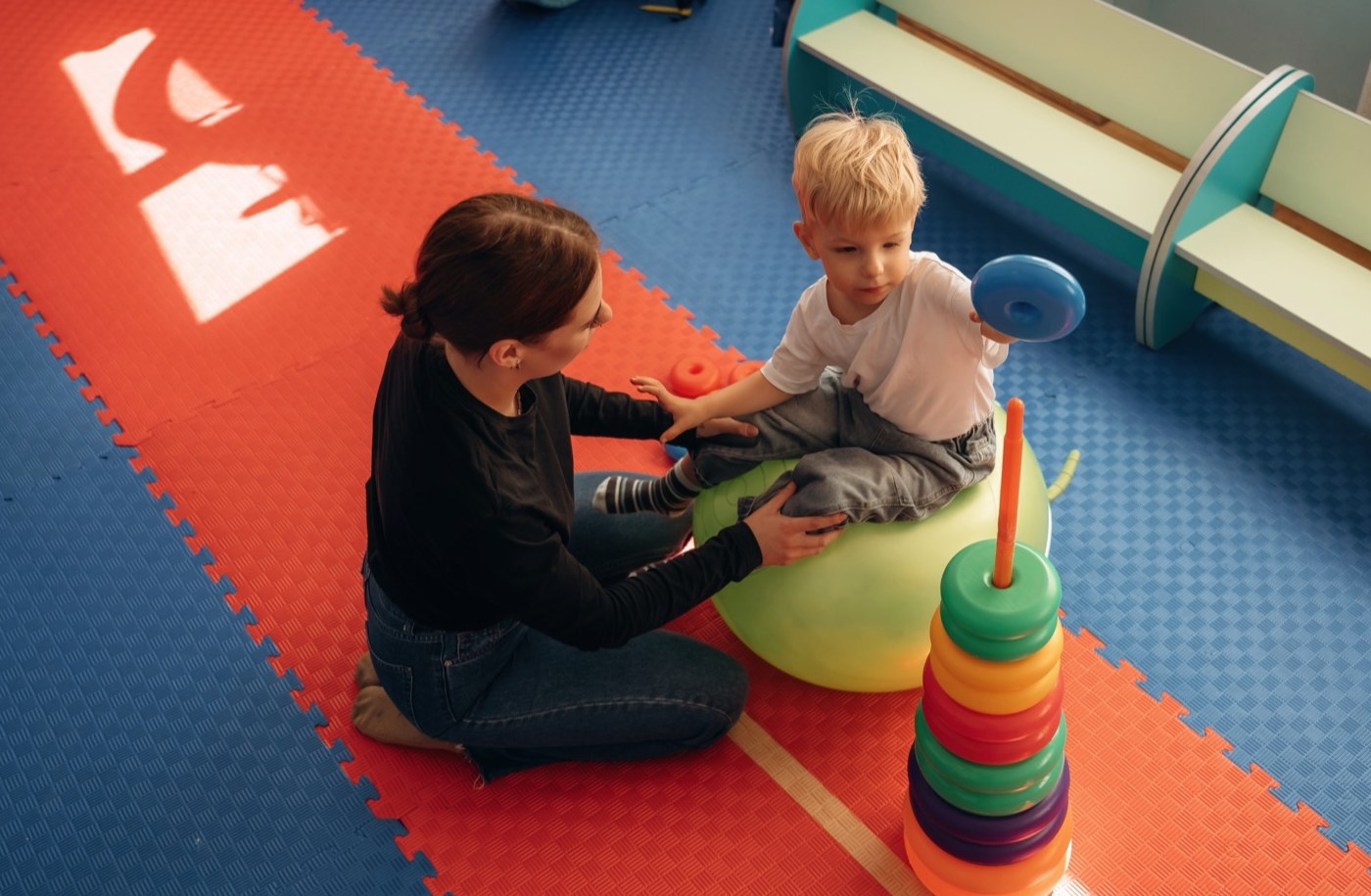
Parents tend to picture exercise: a therapist stretching a child’s legs or walking them between parallel bars. Pediatric physical therapy is closer to engineered play. The therapist works out which movement skill is missing and why — weakness, tone, balance, motor planning, fear, an orthopedic issue — then sets up the environment so the child has to use that skill to get what they want.
A baby who is not rolling gets placed on their side with the toy just out of reach. A toddler who will not pull to stand gets the snack on the couch cushion. A four-year-old who cannot jump gets a game that involves jumping off a step, then a higher step. The child experiences it as play. The therapist is controlling the difficulty, the number of repetitions, and where their hands go.
Physical therapists also screen for what needs a doctor: muscle tone that is unusually high or low, a persistent head tilt, asymmetry, or a loss of skills. And they address the orthopedic side of development — toe walking, W-sitting, feet and hips — that often gets written off as “just how they walk.”
What does a pediatric occupational therapist actually do?
The word “occupational” confuses everyone. For a child, the occupations are eating, dressing, playing, and eventually writing and managing a classroom. Occupational therapy covers the hands, the senses, and the daily routines those support.
For a toddler that might mean the grasp patterns needed for self-feeding, the tolerance for textures needed to eat a varied diet, or the ability to sit through a haircut. For a preschooler it might be scissors, buttons, tooth-brushing, or a sensory profile that makes the classroom intolerable. An OT is also usually the person who assesses sensory processing differences — the child who cannot stand tags, cannot stand still, or melts down in a loud room — and who builds the plan for them.
What parents tend to assume is that OT means fine motor, meaning handwriting, meaning something for school-age children. In practice OT is often the first therapy a toddler needs, because self-feeding and sensory regulation are the daily-life skills that break down first.
What does a speech-language pathologist actually do?
Three things that parents tend to collapse into one. Speech is the sounds — articulation, clarity, stuttering. Language is the meaning — understanding what is said and getting ideas out, whether by words, gestures, signs or a device. Feeding and swallowing is the mouth’s other job, and SLPs assess and treat it.
Most toddlers referred to speech therapy have a language problem rather than a speech problem. A two-year-old with ten words is not struggling to pronounce things; they are struggling to build the system. The therapy for that looks nothing like drilling sounds. It looks like the therapist playing on the floor, following the child’s interest, modeling one word above the child’s level, and coaching the parent to do the same all day.
Two things worth knowing. Late talkers with good understanding often do catch up, but there is no reliable way at 18 or 24 months to identify in advance which ones will, so waiting is a gamble with the child’s language-learning window.2 And augmentative communication — signs, picture boards, speech-generating devices — does not appear to hold speech back: in a review of the cases with sufficient methodological rigor, none showed a decrease in speech production, 11% showed no change and 89% showed gains, mostly modest.3 That matters because parents often refuse it on exactly that fear. The toddler language strategies page covers what to do at home.
How do I get a free developmental evaluation?
In the US, if your child is under three, you can refer them yourself. Part C of the Individuals with Disabilities Education Act requires every state to run an early intervention program, allows a referral from any source including a parent, and requires that early intervention services be provided at no cost, except where a state operates a system of payments by families. The initial evaluation, the initial assessments and the initial planning meeting must be completed within 45 days of the program receiving the referral.4
- ReferralYou call. Any source can refer, including you.
- EvaluationCompleted within 45 days of the referral.
- IFSP meetingHeld within the same 45 days if your child is eligible.
Free, and no doctor’s referral required.
To find yours, search for your state’s early intervention program or ask your pediatrician for the number. It goes by different names in different states — Early Steps, First Steps, Birth to Three, ECI and others. You call, you say you have concerns about your child’s development, and the 45-day clock starts.
Eligibility rules vary by state. Some serve children with any measurable delay; others require a delay of a certain size, or a diagnosed condition likely to cause one. If your child is evaluated and found not eligible you still get the evaluation results, and you can pursue therapy privately or through insurance.
At three, responsibility shifts to the school district under Part B of the same law. The district evaluates, again at no cost, and provides services through preschool special education. If your child is in Part C approaching three, the program is required to plan the transition with you.4
What happens at an early intervention evaluation?
Before
You will be asked about your concerns, your child’s history, and what a typical day looks like. Write down what you have noticed and when. “Does not say much” is less useful than “has about eight words, no two-word combinations, and does not point to show me things.”
During
Usually a home visit, sometimes a clinic. Two or more professionals — typically a developmental specialist plus a therapist from the discipline your concern points to — play with your child and watch. They may use a standardized tool that scores what your child does against age norms across motor, communication, cognitive, social-emotional and adaptive areas. They will ask you questions throughout. It usually takes one to two hours.
After
You get a written report with scores and observations. If your child is eligible you will have a meeting to write an Individualized Family Service Plan: what the goals are, which services address them, how often, and where. In Part C, “where” is usually your home or your child’s daycare, because the model is built on coaching the adults who are with the child all day.4
When should I refer instead of wait?
The table below is not a milestone list. It is the shortlist of things late enough, or specific enough, to act on the day you notice them. For full milestone ranges use the developmental milestones page.
| Age | Act if… |
|---|---|
| Any age | Your child has lost a skill they had — words, a motor skill, eye contact, social interest. This is never wait-and-see; contact their doctor the same week. |
| Any age | Your child consistently uses one side of the body and neglects the other, or holds their head tilted. |
| 6–9 months | Not sitting with support, not reaching for objects, not responding to sounds or to their name. |
| 12 months | Not babbling, not pointing or gesturing, not bearing weight on legs when held up. |
| 15–18 months | Not walking alone, no words, not pointing to show you things. |
| 2 years | No two-word phrases, not following simple directions, cannot feed self with fingers, not engaging in pretend play. |
| 3 years | Strangers cannot understand most of what they say, cannot jump, cannot manage a spoon, cannot tolerate ordinary clothing or grooming. |
“Boys talk later.” “My uncle did not walk until two.” “The pediatrician said give it six months.” All of these may be true and none changes the arithmetic. An evaluation is free and takes an afternoon. The cost of waiting six months on a child who did need help is six months of a developmental window. The cost of evaluating a child who did not need help is an afternoon.
Does early therapy work?
For the populations it has been tested in, yes, with the usual caveat that “therapy” is not one thing.
The strongest single body of evidence is for infants born preterm. A Cochrane review of early developmental intervention programs, updated in 2024 across 44 studies and 5,051 participants, found that intervention probably improves cognitive and motor outcomes during infancy, on low-certainty evidence, and improves cognitive outcomes at preschool age, on high-certainty evidence.5 For speech and language delay, a Cochrane review found therapy effective for expressive phonological and expressive vocabulary difficulties, with less evidence of effect for receptive language difficulties.6
The pattern across the evidence is that intervention works best when it starts early, when it is intensive enough to matter, and when the parent is coached to carry it into daily routines rather than treating the weekly session as the treatment.5 That is why early intervention under Part C is built on home visits and parent coaching rather than clinic appointments, and why a therapist who hands you a home program is doing the job rather than shirking it.
What therapy cannot do is change a child’s underlying condition or guarantee they will catch up. A child with a motor delay from cerebral palsy is not going to be un-delayed; the goal is the most function, independence and participation the child can have. That is still worth a great deal, and it is still the reason to start early.
What does therapy look like week to week?
In early intervention: typically one visit a week, sometimes every other week, at home or daycare, 45 to 60 minutes. The therapist plays with your child, shows you what they are working on and why, and leaves you with two or three things to build into the day. Bath time becomes an OT session, the walk to the mailbox becomes PT, every snack is a language opportunity. Progress is reviewed against the IFSP goals.
In outpatient or private therapy: usually a clinic, usually 30 to 60 minutes, weekly or twice weekly, with a parent in the room for younger children. A plan of care sets goals and a re-evaluation date. Frequency depends on the diagnosis, the child’s tolerance and, realistically, insurance. DrSensory covers whether insurance covers pediatric therapy and options without insurance.
The honest measure of whether it is working is not whether your child enjoys the session — they usually do — but whether the specific skill in the plan is moving. If it is not after a couple of months, ask why, and ask what changes.
Frequently asked questions
Does my child need therapy if they're behind on one milestone?
Usually not. One late skill with everything else on track is worth watching. Two or more areas late, a lost skill, or a growing gap is worth an evaluation.
What's the difference between PT and OT for a child?
Physical therapy is how the whole body moves — sitting, walking, climbing, balance. Occupational therapy is how the hands and senses are used for daily life — feeding, dressing, play, tolerating textures and noise. They overlap on posture and play, and an evaluation sorts out which is needed.
Do I need a doctor's referral for early intervention?
No. Under IDEA Part C a parent can refer their own child under three directly to the state early intervention program, and the evaluation is provided at no cost.
How long does early intervention have to evaluate my child?
45 days. The regulation requires the initial evaluation, the initial assessments and the initial IFSP meeting to be completed within 45 days of the program receiving the referral.
Is early intervention free?
Early intervention services must be provided at no cost, except where a state operates a system of payments by families, which can include a sliding fee scale for some services. Ask your program what applies in your state.
What is an IFSP?
An Individualized Family Service Plan — the written plan produced after an early intervention evaluation. It sets goals, names the services, and says how often and where they will happen.
My child understands everything but doesn't talk. Should I wait?
Get an evaluation. Many late talkers with good comprehension catch up, but there is no reliable way at 18 or 24 months to tell which ones will, and the evaluation is free.
Why did the CDC change the milestone ages in 2022?
The old checklists listed the age when about half of children reached a milestone, which made missing one hard to interpret. The revised lists use the age by which at least 75% of children do it, so missing one is a reason to look closer. Crawling was removed as a milestone and walking alone moved to 15 months.
Will therapy stop my child from doing it on their own?
No. Therapy is structured practice of the skill the child is already working toward. Nothing about it replaces the child's own effort.
Does a sign or a picture board stop a child from learning to talk?
The evidence does not support that fear. In a review of cases with sufficient methodological rigor, none showed a decrease in speech production following augmentative communication; most showed gains, generally modest.
What happens when my child turns three?
Responsibility moves from the early intervention program under Part C to the school district under Part B. The district evaluates, at no cost, and provides preschool special education services if the child is eligible. Your Part C program helps plan the transition.
How do I find a pediatric therapist near me?
For children under three, start with your state early intervention program. For any age, the DrSensory directory lists pediatric physical, occupational and speech therapists by state.
Related on DrSensory
- Developmental milestones by age
- Milestone tracker
- What is the difference between PT and OT?
- Strategies for encouraging language development in toddlers
- Does insurance cover pediatric therapy?
- Find a pediatric physical therapist, occupational therapist or speech therapist by state.
Sources
- Zubler JM, Wiggins LD, Macias MM, et al. Evidence-Informed Milestones for Developmental Surveillance Tools. Pediatrics. 2022;149(3):e2021052138. doi:10.1542/peds.2021-052138 (PMID 35132439). Milestones are placed at the age by which at least 75% of children are expected to demonstrate them, replacing the 50th percentile, explicitly to discourage a wait-and-see response.
- American Speech-Language-Hearing Association. Late Language Emergence (Practice Portal). Checked September 9, 2026.
- Millar DC, Light JC, Schlosser RW. The impact of augmentative and alternative communication intervention on the speech production of individuals with developmental disabilities: a research review. Journal of Speech, Language, and Hearing Research. 2006;49(2):248–264. doi:10.1044/1092-4388(2006/021) (PMID 16671842). Of 27 cases meeting the review’s evidence standard, none showed a decrease in speech production; 11% showed no change and 89% showed gains, mostly modest.
- Individuals with Disabilities Education Act, Part C, 34 CFR Part 303. Referral by any source including a parent: §303.303. Services at no cost, subject to a State system of payments under §§303.520 and 303.521: §303.13(a)(3). Initial evaluation, assessments and initial IFSP meeting “must be completed within 45 days from the date the lead agency or EIS provider receives the referral”: §303.310(a). Checked September 9, 2026.
- Spittle A, Orton J, Anderson PJ, Boyd R, Doyle LW, et al. Early developmental intervention programmes provided post hospital discharge to prevent motor and cognitive impairment in preterm infants. Cochrane Database of Systematic Reviews. 2024;(2):CD005495 (PMID 38348930). 44 studies, 5,051 participants. Intervention probably improves cognitive and motor outcomes during infancy (low-certainty evidence); at preschool age it improves cognitive outcomes (high-certainty evidence).
- Law J, Garrett Z, Nye C. Speech and language therapy interventions for children with primary speech and language delay or disorder. Cochrane Database of Systematic Reviews. 2003;(3):CD004110 (PMID 12918003). Effective for expressive phonological (SMD 0.44) and expressive vocabulary (SMD 0.89) difficulties; less evidence of effect for receptive difficulties (SMD −0.04).
Medical disclaimer. This page is for general educational purposes and does not constitute medical advice, diagnosis, or treatment. If your child has lost skills they previously had, contact their doctor.