
Speech and language
Strategies for Encouraging Language Development in Toddlers
What helps a toddler talk is a responsive adult, not a better teaching method. Here is what the evidence supports at home, and the point at which home strategies stop being the answer.
- Editorially Reviewed
- Plain Language
- Patient Focused
Quick answer. The strategies with the best evidence behind them make you a better conversation partner, not a better teacher: get down to your toddler’s level, talk about what they are already looking at, say back what they said with one word added, and ask fewer questions. Gestures, signs and picture boards help speech rather than delay it. Blowing bubbles and other mouth exercises do not build speech. And if your toddler is not saying a word or two besides “mama” and “dada” by 15 months, has fewer than about 50 words and no two-word combinations at 24 months, or has lost words they used to have, get a hearing test and a free evaluation now rather than waiting to see.
Key takeaways
- Toddlers learn language from responsive adults, not from exposure to words in general. What matters is the back-and-forth.
- Follow the child’s attention. Talking about what they are looking at is more useful than redirecting them to what you want to name.
- Expansion — saying back what the child said with one element added — is the most-studied thing a parent can do at home, and it is free.
- Questions put a toddler on the spot; comments hand them language without asking for anything back. Aim for several comments to every question.
- Gestures, baby signs and augmentative communication do not delay speech. The evidence points the other way.
- Non-speech oral motor exercises — bubbles, straws, horns — have no strong evidence behind them. Do not spend the time.
- A late talker is a toddler with delayed language and otherwise typical development. Many catch up, but which ones can only be known afterward, so evaluate rather than wait.
- Every toddler with a language concern needs a hearing test.
- Learning two languages does not cause a language disorder. Count vocabulary across both.
- Any loss of words the child previously had: contact their doctor the same week.
What actually helps a toddler learn to talk?
A responsive adult. Toddlers do not acquire language from hearing words go by; they acquire it from interaction in which their own attempts get answered. The parent-coaching approach used in speech-language therapy — teaching the parent to follow the child’s lead, respond to communication attempts, model language slightly above where the child is, and expand what the child says — has been tested in enough controlled studies to support a meta-analysis. Across 18 studies of children aged 18 to 60 months, it had a significant, positive impact on both receptive and expressive language.1
That is the whole page in one paragraph. Everything below is how to do it.
How much should I talk to my toddler, and how?
Talk a lot, but talk about what they are attending to. A toddler staring at the dog does not benefit from you naming the spoon. Look at what they are looking at, then say what it is and what it is doing: “Dog. The dog’s eating. Crunch crunch.”
Three habits that turn ordinary time into language time:
- Narrate what you are doing in short phrases, especially during the routines your child sees every day — diaper changes, bath, getting into the car. Repetition in context is how toddlers map words onto meaning.2
- Get face to face. On the floor, at their level. Toddlers learn from watching mouths and faces, and a face at eye level is far easier to attend to than a voice from above.
- Wait. After you say something, pause. Count to five. The pause is where the child’s turn happens, and most adults fill it before the child can.2
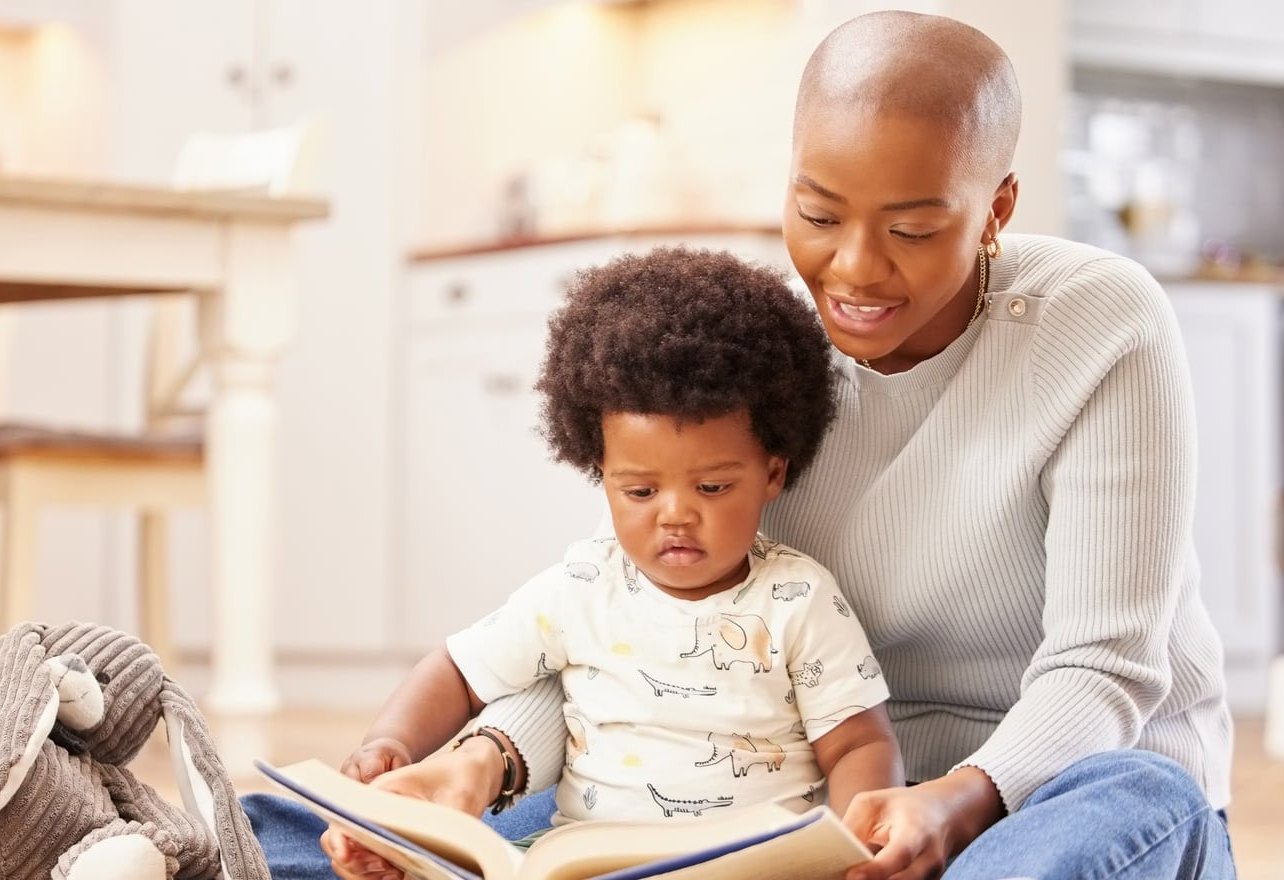
Reading counts, but how it is read matters more than the book. You do not have to read every word. A toddler who is allowed to turn pages, point, and make the animal sounds while you respond is learning language; a toddler expected to sit through the text as written is learning to sit.2
Should I ask my toddler questions?
Fewer than you think. Questions feel like engagement, but to a toddler with limited language a question is a test with a right answer, and a test is a reason to go quiet. “What’s that?” “What color is it?” “Can you say ball?” each put the child on the spot and end the exchange if they cannot answer.
Comments do the opposite. They hand the child language to take without demanding anything back.
| Instead of | Try |
|---|---|
| “What’s that?” | “It’s a truck. A big truck.” |
| “Can you say ‘ball’?” | (rolling it) “Ball. Ball goes.” |
| “What color is the cup?” | “Blue cup. You’ve got the blue cup.” |
| “What did you do today?” | “You went to the park. You went on the swing.” |
| “Say ‘more’.” | (holding it up, waiting) … “More? More crackers.” |
| “Where’s your nose?” (for the fifth time) | “There’s your nose. Beep.” |
Several comments to every question is the rule of thumb parent-coaching programs use. It is a practice heuristic rather than a tested ratio, but the direction it points in — comment more, quiz less — is the same direction the intervention research points.1 When you do ask, ask the kind with no wrong answer. “Should we do the red one or the green one?” gives a choice; “Where should the cow go?” hands the child control of the play.
The “What did you do today?” style of open-ended question that used to be on this page is good advice for a four-year-old. It is beyond most toddlers, and it has been removed.
How do I expand on what my toddler says?
Say back what they said, correctly, with one thing added. That is expansion, and adding on to what the child says is one of the strategies ASHA gives parents directly.2
Three rules make it work: keep it just above where the child is, one or two words up rather than a full sentence; keep the child’s own word in it so they hear the link; and do not demand a repeat. The child hears the better version and gets their juice. Over hundreds of repetitions, the better version becomes theirs.
Two related moves. Recasting is expansion with a grammar fix: the child says “him go” and you say “he’s going.” Self-talk and parallel talk are narrating your own actions and the child’s, which give a child with few words a steady model without requiring them to produce anything. All of these sit inside the same family of parent-implemented techniques the meta-analysis found effective.1
Do gestures and signs help toddlers talk?
Yes, and the fear that they will replace speech is not supported.
Gesture comes before words in typical development, and how much a toddler gestures predicts how much language comes later: in one study of 52 children observed at home, the number of different meanings a child conveyed in gesture at 18 months predicted their vocabulary at 42 months, even with the child’s early speech controlled for.3 Adding your own gestures to your words — waving with “bye”, pointing with “look”, arms up with “up” — gives the child a second channel to map meaning onto, and it is one of the first things ASHA tells parents to do.2
Baby signs work the same way. A toddler who signs “more” is communicating a want they could not say, and most children drop the sign once they can say the word.
The same holds for the formal version. Augmentative and alternative communication — picture boards, communication books, speech-generating devices — is often refused by parents who believe it will make the child stop trying to talk. A research review of AAC intervention found the opposite: of the 27 cases with sufficient methodological rigor, not one showed a decrease in speech production, 11% showed no change, and 89% showed gains.4 If a therapist suggests AAC for your toddler, it is because the child needs a way to communicate now, and having one makes speech more likely rather than less.
What play helps toddlers talk?
Any play in which an adult follows the child, comments, waits, and expands. The toy matters much less than the adult.
What works well: toys that do things — cars, animals, a ball, blocks — because they generate action words and repetition. Routines with built-in anticipation, like peekaboo, “ready, set… go”, and rolling a ball back and forth, because the child learns to fill the gap. And songs with actions and a predictable shape, because a toddler can join in on the last word of a familiar line long before they can produce it alone.
What works less well for toddlers: rule-based games such as Simon Says and I Spy, which belong to the preschool years; flashcards and labeling drills, which are questions in disguise; and any activity where the adult directs and the child complies.
Playdates are good for many reasons, but a toddler learns language primarily from adults. Two two-year-olds side by side are mostly playing in parallel. Do not count peer time as language time.
Does screen time affect toddler speech?
Screens do not teach toddlers language, and time on a screen is time not spent in the back-and-forth that does. The American Academy of Pediatrics recommends no screen media other than video-chatting under 18 months, and for 18 to 24 months only high-quality programming watched with a parent who talks about what is on screen.5
The mechanism is the same as everything else on this page: toddlers learn from responses contingent on what they just did. A screen cannot respond to a child’s attempt. Video chat is the exception because the grandparent on the other end can. Apps that claim to teach vocabulary are, at best, flashcards with animation.
Background television counts too. The AAP’s guidance for families is blunt about it: screen media, whether in the background, on a parent’s phone, or on a tablet in front of the child, displaces speaking to your baby, back-and-forth play, singing, and reading together.6
Do blowing bubbles and oral motor exercises help speech?
There is no strong evidence that they do. This one is worth being direct about, because it is common advice and it costs families time.
The idea is that speech is a motor act, so exercising the mouth — blowing bubbles, sucking through straws, horns and whistles, tongue push-ups, chewing tools — should strengthen the muscles and improve speech. A Cochrane review of non-speech oral motor treatment found only three studies covering 22 children, all with serious methodological limitations, and concluded that no strong evidence suggests these treatments are effective either on their own or added to conventional speech therapy.7 The problem with the underlying theory is that speech does not take much strength. It takes precise, fast, coordinated movement, which is learned by speaking.
Two honest limits on that review. It studied children aged three and up with speech sound disorders, not toddlers with language delay, and 22 children is a thin evidence base in either direction. What it does not support is the confident claim that mouth exercises build speech.
Bubbles are still a fine toy. Blow them, say “pop”, wait for the child to say “pop”, expand to “big pop”. That is language work. The blowing is not. And if a therapist’s plan for your child is mostly oral motor exercises with no speech or language target, ask what the evidence is. Feeding and swallowing therapy is a separate matter with a different rationale, and is not what this section is about.
Is my toddler a late talker?
A late talker is a toddler whose language is late to arrive with no other diagnosed disability or delay in cognition or motor development. The widely used criterion is an expressive vocabulary of fewer than 50 words and no two-word combinations by 24 months, and prevalence at age two is estimated at 10% to 20%.8
Many late talkers do catch up. The problem is that the ones who will and the ones who will not look the same at the outset — ASHA’s summary of the research is that the distinction can only be made after the fact.8 That is why the answer to “should I wait and see” is no. A late talker who catches up loses nothing by being evaluated. A late talker who does not catch up loses a year of the window in which intervention works best.
Act if:
- No words besides “mama” or “dada” by 15 months, or no pointing to ask for something or to get help. Both are 15-month milestones, meaning at least three-quarters of children do them by then.9
- Fewer than three words besides “mama” or “dada” at 18 months, or unable to follow a one-step direction without a gesture.9
- Fewer than about 50 words and no two-word combinations at 24 months. This is the standard criterion for late language emergence; either half of it alone is reason enough to ask.8
- Understanding is behind as well as talking. A toddler who does not follow simple directions or respond to their name has more than a late-talker profile, and gesture is worth watching too — children who go on to catch up tend to gesture more than those who stay delayed.8
- Any loss of words the child previously used. Regression is never wait-and-see. Contact their doctor the same week.9
The difference between a late talker and a language disorder is not something a parent can settle at home, and it is not something a pediatrician can settle in a fifteen-minute visit. It takes an evaluation. The full age-by-age ranges are on the speech and language milestones page.
Could it be hearing, bilingualism, or gestalt language processing?
Three things to have in mind before settling on “just a late talker.”
Hearing. Every toddler with a language concern needs a hearing test, including toddlers who passed newborn screening. ASHA’s guidance is explicit that hearing loss has to be considered in working out what is going on, and that screening includes a hearing screening.8 Fluctuating hearing loss from repeated ear infections is common at this age and is enough to affect language. A child who seems to hear fine because they react to loud sounds can still be missing the high-frequency consonants that words are built from.
Bilingualism. Learning two languages does not confuse a child and does not cause a language disorder. It does take longer than learning one, so a bilingual toddler will often know fewer words in each single language than a monolingual peer — which is exactly why vocabulary has to be counted across both languages rather than in English alone. A bilingual toddler with a small vocabulary across both languages is a late talker in both, not a child who is “confused.” Keep speaking the languages you speak well; switching to English-only does not help.10
Gestalt language processing. Some toddlers, autistic toddlers in particular, take language in as chunks rather than single words: a whole line from a show, or a phrase you say, produced intact with the original intonation and often out of context. From the outside it can look like a child with no language who just echoes. It is language, taking a different route in. A child who says “to infinity and beyond” every time they are excited is using a meaningful unit, and the intervention approach differs from the one for a child building word by word. The evidence base for the specific therapy frameworks is still thin, but recognizing the pattern matters because it changes what progress looks like. Our page on gestalt language processing covers the signs and the approaches, and speech therapy for autism covers what therapy involves.
When should I get my toddler evaluated?
Now, if any of the “act if” items above apply. In the US, if your child is under three, you can refer them yourself to your state’s early intervention program under Part C of the Individuals with Disabilities Education Act. Parents are listed in the regulation as a primary referral source, so no doctor’s referral is required; evaluation and assessment are among the functions that must be carried out at public expense with no fee charged to parents; and the program has 45 days from the referral to complete the evaluation and hold the planning meeting.11 Search for your state’s early intervention program by name, or ask your pediatrician for the number.
Ask for a hearing test at the same time, through your pediatrician or an audiologist.
If your child is over three, the school district evaluates, also at no cost. And at any age a pediatric speech-language pathologist can evaluate privately; our directory lists speech therapy clinics by state.
What an evaluation gives you, even when the answer is “typical range, keep going”, is a baseline and a set of strategies specific to your child. What waiting gives you is six more months of not knowing. The page on how physical, occupational and speech therapy help with milestones walks through what an evaluation involves and what therapy looks like if your child needs it.
Frequently asked questions
How can I help my 2-year-old talk?
Get face to face, talk about what they are already looking at, say back what they say with one word added, and ask fewer questions. Narrate routines, pause and wait for their turn, and add gestures to your words. These are the strategies with evidence behind them, they cost nothing, and they fit into an ordinary day.
My toddler understands everything but doesn't talk. Is that normal?
It is a common late-talker profile, and many of these children do catch up. But the distinction between a late bloomer and a child who stays delayed can only be made after the fact, so a hearing test and a free early intervention evaluation beat waiting to see.
How many words should an 18-month-old say?
The CDC's 18-month milestone is trying to say three or more words besides “mama” or “dada”, and following a one-step direction without gestures. Milestones are what at least 75% of children do by that age, so missing one is a reason to look closer rather than a diagnosis.
Do baby signs delay speech?
No. Signs give a toddler a way to communicate before they can say the word, and children typically drop the sign once speech takes over. In the research review of augmentative communication, none of the rigorously analyzed cases showed a decrease in speech production.
Does bilingualism cause speech delay?
No. Dual language input does not confuse children. A bilingual toddler will often know fewer words in each single language than a monolingual peer, which is why vocabulary should be counted across both languages. A bilingual toddler with few words in both is a late talker, and keeping both languages is the right call.
Do bubbles and straws help with speech?
There is no strong evidence that they do. A Cochrane review of non-speech oral motor treatment found three small studies covering 22 children and concluded the evidence does not support the approach. Use bubbles as a language activity — “pop!” — rather than as a mouth exercise.
Is screen time bad for toddler language?
A screen cannot respond to a toddler, and responding is how toddlers learn language. The AAP recommends no screen media except video-chatting under 18 months, and co-viewed high-quality programming from 18 to 24 months. Background television also displaces the talking and back-and-forth play that build language.
Should I correct my toddler's mistakes?
Not directly. Say the correct version back inside an expansion: the child says “him go” and you say “he's going.” The child hears the right form without being told they got it wrong, and nothing is demanded of them.
What is a late talker?
A toddler with delayed language onset and no other diagnosed disability or delay. The widely used criterion is fewer than 50 words and no two-word combinations by 24 months. Prevalence at age two is estimated at 10% to 20%.
When should I worry about my toddler not talking?
No words besides “mama” or “dada” and no pointing to ask by 15 months; fewer than three words or no one-step directions without gestures at 18 months; fewer than about 50 words and no two-word combinations at 24 months; understanding behind as well as talking; or any loss of words. Get a hearing test and an evaluation.
How do I get a free speech evaluation for my toddler?
Under three: call your state's early intervention program. A parent is a primary referral source under IDEA Part C, no doctor's referral is needed, the evaluation must be carried out at public expense with no fee to you, and the program has 45 days. Over three: your school district evaluates.
What is gestalt language processing?
Learning language in whole chunks — a phrase, or a line from a show, produced intact with its original intonation — rather than word by word. It can look like echoing with no meaning, but it is a different route into language, and it changes what progress looks like.
Related on DrSensory
- Speech and language milestones: birth to seven
- Gestalt language processing
- How physical, occupational, and speech therapy help with developmental milestones
- Speech therapy for autism: what parents should know
- Find a speech therapy clinic by state
Sources
- Roberts MY, Kaiser AP. The effectiveness of parent-implemented language interventions: a meta-analysis. American Journal of Speech-Language Pathology. 2011;20(3):180–199. doi:10.1044/1058-0360(2011/10-0055) (PMID 21478280). Eighteen studies, children aged 18 to 60 months: parent-implemented language intervention had “a significant, positive impact on receptive and expressive language skills.” Effect sizes (g) ranged from −0.15 to 0.82 depending on the outcome measure and comparison group.
- American Speech-Language-Hearing Association. Activities to Encourage Speech and Language Development. Cited for narrating routines, pausing after you speak, adding on to what the child says, reading by talking about the pictures, and using gestures such as waving and pointing. Checked September 9, 2026.
- Rowe ML, Goldin-Meadow S. Early gesture selectively predicts later language learning. Developmental Science. 2009;12(1):182–187. doi:10.1111/j.1467-7687.2008.00764.x (PMID 19120426). In 52 children observed at home, the number of different meanings conveyed in gesture at 18 months predicted vocabulary at 42 months, with early child speech controlled.
- Millar DC, Light JC, Schlosser RW. The impact of augmentative and alternative communication intervention on the speech production of individuals with developmental disabilities: a research review. Journal of Speech, Language, and Hearing Research. 2006;49(2):248–264. doi:10.1044/1092-4388(2006/021) (PMID 16671842). Of the 27 cases meeting the review’s evidence standard, none showed a decrease in speech production; 11% showed no change and 89% showed gains, mostly modest.
- Council on Communications and Media. Media and Young Minds. Pediatrics. 2016;138(5):e20162591. doi:10.1542/peds.2016-2591 (PMID 27940793). The policy statement behind the AAP’s age guidance: no screen media other than video-chatting under 18 months, and from 18 to 24 months high-quality programming used together with a parent rather than alone.
- American Academy of Pediatrics. Kids & Screen Time: The 5 C’s Questions to Ask for Infants, HealthyChildren.org. “Screen media—whether in the background, on a parent’s mobile device or on a tablet in front of a baby—displaces the important building blocks of brain development. This includes speaking to your baby or others around them, back-and-forth play, singing, reading together.” Checked September 9, 2026.
- Lee ASY, Gibbon FE. Non-speech oral motor treatment for children with developmental speech sound disorders. Cochrane Database of Systematic Reviews. 2015;(3):CD009383. doi:10.1002/14651858.CD009383.pub2 (PMID 25805060). Three studies, 22 children, all aged three or older. The authors’ conclusion: “Currently no strong evidence suggests that NSOMTs are an effective treatment or an effective adjunctive treatment for children with developmental speech sound disorders.”
- American Speech-Language-Hearing Association. Late Language Emergence (Practice Portal). Prevalence at two years is put at 10% to 20%; the widely used criterion is “an expressive vocabulary of fewer than 50 words and no two-word combinations by 24 months of age”; late bloomers cannot be told apart from children who stay delayed at the outset, because “this distinction can be made only after the fact”; and differential diagnosis requires considering hearing loss. Checked September 9, 2026.
- Centers for Disease Control and Prevention. Learn the Signs. Act Early. — Milestones by 15 Months and Milestones by 18 Months. Milestones are the things at least 75% of children do by that age. At 15 months: tries to say one or two words besides “mama” or “dada”, and points to ask for something or to get help. At 18 months: tries to say three or more words besides “mama” or “dada”, and follows a one-step direction without any gestures. Checked September 9, 2026.
- Hoff E, Core C. What clinicians need to know about bilingual development. Seminars in Speech and Language. 2015;36(2):89–99. doi:10.1055/s-0035-1549104 (PMID 25922994). Dual language input does not confuse children; the two languages need not be kept separate; learning two takes longer than learning one, so bilingual children lag monolingual peers in single-language comparisons; total vocabulary across both languages is the best indicator of learning capacity; and immigrant parents should not be discouraged from speaking their native language.
- Individuals with Disabilities Education Act, Part C, 34 CFR Part 303. Parents are a primary referral source: §303.303(c)(3). The initial evaluation, initial assessments and initial IFSP meeting must be completed within 45 days of the referral: §303.310(a). Evaluation and assessment are among the “required functions that must be carried out at public expense, and for which no fees may be charged to parents”: §303.521(b)(2). Checked September 9, 2026.
Medical disclaimer. This page is for general educational purposes and does not constitute medical advice, diagnosis, or treatment. If your child has lost skills they previously had, contact their doctor.