Speech and language
Online Speech Therapy: What It Is, What Works, and Who It Suits
Video sessions remove the drive and the waitlist. Here is what the research supports, and where a room still beats a screen.
- Editorially Reviewed
- Plain Language
- Patient Focused
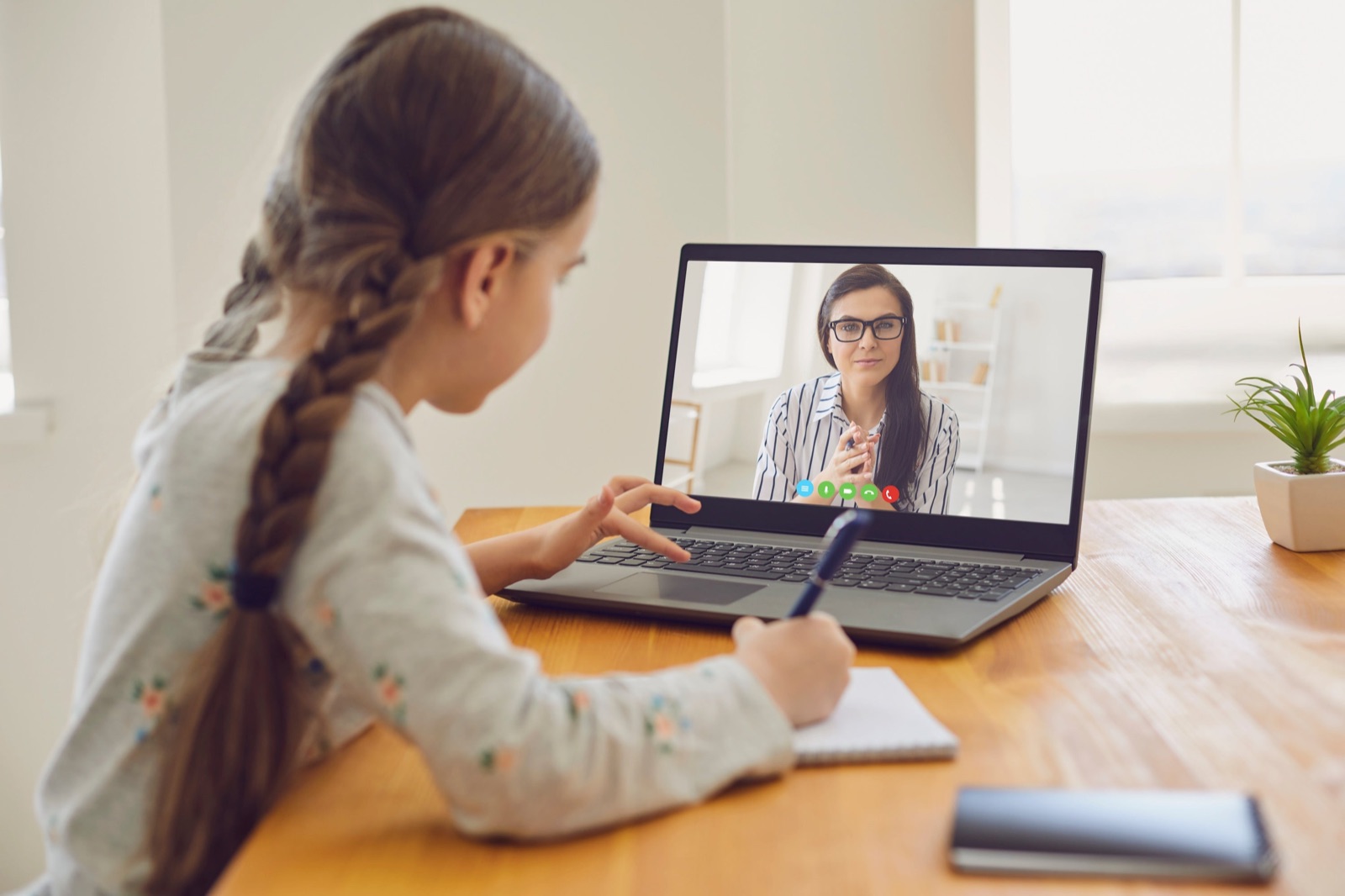
Online speech therapy — telepractice — delivers speech-language services by video, with a licensed speech-language pathologist assessing and treating in real time. The research is encouraging but not settled: a systematic review of school-age children found telehealth and in-person groups improved similarly on five of six outcome measures, with the authors calling the evidence limited but promising.1 It tends to work well for articulation, language, fluency and parent coaching, and less well where the therapist needs hands on or eyes in the mouth — feeding, swallowing, and some oral-motor work. What makes or breaks it is usually not the child’s age but the setup: a quiet room, a working connection, and an adult beside a younger child.
Key takeaways
- Telepractice is speech-language therapy by video with a licensed speech-language pathologist. It is not an app and not a self-guided program.
- The evidence is limited but promising: similar gains to in-person on five of six measures across seven studies, with the authors asking for more rigorous designs.1
- The strongest case is where the alternative is not in-person therapy but no therapy at all — rural families, long waitlists, no transport. The review names rural children specifically.1
- It suits articulation, language, fluency, social communication and parent coaching.
- It suits feeding, swallowing and hands-on oral-motor work poorly.
- A younger child usually needs an adult beside them, and that adult is part of the therapy rather than a spectator.
- The therapist must hold a license in the state where your child is sitting and in the state they are providing from.2
- Under age three, the free early intervention route may deliver therapy at home regardless.
What is online speech therapy?
Telepractice — also called teletherapy or telehealth — is speech-language therapy delivered over video by a licensed speech-language pathologist. The SLP assesses, sets goals, runs sessions and coaches the family, the same as in a clinic, using a video platform instead of a room. It is a delivery method, not a different treatment.
The American Speech-Language-Hearing Association treats telepractice as an established model of service delivery, held to the same codes of ethics, scopes of practice and standards of care as in-person work.2 That matters for what you are buying: a telepractice session is therapy, and it should look like therapy — goals, a plan, progress you can see. Apps, games and subscription “speech programs” with no named clinician are something else.
This page is about the delivery method. For the difficulties themselves, the underlying speech and language difficulties are covered separately.
Does online speech therapy actually work?
Promising, not proven. A systematic review of telehealth speech and language intervention in primary school-age children screened 132 articles and found seven that met inclusion criteria. Across them, children seen by telehealth and children seen in person made significant and similar improvements on five of the six outcome measures used. The authors describe the evidence as limited but promising, note it is encouraging particularly for rural children where in-person services are limited, and call for more rigorous study designs.1
Three things follow from that, and they are more useful than a verdict.
The comparison that matters is often not video against room. For a family two hours from the nearest pediatric SLP, or facing a nine-month waitlist, the real alternative is no therapy. Against that, similar results on five of six measures is a strong finding — and it is the case the review itself makes for rural families.
It is a reason to try, and to review. Agree goals at the start and look at them after two or three months. If the goals are not moving, change something: the format, the therapist, the frequency. That is equally true of in-person therapy. It is just easier to let a video session drift.
Be wary of anyone who tells you it is identical. An earlier version of this page said research shows teletherapy is “equally effective”, which overstates what the review found. If a provider’s marketing says the question is settled, it is worth asking what they are citing.
The same question for occupational therapy sits at a similar stage.
What does a session look like?
The therapist sends a link. At the appointment time you join, and therapist and child can see and hear each other.
The first session is an evaluation. The SLP asks about history and concerns, watches your child talk and play, often uses standardized materials shared on screen, and may ask you to record a sample of your child’s speech beforehand. From that come goals and a plan: what is being worked on, how often, and how progress gets measured.
Sessions after that are usually 30 to 45 minutes and look a lot like clinic sessions. Shared-screen games and activities, turn-taking, drills for specific sounds, books read together, and a stretch at the end where the SLP tells you what to practice. For younger children the SLP often coaches you live: you do the activity with your child, and the therapist watches and adjusts in real time. That is not a compromise — parent coaching is how much of early speech therapy works anyway. What a speech therapy session involves covers the in-person version for comparison.
Expect it to be short. A four-year-old’s attention on a screen is not a 60-minute resource, and a good teletherapist plans around that.
Which children is it a good fit for?
Fit depends more on the goal and the setup than on age. Plenty of three-year-olds do well with a parent beside them, and plenty of ten-year-olds do not without a quiet room.
| Often works well over video | Usually better in person |
|---|---|
| Articulation and speech sound work, where a child can watch the therapist’s mouth up close — sometimes better than across a table | Feeding and swallowing difficulties, where the SLP needs to see the mouth and hear the swallow |
| Expressive and receptive language goals | Hands-on oral-motor work |
| Fluency and stuttering | A first evaluation where a swallow or airway concern is on the table |
| Social communication, including for autistic children who often find video less socially demanding than a room with a stranger | A child who will not stay at the screen, even with an adult beside them |
| Parent coaching for toddlers and preschoolers | A child who is over-responsive to sound and finds compressed audio through a speaker hard to tolerate |
| AAC and device support, including for gestalt language processors | Homes with no reliable connection or no quiet space. This is a real constraint, not a failure |
| School-age children already comfortable with a screen | Children who need physical redirection to stay regulated enough to learn |
When is in person the better choice?
The right-hand column above is the short answer, and the pattern in it is simple: video struggles wherever the therapist needs to be close to the mouth, or hands need to be involved, or the child cannot hold still at a screen long enough to learn.
Feeding and swallowing is the clearest case. Some assessment cannot be done over video at all, and getting it wrong has consequences that an articulation goal does not.
A hybrid is common and sensible: evaluation and periodic reviews in person, weekly sessions by video. Ask whether a provider offers it, because many do and few advertise it.
What do we need at home?
Equipment
- A stable internet connection. Wired, or close to the router, beats far-side-of-the-house wifi
- A device with a camera and microphone — laptop, tablet or phone, though a bigger screen helps a young child
- Headphones for an older child in a busy house. Not usually for a preschooler
- A HIPAA-compliant platform, which the therapist provides. If a provider suggests a consumer video app for therapy, ask about it
The space
- A quiet room with a door, or the quietest corner available
- The child seated at a table, device at eye level and stable — a stand or a stack of books, not held in a lap
- A plain wall behind the child where possible
- Whatever the therapist asked you to have ready: mirror, cards, a favorite toy, a snack for a feeding-adjacent goal
How do I set up the space and my own role?
Your job during the session
- Be present for a younger child. Be reachable for an older one
- Do what the therapist asks and let them lead. Resist correcting your child yourself mid-activity
- Take notes on the home practice, or ask for it in writing
- Say when something is not working. A session failing on a technical or attentional problem is fixable, and the therapist cannot see your room
- Protect the time: no siblings, no television in the background, phone away
Between sessions is where most of the progress happens. Ten minutes a day of the thing the SLP gave you outperforms an hour of catch-up before the next appointment. For toddlers, what you are doing between sessions is the same set of strategies a teletherapist will coach you through.
What does it cost, and does insurance cover it?
Coverage is state- and plan-specific, and it has changed a great deal since 2020. Most commercial plans now cover telehealth speech therapy, often at the same rate as in-person — but “covered” and “covered without a referral” are different questions, and both are worth asking before the first session.
What to ask the provider: the self-pay rate, whether they bill your insurance, whether an evaluation is billed separately, and what a typical course costs. What to ask your plan: whether telehealth speech-language pathology is covered, whether you need a referral or prior authorization, and what the visit limit is.
If cost is the barrier, whether insurance covers pediatric therapy covers the insured path, and the free and low-cost routes cover early intervention, school services, Medicaid and EPSDT, and university clinics — several of which offer telehealth.
Can a therapist in another state treat my child?
Not unless they are licensed for it, and the requirement is stricter than most families expect. ASHA’s guidance is that telepractitioners must be licensed in both the state from which they provide services and the state where the client is located at the time of service.2 It is not enough that the therapist is licensed where they live, and it is not enough that they are licensed where you live.
This is the rule that surprises families who find a therapist they like online and discover she cannot treat them. The practical consequences: ask a prospective therapist directly which states they are licensed in. Check before a move, and before a long stay somewhere else — a summer at grandparents’ in another state can interrupt therapy. Some SLPs hold licenses in several states, and interstate arrangements exist for some professions and continue to change, so it is worth asking rather than assuming.
Verify the license yourself through your state licensing board. It takes two minutes and it is the single best check on a provider you found online.
Does my child need speech therapy at all?
Worth asking before you compare delivery formats. Any of these is a reason for an evaluation:
- Not meeting speech and language milestones for their age
- Trouble producing particular sounds, or speech that strangers cannot understand
- Difficulty understanding language — following directions, answering questions
- Stuttering that persists past about age five, or that comes with visible struggle
- Limited vocabulary, or few ways to express an idea
- Difficulty with conversation: turn-taking, staying on topic, reading social cues
- Visible frustration or avoidance when trying to communicate
- Any difficulty with chewing or swallowing. This one needs an in-person look
Under age three, your state’s early intervention program evaluates free, without a doctor’s referral, and often delivers services at home. A free early intervention evaluation covers how that works. From age three, the school district evaluates free. Before booking anything private it is also worth ruling in or out autism or auditory processing, because either changes the plan.
How do I find a licensed teletherapist?
Before you book
- Confirm the credential. A speech-language pathologist holds a master’s degree, a state license, and usually ASHA’s Certificate of Clinical Competence (CCC-SLP). “Speech coach” and “communication specialist” are not licensed titles
- Confirm the states. Licensed where your child sits, and where they practice from
- Ask about their telepractice experience, and about your child’s specific goal. An SLP who has run a hundred articulation sessions over video is a different proposition from one who started last month
- Ask how they handle a child who will not engage on screen. The answer tells you a lot
- Ask what they expect from you, during and between sessions
- Ask about evaluation and review: how goals are set, how progress is measured, and when you will review them
The DrSensory directory lists speech-language pathology clinics by state, including clinics offering remote sessions. Your state licensing board’s public lookup verifies any license.
Frequently asked questions
Does online speech therapy work?
The evidence is limited but promising. A systematic review of school-age children found telehealth and in-person groups improved similarly on five of six outcome measures across seven studies, with the authors calling for more rigorous research.
Is teletherapy as good as in-person speech therapy?
For many goals it appears comparable, but the research is not settled, and some work — feeding, swallowing, hands-on oral-motor — is better in person. The strongest case for video is where the alternative is no therapy.
What age can a child start online speech therapy?
There is no fixed age. Toddlers do well when a parent is beside them and the therapist coaches the parent. Fit depends more on the setup and the goal than the birthday.
What equipment do we need?
A stable internet connection, a device with a camera and microphone, a quiet space, and the HIPAA-compliant platform the therapist provides. A larger screen at eye level helps younger children.
Do I need to sit with my child?
For younger children, yes — and you are part of the therapy rather than an observer. Older children often manage alone with an adult nearby.
Does insurance cover online speech therapy?
Often, and at parity with in-person on many plans, but it varies by state and plan. Ask your plan about coverage, referral, prior authorization and visit limits before the first session.
Can a speech therapist in another state treat my child?
Only if they hold a license in the state where your child is physically located during the session, as well as in the state they provide from. Ask directly and verify with your state board.
Is online speech therapy good for autistic children?
It can be. Many autistic children find video less socially demanding than a room with an unfamiliar adult, and it suits language, social communication and AAC work. Sensory tolerance for screen audio is the thing to watch.
Can feeding and swallowing problems be treated online?
Generally not well. The therapist needs to see the mouth, hear the swallow, and sometimes have hands involved. Seek an in-person evaluation.
What are the signs my child needs speech therapy?
Missed milestones, unclear speech, trouble understanding language, persistent stuttering past age five, limited vocabulary, difficulty with conversation, frustration when communicating, or any chewing or swallowing difficulty.
Do I need a referral?
Some plans require one and many providers accept clients without. Under three, the early intervention route needs no referral and is free.
How do I know the therapist is qualified?
Look for a master’s degree, a current license in your child’s state, and usually the CCC-SLP. Verify the license on your state board’s public lookup.
Sources
- Wales D, Skinner L, Hayman M. The Efficacy of Telehealth-Delivered Speech and Language Intervention for Primary School-Age Children: A Systematic Review. International Journal of Telerehabilitation. 2017;9(1):55–70. PRISMA systematic review; 132 articles screened, seven included. “Results revealed both telehealth and in-person participants made significant and similar improvements when treatment effects were measured through five of the six outcome measures.” “Findings showed there is limited but promising evidence to support telehealth… Whilst this is encouraging, particularly for rural children where in-person services are limited, more rigorous study designs are required.” doi:10.5195/ijt.2017.6219 (PMID 28814995)
- American Speech-Language-Hearing Association. Telepractice. Practice Portal. Treats telepractice as an established service delivery model, to be “of equal quality to in-person services and delivered in a manner consistent with… codes of ethics… professional scopes of practice”. On licensure: “telepractitioners must be licensed in both the state from which they provide services and the state where the client is located at the time of service.” asha.org. Checked September 13, 2026.
Medical disclaimer. This page is for general educational purposes and does not constitute medical advice, diagnosis, or treatment.