
Sleep
Best Night Light Color for Baby Sleep: Why Red Wins
What night-light color helps babies sleep best? Learn why red and amber beat blue and white, and how to pick a night-light that protects healthy sleep.
- Expert Reviewed
- Plain Language
- Patient Focused
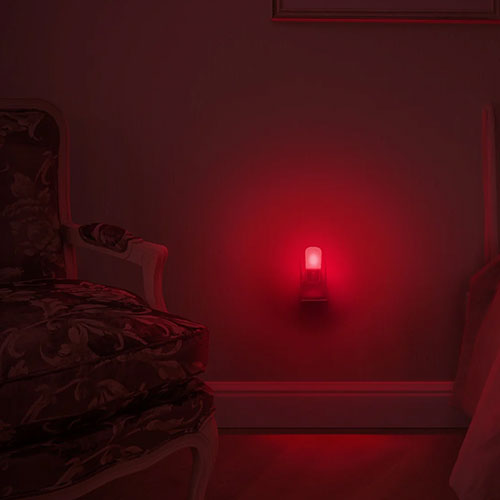
Red or amber disturbs melatonin least. What the research shows about light and sleep in young children, how bright is too bright, and whether a baby needs a night light at all.
Quick answer. If you use a night light, red or amber is the best color for a baby's room — not because it helps sleep, but because it interferes with it least. Melatonin, the hormone that signals night, is suppressed most by blue and cool-white light and least by long-wavelength red.1,2 Young children's eyes let more light through than adults', so their melatonin drops further and stays down longer after the same exposure.3 Brightness matters as much as color: a dim light of any warm tone beats a bright red one. And a newborn doesn't need a night light at all; it's for the parent, and later for a toddler with fears.
Key takeaways
- Red or amber, dim, low, and away from the crib is the whole answer for most families.
- No light color increases melatonin. Darkness does that. The question is which light suppresses it least, and the answer is long-wavelength red.1,2
- Blue and cool-white light — screens, LED bulbs above about 4000K, most "white" night lights — suppress melatonin most and delay sleep timing.2,4
- Preschool-age children showed strong melatonin suppression from evening light, and it stayed suppressed after the light went off.3 Assume a baby is more sensitive than you are, not less.
- Brightness matters, but less than most advice implies: in 3-to-5-year-olds, even 5 to 40 lux — night-light territory — suppressed melatonin by about 78%.6 A night light should still be dim enough that you can't read by it, and off when nobody needs it.
- Newborns don't need a night light. Older toddlers with fears often do, and a dim red one is the right compromise.
- There's no evidence that red light does anything specific for autistic children beyond what it does for every child.
What color night light is best for a baby?
Red, or amber. Both are long-wavelength light, and long wavelengths have the least effect on melatonin — the hormone the brain releases in darkness to signal that it's time to sleep.
| Color | Effect on melatonin | Verdict | Notes |
|---|---|---|---|
| Red | Least suppression of any visible color1 | Best | Looks odd at first; parents adjust in a week |
| Amber / orange | Low suppression; slightly more than red | Very good | Easier on the eye for reading a diaper |
| Warm white (≤2700K) | Moderate; contains some blue | Acceptable if very dim | Most "warm" LED night lights are this; keep them faint |
| Cool white (≥4000K) | High | Avoid | Most bulbs, most screens, most plug-in night lights |
| Blue | Highest1 | Avoid | Includes "calming" blue night lights and projectors |
The reason is physiology, not fashion. The cells in the retina that tell the brain about ambient light are most sensitive to short-wavelength (blue) light, around 460–480 nm, and least sensitive to long-wavelength red.1,5 Blue light at night tells the brain it's daytime. Red light barely registers as light at all on that channel, which is why it's the color that leaves melatonin alone.
Two caveats that matter more than the color chart. First, brightness: a bright red light still suppresses melatonin more than a dim warm-white one, because the retina responds to intensity as well as wavelength.4 Second, the baby's age: a newborn has no circadian rhythm to protect yet (see below), and a night light in the first weeks is for you.
Does red light help babies sleep — or just disturb it less?
Disturbs it less. That's a real benefit, and it's the honest way to say it.
No study has shown that a red night light makes babies fall asleep faster or sleep longer than they would in darkness. What the research shows is the opposite direction: light at night — especially blue-rich light — delays melatonin, delays sleep onset, and shifts the body clock later, and red light does this least.2,4 A red night light is the way to have some light in the room while giving up the least sleep to it.
So the comparison isn't "red light versus no night light." Darkness wins that one. The comparison is "red light versus the white or blue one you'd otherwise use," and red wins that comfortably.
One study is worth naming because it is often cited for more than it shows. Ten adult men were shown seven colors of light and fell asleep fastest under whichever color they personally preferred, not under any particular wavelength.10 It is a study about preference, in adults, and it is where a good deal of "the best color for sleep" writing traces back to. It says nothing about babies, and nothing about red.
Does red light increase melatonin?
No. This claim is everywhere, and it's wrong.
Melatonin is released by the pineal gland in response to darkness — the absence of the light signal from the retina. Light of any color can only suppress it, by more or less; no color stimulates it.5 Red light is the color that suppresses melatonin least, which is a very different thing from a color that produces it. Products marketed as "melatonin-boosting" red lights are selling the first thing under the name of the second.
The distinction matters practically. If red light boosted melatonin, more of it would be better. Because it merely disturbs melatonin least, less of it is better — dim, low, and off when it isn't needed.
Is blue or white light bad for baby sleep?
At night, yes — and children may be more affected than adults.
The best-known adult study compared reading on a light-emitting e-reader with reading a printed book before bed: the e-reader group had suppressed melatonin, took longer to fall asleep, had less REM sleep, and were less alert the next morning.2 The effect comes from short-wavelength light, which screens and cool-white LEDs emit heavily.
Children appear to be more sensitive. In a study of preschoolers aged 3 to 5, an hour of bright light in the evening suppressed melatonin substantially, and levels stayed suppressed for the better part of an hour after the light was turned off.3 A larger follow-up in the same age group is the more useful finding: 36 children aged 3 to 5 were given an hour of evening light at one of fifteen intensities from 5 to 5,000 lux, and melatonin was suppressed by 69% to 99% across the entire range, averaging 85%.6 The very dimmest levels tested — 5 to 40 lux, about what a night light gives off — still suppressed melatonin by an average of 78%. Dimming helps, but far less than the difference between having a light on and not. The likely reason is anatomical: young children's pupils are larger and their lenses clearer, so more light reaches the retina for the same room.
What that means in the nursery: a phone screen during a night feed, a bright white hallway light through the door, or a "soft white" LED night light that's brighter than it looks are all doing more than they seem. Warm, dim, and red or amber is the setting that respects a child's sensitivity rather than assuming they're a small adult.
Does a baby need a night light at all?
A newborn doesn't. Babies are born without a circadian rhythm — the internal day-night clock matures over the first months, with clear sleep-wake and hormone rhythms generally appearing after about two months, driven largely by the daily light-dark cycle.7 In those weeks a night light is for the parent: to feed, change, and check without turning on the overhead. A red or amber light, or a dim lamp with a red bulb, does that job.
A baby between three months and about two years doesn't either, and the case for darkness is strongest here, because this is when the body clock is consolidating. If you need to see, use the dimmest red light that lets you, and turn it off when you leave.
A toddler with fears often does. Fear of the dark tends to arrive between two and four, with imagination, and a child who can't sleep because the room is frightening isn't helped by the argument that darkness is better for melatonin. A dim red or amber night light is the compromise: enough to see the shapes in the room, little enough to leave melatonin mostly alone.
A parent doing night feeds does, for the first months at least — see placement below.
How bright should a baby's night light be?
Dim enough that you couldn't read by it, and dimmer than most night lights ship.
There's no official brightness standard for night lights, but the research gives a useful frame. The first preschool study used about 1,000 lux — far brighter than any night light — and suppressed melatonin by roughly 88%.3 The follow-up went down to 5 lux and still found about 78% suppression at the dimmest levels.6 So dimming is worth doing, but it buys less than it seems: the light being off buys much more. The goal is the least light, for the least time, that does the job.
- Moonlight is under 1 lux. That's the target for a light left on all night.
- A candle at arm's length is roughly 10 lux. That's the ceiling for a light you use while feeding or changing.
- A phone screen at normal brightness held near the face is far brighter than either, and blue-rich. Turn it face down or use a red screen filter during night feeds.
Practically: buy a night light with a dimmer or a low setting, and use the lowest one. If it has no dimmer and casts shadows across the room, it's too bright. Projector-style lights that throw stars on the ceiling are entertainment, not night lights; they're bright, they move, and they hold a child's attention — the opposite of what the room is for.
Where should the night light go?
Low, and out of the baby's line of sight from the crib.
- Behind a piece of furniture or below crib-mattress height, so the crib is lit indirectly and the child isn't looking at a light source.
- Near where you stand to feed or change, so you can see what you're doing without the crib being bright.
- Not on the ceiling, not on the crib, not on a shelf facing the mattress.
- On a timer if it's only for the bedtime routine, so it's off by the time the child is asleep.
- Away from the child's reach, with the cord managed, and nothing that gets warm.
A single dim red light low in the corner does more than two bright ones anywhere else.
What's the best night light color for toddlers?
The same: red or amber, dim. Two things change with a toddler.
The night light is now for the child, not the parent. A toddler who is afraid of the dark needs to see the room, and a red light shows shapes without color, which is enough for reassurance and still gentle on melatonin. If a child says red is "scary" — some do, because it's unfamiliar — amber is the fallback.
The bedtime routine matters more than the bulb. A toddler's sleep is far more affected by screens in the hour before bed, a bright bathroom during teeth-brushing, and an overhead light left on for stories than by the night light color. Dim the whole house in the last hour, do the routine under a lamp, and the night light becomes a detail. The sleep regressions page covers the toddler-fears stage.
Does red light help autistic children sleep?
There's no evidence that it helps autistic children in any way it doesn't help every child. Red light has not been tested as a sensory intervention in autism at all, and the products sold on that promise are ahead of the research.
What is true: autistic children have more sleep problems than other children, often have below-average melatonin levels or an abnormal melatonin rhythm, and are often over-responsive to light.8 For those children, the general rule applies with more force — a dark room, no blue light in the evening, and if a light is needed, the dimmest red or amber one. A child who is over-responsive to light may do better with none at all, or with a light on a timer that's off before they're asleep. The autism and sleep page covers the whole picture, including the honest evidence on melatonin supplements.
Can red light help with morning grogginess?
Possibly, in adults; not established in children.
One small study gave 30 adults red light through closed eyelids while they slept and on waking, and found better performance on some tasks than in dim light, though subjective sleepiness improved with time awake regardless of the light.9 The first author reports a pending patent on the light mask used. It's an interesting finding and a plausible one, since red light doesn't suppress melatonin the way a bright white alarm-clock light would while still signaling "awake." It hasn't been tested in children, and a baby's morning is better served by opening the curtains: daylight is the strongest signal the body clock has, and mornings are when it does the most good.7
How should I light the nursery, day and night?
Light is the body clock's main input. Using it deliberately does more for a baby's sleep than any product.
| Daytime | Evening (last hour) | Night | |
|---|---|---|---|
| Goal | Bright, natural light — sets the clock | Dim, warm — signals night is coming | Dark, or the dimmest red/amber |
| Do | Open blinds on waking; naps in daylight are fine; outdoor time daily | Lamps not overheads; warm bulbs; screens off; bath and stories under a dim lamp | Red night light, low, out of sight; phone face down or red-filtered during feeds |
| Avoid | Keeping the house dim all day; blackout naps for a newborn still building a rhythm | Overhead LEDs; a bright bathroom; TV in the background | Any white or blue light; turning on the overhead for a change; bright hallway light through an open door |
Blackout blinds are for night, not day: a newborn learns day from night by experiencing both. Once the rhythm is established (around three months), blackout helps with early waking and summer bedtimes.
---
Frequently asked questions
What is the best night light color for a baby?
Red or amber. Long-wavelength light suppresses melatonin least, so it's the color that interferes with sleep the least. Keep it dim and low. No color helps sleep more than darkness does.
Does red light help babies sleep?
It disturbs sleep less than white or blue light does. It doesn't help sleep more than darkness; it's the best choice if you need light in the room.
Does red light increase melatonin?
No. Only darkness does. Light of any color suppresses melatonin by more or less; red suppresses it least. Products that claim to "boost" melatonin with red light are describing that mistakenly.
Is a white night light bad for babies?
Cool-white is; it contains a lot of blue, which suppresses melatonin most. A very dim warm-white light is acceptable but red or amber is better.
Do newborns need a night light?
No. Newborns don't have a body clock yet, and a night light in the first weeks is for the parent's convenience during feeds. Use a dim red or amber one for that.
What color night light is best for a toddler?
Red or amber, dim. A toddler afraid of the dark needs to see the room, and a red light shows shapes with the least effect on melatonin. If red seems scary, amber.
How bright should a night light be?
Dim enough that you couldn't read by it — under moonlight brightness if left on all night, no brighter than a candle at arm's length for feeds. Use the lowest setting.
Where should I put the night light?
Low, behind furniture or below mattress height, near where you stand to feed, and out of the crib's line of sight. Never on the crib or facing the mattress.
Does red light help autistic children sleep?
No evidence for anything specific to autism. Autistic children are often more sensitive to light, so the general rule — dark, no blue light in the evening, dimmest red or amber if any — applies with more force.
Is blue light bad for my baby at night?
Yes. Blue and cool-white light suppress melatonin most and delay sleep timing, and young children appear more sensitive than adults. Screens during night feeds are the common culprit.
Sources
- Brainard GC, Hanifin JP, Greeson JM, et al. Action spectrum for melatonin regulation in humans: evidence for a novel circadian photoreceptor. Journal of Neuroscience. 2001;21(16):6405–6412. Peak melatonin suppression at short wavelengths (~446–477 nm); minimal at long wavelengths. doi:10.1523/JNEUROSCI.21-16-06405.2001
- Chang AM, Aeschbach D, Duffy JF, Czeisler CA. Evening use of light-emitting eReaders negatively affects sleep, circadian timing, and next-morning alertness. PNAS. 2015;112(4):1232–1237. Suppressed melatonin, delayed sleep onset, reduced REM, and reduced morning alertness after evening exposure to blue-rich screen light. doi:10.1073/pnas.1418490112
- Akacem LD, Wright KP Jr, LeBourgeois MK. Sensitivity of the circadian system to evening bright light in preschool-age children. Physiological Reports. 2018;6(5):e13617. PMID 29504270. Ten preschool-age children (mean 4.3 years); one hour of ~1,000 lux evening light suppressed melatonin by 87.6 ± 10.0%, and levels remained attenuated 50 minutes after the light ended. doi:10.14814/phy2.13617
- Thapan K, Arendt J, Skene DJ. An action spectrum for melatonin suppression: evidence for a novel non-rod, non-cone photoreceptor system in humans. Journal of Physiology. 2001;535(1):261–267. Independent confirmation of short-wavelength peak sensitivity and of the intensity-response relationship. doi:10.1111/j.1469-7793.2001.t01-1-00261.x
- Berson DM, Dunn FA, Takao M. Phototransduction by retinal ganglion cells that set the circadian clock. Science. 2002;295(5557):1070–1073. The melanopsin-containing retinal ganglion cells that signal ambient light to the circadian system. doi:10.1126/science.1067262
- Hartstein LE, Diniz Behn C, Wright KP Jr, Akacem LD, Stowe SR, LeBourgeois MK. High sensitivity of melatonin suppression response to evening light in preschool-aged children. Journal of Pineal Research. 2022;72(2):e12780. PMID 34997782. Thirty-six children aged 3.0–4.9 years, one hour of evening light at fifteen intensities from 5 to 5,000 lux. Melatonin was suppressed 69.4–98.7% (mean 85.4%) across the whole range, with no overall intensity-dependent response; the lowest quartile, 5–40 lux, still averaged 77.5% suppression. A 2023 correction to this paper (doi:10.1111/jpi.12903) restored an omitted funding statement; the data are unchanged. doi:10.1111/jpi.12780
- Rivkees SA. Developing circadian rhythmicity in infants. Pediatrics. 2003;112(2):373–381. PMID 12897290. Review. Pronounced sleep-wake and hormone rhythms generally develop after two months of age, and cycled lighting establishes rest-activity patterns in phase with the 24-hour light-dark cycle. doi:10.1542/peds.112.2.373
- Rossignol DA, Frye RE. Melatonin in autism spectrum disorders: a systematic review and meta-analysis. Developmental Medicine & Child Neurology. 2011;53(9):783–792. PMID 21518346. Systematic review of 35 studies. Of the nine that measured melatonin in ASD, all reported at least one abnormality — below-average physiological levels in seven and an abnormal circadian rhythm in four. doi:10.1111/j.1469-8749.2011.03980.x
- Figueiro MG, Sahin L, Roohan C, Kalsher M, Plitnick B, Rea MS. Effects of red light on sleep inertia. Nature and Science of Sleep. 2019;11:45–57. PMID 31118850. Thirty adults (mean age 30.4), crossover design. Performance on some tasks was significantly better with red light delivered through closed eyelids than with dim light; subjective sleepiness fell with time awake in every condition. The first author reports a pending patent on the light mask. doi:10.2147/NSS.S195563
- Cho JR, Joo EY, Koo DL, Hong SB, Lee JH, et al. Effect of color light stimulation using LED on sleep induction time. Journal of Healthcare Engineering. 2017;2017:6030268. doi:10.1155/2017/6030268. Ten adult men (mean age 26) shown seven colors of light; sleep onset was shortest under each participant's preferred color rather than under any particular wavelength. The paper makes no claim about red light or about circadian rhythm, and does not involve children. ncbi.nlm.nih.gov. Checked September 3, 2026.
Medical disclaimer. This page is for general educational purposes and does not constitute medical advice, diagnosis, or treatment.