
Sensory processing
Sensory Processing Books for Parents and Kids
The books parents ask about most, what each covers and who it suits, picture books for children, and what the research says about the claims inside them.
- Expert Reviewed
- Plain Language
- Patient Focused

Three guides answer most parents’ questions: Carol Stock Kranowitz’s The Out-of-Sync Child, Lucy Jane Miller’s Sensational Kids and Lindsey Biel and Nancy Peske’s Raising a Sensory Smart Child. Treat them as practical help, not medical evidence: sensory processing disorder is not in the DSM-5-TR, and the American Academy of Pediatrics advises against diagnosing it.1,2,3,4,5
Which book first?
Families who want ideas for play at home, ideally chosen with your child’s occupational therapist.17
Parents of tweens and teens, and older teens themselves.21
Sam’s over-sensitivity disrupts his day at home and school until his teacher suggests an occupational therapist; told from Sam’s point of view.11
Key takeaways
- The Out-of-Sync Child (first published 1998, third edition 2022) is the long-standing general introduction; its subtitle now says “sensory processing differences”.6,7
- Sensational Kids (revised 2014) is by an occupational therapist who founded an SPD research program, and covers the four subtypes she describes.2,8
- Raising a Sensory Smart Child (revised 2009 and 2018) is the most practical handbook, by a pediatric occupational therapist and a parent.3,9
- The Everything Parent’s Guide to Sensory Processing Disorder (Adams Media, 2014) exists in print and as an ebook; a library is the free legal way to read it.10
- Picture books such as Sensitive Sam and Why Does Izzy Cover Her Ears? give young children words for what they feel.11,12
- Sensory processing disorder is not in the DSM-5-TR or ICD-11; sensory reactivity is one possible feature of autism.4,13
- The American Academy of Pediatrics calls research on sensory integration therapy limited and inconclusive, and a UK randomized trial of 138 autistic children found no benefit on its main outcome.5,14
What are the best books for parents of kids with sensory processing issues?
Start with one general guide and one practical handbook, then add a picture book if your child is young. The table sums up who each book suits; every entry below gives the author, edition, publisher, what it covers and a note on its evidence.1,3
| Book | Author | Edition and year | Best for | Format |
|---|---|---|---|---|
| The Out-of-Sync Child | Carol Stock Kranowitz | Third edition, 2022 | A broad first introduction for parents and professionals.1 | Overview |
| Sensational Kids | Lucy Jane Miller | Revised edition, 2014 | The SPD subtypes, assessment and treatment, from an occupational therapist who founded an SPD research program.2,8 | Researcher’s framework |
| Raising a Sensory Smart Child | Lindsey Biel and Nancy Peske | 2005; revised 2009 and 2018 | Daily routines, school advocacy and a long list of practical strategies, from a pediatric occupational therapist and a parent.3,9 | Practical handbook |
| The Everything Parent’s Guide to Sensory Processing Disorder | Terri Mauro | 2014 | An overview of information and treatment options, technically reviewed by an occupational therapist.10 | Guide, in print and as an ebook |
| The Sensory-Sensitive Child | Karen A. Smith and Karen R. Gouze | 2004 | Parents whose main worry is behavior at home.15 | Practical solutions |
| Sensory Integration and the Child | A. Jean Ayres | 1979; 25th anniversary edition 2005 | Parents who want the theory behind sensory integration therapy.16 | Theory |
| The Out-of-Sync Child Has Fun | Carol Stock Kranowitz | 2003; revised edition 2006 | More than 100 play activities to try at home.17 | Play activities |
| Raising Kids With Sensory Processing Disorders | Rondalyn V. Whitney and Varleisha D. Gibbs | 2014; second edition 2020 | Parents who want a structured plan to work through one week at a time.18 | Week-by-week guide |
| Understanding Your Child’s Sensory Signals | Angie Voss | 2011 | Parents and teachers who want a short daily reference.19 | Daily reference |
| Answers to Questions Teachers Ask about Sensory Integration | Jane Koomar and colleagues | 2007 | A book to give your child’s teacher.20 | Answers to teachers’ questions |
| The Out-of-Sync Child Grows Up | Carol Stock Kranowitz | 2016 | Tweens, teens and young adults, with first-person accounts.21 | First-person accounts |
| Too Loud, Too Bright, Too Fast, Too Tight | Sharon Heller | 2002 | Adults who are sensory defensive, including parents who recognize themselves.22 | Self-help |
| Not Just Spirited | Chynna T. Laird | 2010 | Parents who want company more than instructions.23 | Memoir |
| The Sensory Processing Diet | Chynna T. Laird | 2020 | Parents curious about one mother’s approach, which is not a tested treatment.24 | A mother’s program |
| Sensitive Sam and Why Does Izzy Cover Her Ears? | Marla Roth-Fisch; Jennifer Veenendall | 2009 | Reading with a young child who is easily overwhelmed.11,12 | Picture books |
Which books explain sensory processing to parents?
These six explain what sensory processing differences are, how they show up, and what families and therapists do about them. They are written for parents, and several are by occupational therapists.2,3,10
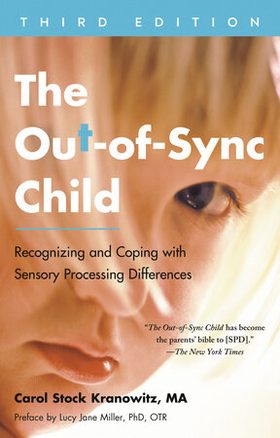
The Out-of-Sync Child by Carol Stock Kranowitz
- Details
- Third edition, TarcherPerigee (Penguin Random House), 2022, with a foreword by Lucy Jane Miller; first published by Perigee in 1998 and revised in 2005.6,7,25
- What it covers
- Over- and under-responsiveness to touch, movement, sound and other senses, sensory craving, poor sensory discrimination and motor problems, with expanded material on look-alikes such as learning disabilities, ADHD and autism.1
- Who it suits
- Parents who want one readable overview. Kranowitz was a preschool teacher for more than 25 years and has a master’s degree in education and human development.1
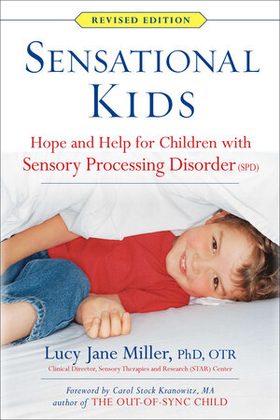
Sensational Kids by Lucy Jane Miller
- Details
- Written with Doris A. Fuller; G.P. Putnam’s Sons, 2006; revised edition, Tarcher (Penguin Random House), 2014.2,8
- What it covers
- The four major subtypes of sensory processing disorder Miller describes, assessment and diagnosis, and treatment options, with the revised edition adding research on its relationship to autism.2,8
- Who it suits
- Parents who want the researcher’s framework. Miller, PhD, OTR, founded the SPD research program the publisher describes as the only nationwide one.2
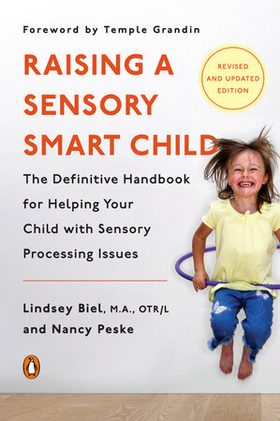
Raising a Sensory Smart Child by Lindsey Biel and Nancy Peske
- Details
- Penguin Books, 2005; revised in 2009 and again in 2018, with a foreword by Temple Grandin.3,9,27
- What it covers
- Everyday routines from tooth brushing to holidays, sensitivities to noise and textures, “sensory diet” activities, behavior, school advocacy, technology, and where to find professional help.3
- Who it suits
- Parents who want a long, practical handbook. Biel is a pediatric occupational therapist; Peske is a parent whose son was diagnosed with sensory integration dysfunction at two.3
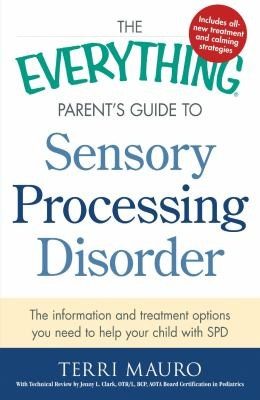
The Everything Parent’s Guide to Sensory Processing Disorder by Terri Mauro
- Details
- Adams Media, Avon, Massachusetts, 2014, in print and as an ebook, with technical review by occupational therapist Jenny L. Clark. It follows Mauro’s 2006 Everything Parent’s Guide to Sensory Integration Disorder, technically reviewed by Sharon A. Cermak.10,28
- What it covers
- In its subtitle’s words, “the information and treatment options you need to help your child with SPD”.10
- Who it suits
- Parents who want information and treatment options gathered in one book.10
Evidence note: Treat the treatment chapters as options to discuss with your child’s clinicians: the AAP says sensory-based therapy may be one component of a comprehensive plan.5
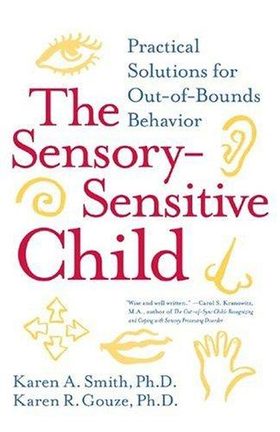
The Sensory-Sensitive Child by Karen A. Smith and Karen R. Gouze
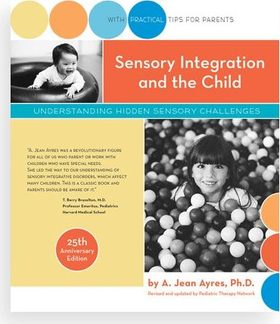
Sensory Integration and the Child by A. Jean Ayres
- Details
- Western Psychological Services, 1979; 25th anniversary edition, revised and updated by Pediatric Therapy Network, 2005.29
- What it covers
- Its publisher calls Ayres “the originator of sensory integration theory”; the book explains sensory integrative dysfunction, how to recognize it and what to do about it.16
- Who it suits
- Parents who want the theory behind sensory integration therapy; its publisher says it helps communication between therapist, parents and teachers.16
Evidence note: In a UK randomized trial of 138 autistic children with sensory difficulties, manualized sensory integration therapy showed no significant effect on problem behaviors at 6 or 12 months, though carers and therapists reported better daily functioning.14
Which sensory processing books have activities and everyday strategies?
These are the books to keep on the kitchen shelf: activity ideas and routines rather than explanation.17,18
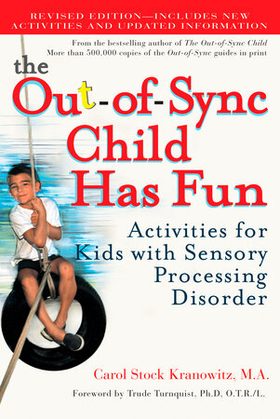
The Out-of-Sync Child Has Fun by Carol Stock Kranowitz
- Details
- Berkley, 2003; revised edition, Tarcher (Penguin Random House), 2006.17
- What it covers
- More than 100 play activities for touch, balance, movement, body position, vision, hearing and motor planning.17
- Who it suits
- Families who want ideas for play at home, ideally chosen with your child’s occupational therapist.17
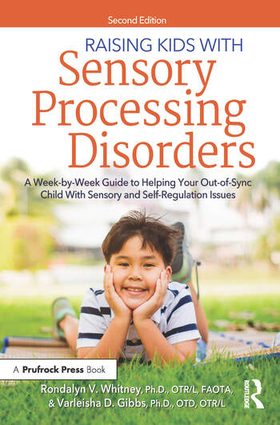
Raising Kids With Sensory Processing Disorders by Rondalyn V. Whitney and Varleisha D. Gibbs
- Details
- Prufrock Press, 2014; second edition 2020. Both authors are occupational therapists with doctoral degrees.18
- What it covers
- A week-by-week guide to everyday sensory issues such as homework, field trips, transitions, bedtime and holidays.18
- Who it suits
- Parents who want a structured plan to work through one week at a time.18
Understanding Your Child’s Sensory Signals by Angie Voss
- Details
- Self-published through CreateSpace, 2011; the author’s site lists third and fourth editions.19,30
- What it covers
- Reading behavior as a “sensory signal”, the author’s term for a clue in how a child reacts to their surroundings, and what to do in response.30
- Who it suits
- Parents and teachers who want a short daily reference.19
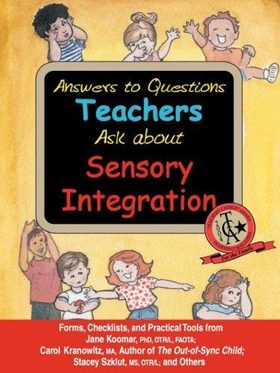
Answers to Questions Teachers Ask about Sensory Integration by Jane Koomar and colleagues
Are there books about sensory processing for teens and adults?
Yes, two stand out: one for teenagers and young adults, and one for adults who are sensory defensive.21,22
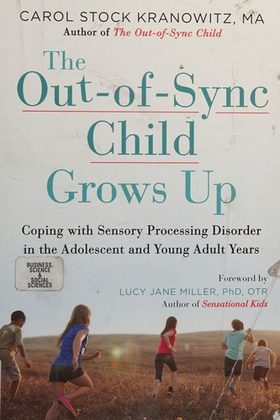
The Out-of-Sync Child Grows Up by Carol Stock Kranowitz
- Details
- TarcherPerigee (Penguin Random House), 2016, with a foreword by Lucy Jane Miller.21
- What it covers
- Grooming, social life and dating, sports and music, and finding support, with first-person accounts from adolescents and teens.21
- Who it suits
- Parents of tweens and teens, and older teens themselves.21
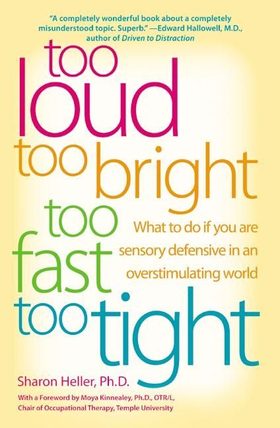
Too Loud, Too Bright, Too Fast, Too Tight by Sharon Heller
Are there memoirs by parents of children with sensory processing disorder?
Yes. Chynna T. Laird has written two books from a mother’s point of view, and they describe one family’s experience rather than a tested method.23,24
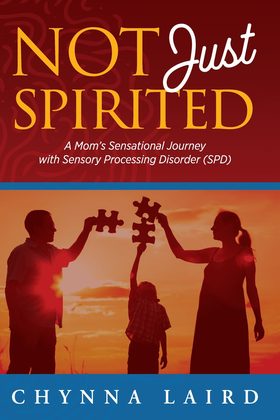
Not Just Spirited by Chynna T. Laird
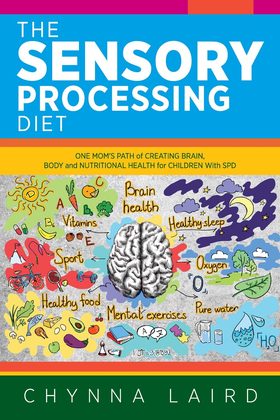
The Sensory Processing Diet by Chynna T. Laird
- Details
- Loving Healing Press, 2020.24
- What it covers
- The publisher says it is “not just about nutrition” but a whole program for a child with sensory processing disorder.24
Evidence note: The Library of Congress catalogs it under alternative treatment, diet therapy and popular works; read it as one mother’s approach, not a tested treatment.24
What are good books for kids about sensory processing?
Picture books give a child words for what they feel, and the sense that other children feel it too. Most are short, illustrated stories told from the child’s point of view, several with discussion questions for adults.11,12,31
| Cover | Book | What it is |
|---|---|---|
| Sensitive SamMarla Roth-Fisch (Future Horizons, 2009)Children’s book | Sam’s over-sensitivity disrupts his day at home and school until his teacher suggests an occupational therapist; told from Sam’s point of view.11 | |
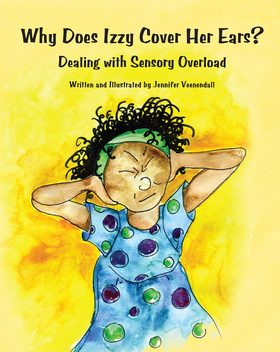 | Why Does Izzy Cover Her Ears?Jennifer Veenendall (Autism Asperger Publishing, 2009)Ages 5–10 | Sensory overload at home and school, the tools that help, and discussion questions.12 |
 | Arnie and His School ToolsJennifer Veenendall (Autism Asperger Publishing, 2008)Children’s book | A boy describes the sensory tools and strategies he uses at school and at home, in simple language.31 |
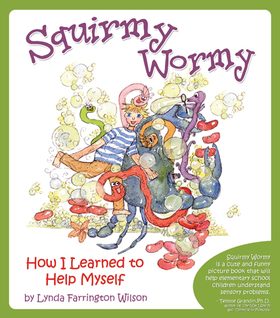 | Squirmy WormyLynda Farrington Wilson (Sensory World, 2009)Children’s book | Tyler, who has autism and sensory processing disorder, learns ways to cope: “How I learned to help myself.”32 |
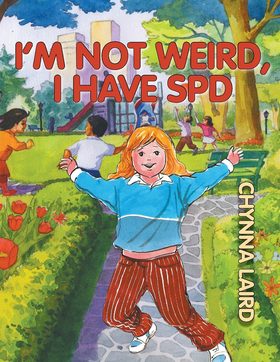 | I’m Not Weird, I Have Sensory Processing Disorder (SPD)Chynna T. Laird (Loving Healing Press, 2nd ed., 2012)Ages 5–8 | Alexandra’s story, written by a parent.33 |
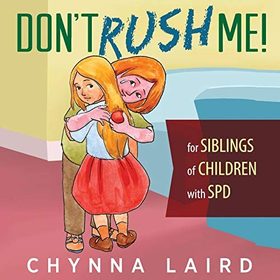 | Don’t Rush Me!Chynna T. Laird (Loving Healing Press, 2018)Ages 5–8 | For brothers and sisters of a child with sensory processing difficulties.34 |
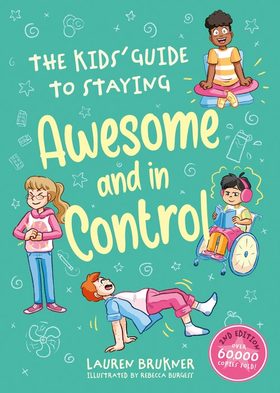 | The Kids’ Guide to Staying Awesome and In ControlLauren Brukner (Jessica Kingsley, 2014; 2nd ed., 2025)Ages 7–14 | Simple strategies to help children regulate their emotions and senses, for children to use themselves.35 |
Read it together the first time. A story about a child who covers their ears can start a conversation about what helps your own child, and the discussion questions in some of these books are written for that.12,31
Is there a free PDF of The Everything Parent’s Guide to Sensory Processing Disorder?
Not from the publisher: the 2014 book is sold in print and as an ebook, and the free legal way to read it is through a library. Its Library of Congress record lists a print ISBN, 9781440574566, and an ebook ISBN, 9781440574573, which your library can use to find or order it.10 DrSensory does not link to download sites for books still under copyright.
Ways to read it without buying it:
- Search your public library’s catalog for the print book and for the ebook edition.
- If your library does not have it, ask about interlibrary loan, or ask the library to buy it.
- Look for the earlier 2006 book by the same author, The Everything Parent’s Guide to Sensory Integration Disorder, which libraries may hold under that title.28
Is sensory processing disorder a recognized diagnosis?
Not in the main diagnostic manuals. Sensory processing disorder is not recognized in the DSM-5-TR or ICD-11; unusual reactions to sensory input appear in the DSM-5 criteria as one possible feature of autism.4,13
The American Academy of Pediatrics says it is unclear whether these problems are a separate disorder or part of other conditions, and that because there is no universally accepted framework for diagnosis, sensory processing disorder generally should not be diagnosed. It notes that difficulty processing sensory information is seen in autism, ADHD, developmental coordination disorder and childhood anxiety.5
On treatment, the AAP says occupational therapy with sensory-based therapies may be one part of a comprehensive plan but that the research is limited and inconclusive.5 In the SenITA trial, which randomized 138 autistic children with sensory difficulties, sensory integration therapy had no significant effect on problem behaviors at 6 or 12 months, although carers and therapists reported better daily functioning.14
What that means for these books: the everyday difficulties they describe are real for many families, and their practical ideas can help; their claims about diagnosis, prevalence and treatment go further than the evidence.5,26
How do you choose a good book about sensory processing?
Look at who wrote it, which edition it is, and what it promises. The checklist below turns that into four questions.5,7
Before you buy or borrow:
- Who wrote it: an occupational therapist or researcher, a teacher, or a parent? Each brings something different, and the publisher’s page usually says.1,3
- Is it the newest edition? Terms have changed: The Out-of-Sync Child’s subtitle went from “sensory integration dysfunction” (1998) to “sensory processing disorder” (2005) to “sensory processing differences” (2022).6,7,25
- Does it suggest a full evaluation? The AAP says other developmental and behavioral conditions must always be considered.5
- Does it tell you how to judge whether something is working? The AAP suggests a trial period and evaluating the effect of any therapy.5
Where can parents get help beyond books?
If sensory reactions are getting in the way of eating, sleep, dressing, school or friendships, talk to your child’s doctor. The AAP advises a thorough evaluation that considers conditions such as autism, ADHD, developmental coordination disorder and anxiety, and sensory-based therapies are used mainly by occupational therapists.5
Frequently asked questions
What is the best book for parents of a child with sensory processing disorder?
There is no single best one. The Out-of-Sync Child is the long-standing general introduction, in its third edition since 2022; Raising a Sensory Smart Child is the most detailed practical handbook; Sensational Kids gives an occupational therapist-researcher's framework.2,3,7
Is The Everything Parent's Guide to Sensory Processing Disorder available as an ebook?
Yes. Its Library of Congress record lists an ebook ISBN, 9781440574573, alongside the print ISBN, 9781440574566, so libraries and booksellers can find the ebook edition.10
Which books on sensory processing are written by occupational therapists?
Raising a Sensory Smart Child (Lindsey Biel, OTR/L, with parent Nancy Peske), Sensational Kids (Lucy Jane Miller, PhD, OTR) and Raising Kids With Sensory Processing Disorders (Rondalyn V. Whitney and Varleisha D. Gibbs, both OTR/L).2,3,18
Is The Out-of-Sync Child still worth reading?
Yes, in its latest edition. The 2022 third edition was revised and updated, with expanded material on look-alikes such as ADHD, learning disabilities and autism.1,7
Is there a book to help siblings understand sensory processing disorder?
Yes. Don't Rush Me! by Chynna T. Laird (Loving Healing Press, 2018) is written for siblings of children with sensory processing disorder.34
Does the American Academy of Pediatrics recognize sensory processing disorder?
No. Its 2012 policy statement says that because there is no universally accepted framework for diagnosis, sensory processing disorder generally should not be diagnosed, and that a thorough evaluation should consider other conditions.5
What is a sensory diet?
In these books, a sensory diet means planned daily activities chosen to meet a child's sensory needs, not a food plan; Laird's The Sensory Processing Diet is the exception that adds nutrition.3,24
Can a book replace an occupational therapy evaluation?
No. Books can help you understand and support your child, but the AAP advises a thorough evaluation, and occupational therapy, where it is used, works best as part of a broader plan.5
Related on DrSensory
Sources
- Penguin Random House. The Out-of-Sync Child, Third Edition (publisher’s page). Published April 19, 2022, by Tarcher. Checked October 22, 2026.
Show the passageHide the passage
“Carol Stock Kranowitz, M.A., has been a preschool teacher for more than 25 years.” The book “offers comprehensive, clear information for parents and professionals–and a drug-free treatment approach for children”; “This revised edition includes expanded information about SPD ‘look-alikes,’ including Learning Disabilities, ADHD, and autism”. - Penguin Random House. Sensational Kids, revised edition (publisher’s page). Published May 6, 2014, by Tarcher. “Lucy Jane Miller, Ph.D., OTR, is the founder of the only nationwide comprehensive SPD research program”; “this revised edition will include the latest research on SPD’s relationship to autism, as well as new treatment options and coping strategies”. Checked October 22, 2026.
- Penguin Random House. Raising a Sensory Smart Child (publisher’s page). Checked October 22, 2026.
Show the passageHide the passage
“Lindsey Biel, M.A., OTR/L, is an occupational therapist specializing in pediatrics.” Nancy Peske “lives in Shorewood, Wisconsin, with her son, who was diagnosed with SI dysfunction when he was two.” Foreword by Temple Grandin. Topics include “Ways to advocate for your child at school” and “Where to get the best professional help and complementary therapies”. - Valencia M, D’Ocon A, Plata R, Simó S, Cantero MJ. Internalizing/externalizing problems and sensory processing alteration in children referred to child mental health centers. Children (Basel). 2025;12(6):664. doi:10.3390/children12060664 (PMID 40564622). “Despite this body of evidence, SPD is not recognized in diagnostic classification systems such as the DSM-5-TR or ICD-11.” Checked October 22, 2026.
- Section on Complementary and Integrative Medicine; Council on Children with Disabilities; American Academy of Pediatrics; Zimmer M, Desch L. Sensory integration therapies for children with developmental and behavioral disorders. Pediatrics. 2012;129(6):1186–1189. doi:10.1542/peds.2012-0876 (PMID 22641765). Checked October 22, 2026.
Show the passageHide the passage
“Because there is no universally accepted framework for diagnosis, sensory processing disorder generally should not be diagnosed.” “Occupational therapy with the use of sensory-based therapies may be acceptable as one of the components of a comprehensive treatment plan. However, parents should be informed that the amount of research regarding the effectiveness of sensory integration therapy is limited and inconclusive.” - Kranowitz CS. The Out-of-Sync Child: Recognizing and Coping with Sensory Integration Dysfunction. 1st ed. New York: Perigee; 1998. Library of Congress catalog record, LCCN 97014601. “A Skylight Press book.” Checked October 22, 2026.
- Kranowitz CS. The Out-of-Sync Child: Recognizing and Coping with Sensory Processing Differences. Third edition. New York: TarcherPerigee, an imprint of Penguin Random House; 2022. Library of Congress catalog record, LCCN 2022287676. Statement of responsibility: “Carol Stock Kranowitz, M.A. ; foreword by Lucy Jane Miller, Ph. D., OTR.” Checked October 22, 2026.
- Miller LJ, Fuller DA. Sensational Kids: Hope and Help for Children with Sensory Processing Disorder (SPD). New York: G.P. Putnam’s Sons; 2006. Library of Congress catalog record, LCCN 2005056490. Checked October 22, 2026.
Show the passageHide the passage
Statement: “Lucy Jane Miller, with Doris A. Fuller.” Publisher description in the record: “Sensory Processing Disorder, a complex brain disorder, affects one in twenty children.” “Dr. Miller identifies the disorder and its four major subtypes, provides insight into assessment and diagnosis, and suggests treatment options and strategies”. - Biel L, Peske N. Raising a Sensory Smart Child: The Definitive Handbook for Helping Your Child with Sensory Processing Issues. Revised edition. New York: Penguin Books; 2018. Library of Congress catalog record, LCCN 2018019812. “Revised edition of the authors’ Raising a sensory smart child, 2009.” Checked October 22, 2026.
- Mauro T. The Everything Parent’s Guide to Sensory Processing Disorder: The Information and Treatment Options You Need to Help Your Child with SPD. Avon, MA: Adams Media; 2014. Library of Congress catalog record, LCCN 2013051352. Checked October 22, 2026.
Show the passageHide the passage
Statement: “Terri Mauro ; with technical review by Jenny L. Clark, OTR/L, BCP, AOTA Board Certification in Pediatrics.” ISBN 9781440574566; ebook ISBN 9781440574573. - Roth-Fisch M. Sensitive Sam. Arlington, TX: Future Horizons; 2009. Library of Congress catalog record, LCCN 2011280723. “At the suggestion of Sam’s teacher, his parents take Sam to see an occupational therapist.” Checked October 22, 2026.
- Veenendall J. Why Does Izzy Cover Her Ears? Dealing with Sensory Overload. Shawnee Mission, KS: Autism Asperger Publishing; 2009. Library of Congress catalog record, LCCN 2009924242. “Includes discussion questions.” Audience: “Ages 5-10.” Checked October 23, 2026.
- Centers for Disease Control and Prevention. Clinical testing and diagnosis for autism spectrum disorder. Among the DSM-5 criteria for autism: “Hyper- or hyporeactivity to sensory input or unusual interest in sensory aspects of the environment”. Checked October 22, 2026.
- Randell E, Wright M, Milosevic S, Gillespie D, Brookes-Howell L, Busse-Morris M, et al. Sensory integration therapy for children with autism and sensory processing difficulties: the SenITA RCT. Health Technology Assessment. 2022;26(29):1–140. doi:10.3310/TQGE0020 (PMID 35766242). Checked October 22, 2026.
Show the passageHide the passage
“A total of 138 participants were randomised”; “There were no significant main effects of the intervention at 6 or 12 months.” “Carers and therapists reported improvement in daily functioning.” - Smith KA, Gouze KR. The Sensory-Sensitive Child: Practical Solutions for Out-of-Bounds Behavior. 1st ed. New York: HarperResource; 2004. Library of Congress catalog record, LCCN 2003056767. Checked October 22, 2026.
- WPS (Western Psychological Services). Sensory Integration and the Child, 25th Anniversary Edition (publisher’s page). “This classic handbook, from the originator of sensory integration theory, is now available in an updated, parent-friendly edition.” It “explains sensory integrative dysfunction, how to recognize it, and what to do about it.” Checked October 22, 2026.
- Penguin Random House. The Out-of-Sync Child Has Fun, Revised Edition (publisher’s page). Published August 1, 2006, by Tarcher; first edition Berkley, 2003 (Library of Congress LCCN 2002025232). It “includes more than one hundred playful activities specially designed for kids with SPD.” Checked October 22, 2026.
- Whitney RV, Gibbs VD. Raising Kids with Sensory Processing Disorders: A Week-by-Week Guide to Helping Your Out-of-Sync Child with Sensory and Self-Regulation Issues. Second edition. Waco, TX: Prufrock Press; 2020. Library of Congress catalog record, LCCN 2020037153. Checked October 22, 2026.
Show the passageHide the passage
Statement: “Rondalyn V. Whitney, Ph.D., OTR/L, FAOTA & Varleisha D. Gibbs, Ph.D., OTD, OTR/L.” First edition 2014 (LCCN 2013025385). - Open Library (Internet Archive) edition record. Understanding Your Child’s Sensory Signals: A Practical Daily Use Handbook for Parents and Teachers. Angie Voss; CreateSpace Independent Publishing Platform; published September 12, 2011; 130 pages; ISBN 9781466263536. Checked October 22, 2026.
- Koomar J, et al. Answers to Questions Teachers Ask about Sensory Integration (Including Sensory Processing Disorder). Arlington, TX: Future Horizons; Watertown, MA: OTA-Watertown; 2007. Library of Congress catalog record, LCCN 2011280762. Checked October 22, 2026.
- Penguin Random House. The Out-of-Sync Child Grows Up (publisher’s page). Published May 24, 2016, by Tarcher; foreword by Lucy Jane Miller. It offers “information and advice for tweens, teens, and young adults living with Sensory Processing Disorder, and their parents”, and “Carol Kranowitz’s insights are supplemented by first-person accounts of adolescents and teens with SPD”. Checked October 22, 2026.
- Heller S. Too Loud, Too Bright, Too Fast, Too Tight: What to Do If You Are Sensory Defensive in an Overstimulating World. 1st ed. New York: HarperCollins; 2002. Library of Congress catalog record, LCCN 2001058335. Checked October 22, 2026.
- Laird CT. Not Just Spirited: One Mother’s Sensational Journey with Sensory Processing Disorder (SPD). Ann Arbor, MI: Loving Healing Press; 2010. Library of Congress catalog record, LCCN 2009035454. Checked October 22, 2026.
- Laird CT. The Sensory Processing Diet: One Mom’s Path of Creating Brain, Body and Nutritional Health for Children with SPD. Ann Arbor, MI: Loving Healing Press; 2020. Library of Congress catalog record, LCCN 2020027614. Checked October 22, 2026.
Show the passageHide the passage
Subject headings include “Alternative treatment”, “Diet therapy” and “Popular works”. Publisher’s summary: “The Sensory Diet is not just about nutrition, it prescribes a complete program to address all of the needs of a child growing up with Sensory Processing Disorder (SPD)”. - Kranowitz CS. The Out-of-Sync Child: Recognizing and Coping with Sensory Processing Disorder. Rev. and updated ed. New York: A Skylight Press Book/A Perigee Book; 2005. Library of Congress catalog record, LCCN 2006273516. Checked October 22, 2026.
- Ahn RR, Miller LJ, Milberger S, McIntosh DN. Prevalence of parents’ perceptions of sensory processing disorders among kindergarten children. American Journal of Occupational Therapy. 2004;58(3):287–293. doi:10.5014/ajot.58.3.287 (PMID 15202626). Checked October 22, 2026.
Show the passageHide the passage
“A total of 703 completed surveys were returned”; “based on parents’ perceptions, 5.3% (96 of 1796) of the kindergarten enrollment met screening criteria for sensory processing disorders.” “Findings suggest a need for rigorous epidemiological studies of sensory processing disorders.” - Biel L, Peske N. Raising a Sensory Smart Child: The Definitive Handbook for Helping Your Child with Sensory Integration Issues. New York: Penguin Books; 2005. Library of Congress catalog record, LCCN 2004053540. Checked October 22, 2026.
- Mauro T. The Everything Parent’s Guide to Sensory Integration Disorder: Get the Right Diagnosis, Understand Treatments, and Advocate for Your Child. Avon, MA: Adams Media; 2006. Library of Congress catalog record, LCCN 2006032599. Statement: “Terri Mauro, with technical review by Sharon A. Cermak.” Checked October 22, 2026.
- Ayres AJ. Sensory Integration and the Child: Understanding Hidden Sensory Challenges. 25th anniversary ed., revised and updated by Pediatric Therapy Network. Los Angeles: WPS; 2005. Library of Congress catalog record, LCCN 2004114169. Statement: “by A. Jean Ayres, with assistance from Jeff Robbins.” First edition: Western Psychological Services, 1979 (LCCN 83173110). Checked October 22, 2026.
- Voss A. A Sensory Life. Books (author’s site). “A sensory signal is a hint, clue, or indicator given by a child’s behavior or reaction to the environment or surroundings.” “Both 3rd and 4th editions are available for purchase!” Checked October 22, 2026.
- Veenendall J. Arnie and His School Tools: Simple Sensory Solutions That Build Success. Shawnee Mission, KS: Autism Asperger Publishing; 2008. Library of Congress catalog record, LCCN 2007939600. “Written from Arnie’s point of view, the book uses simple language to describe some of the sensory tools and strategies he uses at school and at home”. Checked October 22, 2026.
- Wilson LF. Squirmy Wormy. Arlington, TX: Sensory World; 2009. Library of Congress catalog record, LCCN 2011280706. “Tyler has autism and sensory processing disorder”; cover line “How I learned to help myself”. Checked October 22, 2026.
- Laird CT. I’m Not Weird, I Have Sensory Processing Disorder (SPD): Alexandra’s Journey. 2nd ed. Ann Arbor, MI: Loving Healing Press; 2012. Library of Congress catalog record, LCCN 2012009882. Interest age level: “5-8.” Interest grade level: “K to grade 3.” Checked October 23, 2026.
- Laird CT. Don’t Rush Me! For Siblings of Children with Sensory Processing Disorder (SPD). Ann Arbor, MI: Loving Healing Press; 2018. Library of Congress catalog record, LCCN 2014049747. Interest age level: “Age 5-8.” Interest grade level: “K to grade 3.” Checked October 23, 2026.
- Brukner L. The Kids’ Guide to Staying Awesome and In Control: Simple Stuff to Help Children Regulate Their Emotions and Senses. London and Philadelphia: Jessica Kingsley Publishers; 2014. Library of Congress catalog record, LCCN 2013050308. Interest age level: “Age 7-14.” A 2nd edition followed in 2025 (LCCN 2024057407), for the same ages. Checked October 23, 2026.
Affiliate disclosure. Some links on this page are affiliate links. If you buy through one, DrSensory may earn a commission at no extra cost to you. As an Amazon Associate, DrSensory earns from qualifying purchases.
Medical disclaimer. This page is for general educational purposes and does not constitute medical advice, diagnosis, or treatment. Always consult a qualified healthcare provider about your child.