

Quick answer
Quick answer. Our top pick is the Braun ThermoScan 7, an ear thermometer whose Age Precision display color-codes the reading for your child’s age; the AAP says ear thermometers are reliable from 6 months.1,2 For a younger baby, take a rectal temperature with a digital stick such as the Vicks Baby Rectal Thermometer ($9.99): rectal readings are the most accurate, especially under 3 months.2,3
Key takeaways
6 points
- Rectal readings are the most accurate at any age, and give the best reading especially for babies under 3 months.2
- Forehead (temporal artery) thermometers can be used at any age; ear thermometers from 6 months; oral from age 4.2
- Most families with a baby do best with two: a digital stick for rectal readings and a forehead or ear thermometer for quick checks.
- Label a stick thermometer “rectal” or “oral” so it is never used in both places, and never use a mercury thermometer.2
- A baby younger than 3 months with a temperature of 100.4°F (38.0°C) or higher needs a call to the doctor right away.4
- Non-contact thermometers read wrong in drafts, in direct sun, or straight after coming in from outside; follow the maker’s distance.2,5
When a baby feels warm, you need a number you can trust, quickly, from a child who will not hold still. The method matters more than the gadget: the AAP ranks rectal readings as the most accurate, forehead next, oral and ear accurate when done properly, and armpit the least accurate.2 This guide shows which method suits which age, reviews six thermometers against their makers’ own specifications, and ends with when a reading means calling the pediatrician.
Rectal, ear or forehead: which baby thermometer for which age?
The American Academy of Pediatrics sets out which method to use at which age.2 The table is its guidance, method by method.
| Method | Age | What to know |
|---|---|---|
| Rectal | Any age; the best reading under 3 months | The most accurate method. A digital stick, inserted 1/2 inch under 6 months, up to 1 inch older. |
| Temporal artery (forehead) | Any age | The next most accurate. Contact and no-touch models; sunlight and cold after being outside can affect it. |
| Tympanic (ear) | 6 months and older | Not reliable for younger babies, whose ear canals are too narrow. Needs correct placement. |
| Oral | 4 years and older | Under the tongue, with the mouth closed. |
| Armpit (axillary) | Any age, to screen | The least accurate; confirm a high reading another way. |
Every row is from the AAP’s guidance.2
What should you look for in a baby thermometer?
Which type of baby thermometer should you buy first?
A digital stick thermometer you keep for rectal use, because that is the method the AAP trusts most for a young baby.2 Add an ear thermometer once your baby is 6 months old, or a forehead thermometer at any age, for quicker checks on a child who will not lie still.
How do you use a rectal thermometer on a baby safely?
A short, flexible tip, and a parent who knows how far to go: the AAP says to insert it 1/2 inch for a baby under 6 months and up to 1 inch for an older child, gently, stopping if there is any resistance, with a little petroleum jelly on the tip.2
How do you take an ear or forehead temperature correctly?
Follow the package first; then placement decides accuracy. For an ear thermometer, the AAP says a correct reading depends on pulling the ear back, back and up for a child over 1 year, and aiming the tip of the probe between the opposite eye and ear. Coming in from a cold day can give a low reading, so wait 15 minutes indoors first.2 For a forehead thermometer, the package tells you how and where to slide or aim the sensor across the forehead, and a no-touch model’s instructions say how close to hold it.2
How fast should a baby thermometer read?
Less than accuracy, but at 3 a.m. a reading in a second or two is the difference between a calm check and a fight. Ear and forehead models are the fast ones: the iHealth reads in one second.6
Which baby thermometer features are worth having?
A backlit display you can read in a dark room, one-button operation, and a fever indicator that changes color. Braun’s Age Precision goes further and adjusts the color coding to your child’s age band.1 Memory recall helps when you are tracking a fever overnight.
Which thermometers should you skip?
A mercury thermometer, always: the AAP warns that the glass can break and release toxic mercury fumes.2 Pacifier thermometers, for children 1 and younger, and fever strips on the forehead are quick screens at most: the AAP says they do not work as well as a digital rectal, forehead, ear or oral reading, and Johns Hopkins Medicine calls them less reliable than a standard thermometer.2,14 Feeling the forehead with your hand is quick but not very exact.2 And a touchless mode meant for bottles and rooms, such as the Frida’s third mode, is not a body temperature.9
Which baby thermometers are the best in 2026?
Each pick was checked against its maker’s own product page: the first four on October 5, 2026, and the Frida and the Kinsa on October 20, 2026, when every price was checked again.
| Thermometer | Method | Ages (maker) | What it needs | Price |
|---|---|---|---|---|
| Braun ThermoScan 7 | Ear | Braun claims newborn accuracy; the AAP says ear readings from 6 months | Disposable lens filters (21 in the box) | No list price |
| Exergen TAT-2000C+ | Forehead, contact scan | All ages, from newborns | 9V battery (included) | $49.00 |
| Vicks Baby Rectal Thermometer | Rectal | Babies | Clean the tip only; do not submerge | $9.99 |
| iHealth No-Touch (PT3) | Forehead, no touch | Infants, children and adults | Held 1.18 in from the forehead | $32.98 |
| Frida Baby 3-in-1 | Ear or forehead; a touchless mode for bottles and rooms | Children and adults; the AAP says ear readings from 6 months | Batteries | $39.99 |
| Kinsa QuickCare | Oral, underarm or rectal stick | All ages, rectally under 6 months; the AAP says oral from age 4 | CR2032 battery; the app is optional | $29.99 |
Specifications are the makers’ own.1,3,6,7,8,9,10
1. Which baby thermometer is best overall? Braun ThermoScan 7 (Ear)
Who it is for: Families with a baby of 6 months or older who want a fast reading that is easy to interpret at a glance.
Age Precision lets you set your child’s age band, and the display colors the result: green for no fever, yellow for a fever, red for a high fever.1 Braun lists three bands, 0–3 months, 3–36 months and 36 months and over, and a tip pre-warmed close to body temperature so the probe does not cool the ear.11
Braun says the ThermoScan 7 is as accurate as rectal readings in newborns.1 The AAP’s advice is still ear thermometers from 6 months, because a younger baby’s ear canal is too narrow.2 We follow the AAP: below 6 months, use it alongside a rectal thermometer, not instead of one.
What it does well
The spec that decides it: your baby’s age. An ear thermometer is the AAP’s choice from 6 months; before that, a rectal reading is the one to trust.2
2. Which forehead thermometer is best? Exergen TAT-2000C+
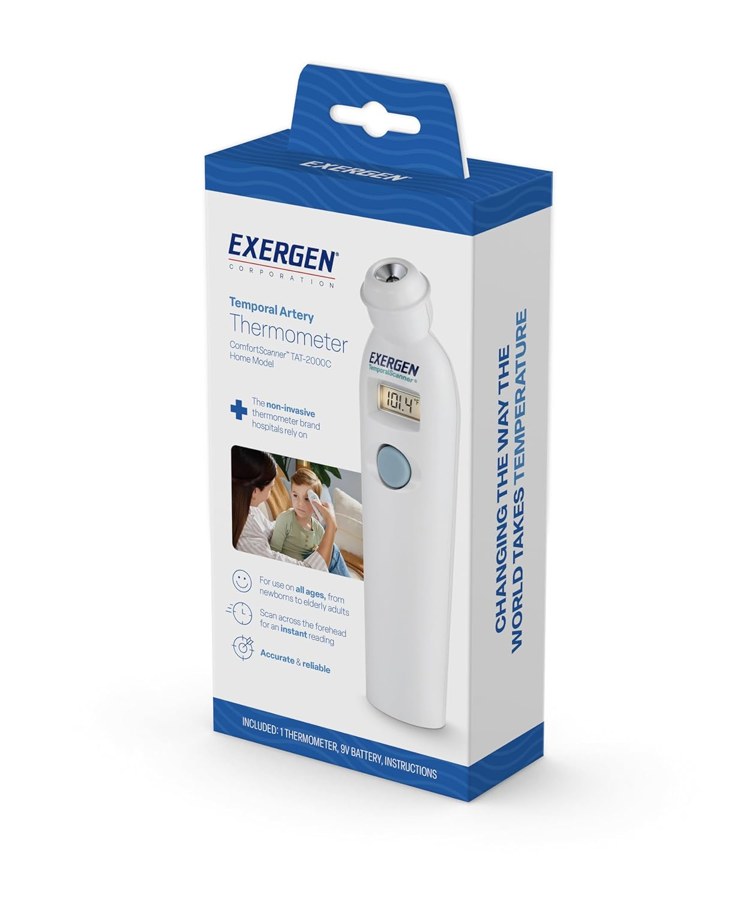
Who it is for: Families who want one thermometer for everyone, newborn to grandparent, without anything going in an ear or a bottom.
You stroke the probe across the forehead, touching the skin the whole way, and it reads the temporal artery. Exergen rates it for all ages, from newborns, and the AAP agrees that temporal artery thermometers can be used at any age.2,7 The TAT-2000C+ is the current version of the home model the page linked; it comes with a 9V battery and a storage tray.7
It is a contact thermometer, not a no-touch one, and technique matters. If your child is sweating, Exergen says the reading behind the ear lobe takes over.12
What it does well
The spec that decides it: technique. The probe must stay flush against the skin for the whole scan, so practice on a well child before you need it on a sick one.12
3. Which rectal thermometer is best? Vicks Baby Rectal Thermometer
Who it is for: Every family with a baby under 3 months, and anyone who wants the most accurate reading at any age.
A digital stick made only for rectal use, with a short, flexible tip and a large display.3 Rectal readings are the most accurate, and the AAP says they give the best reading especially for babies under 3 months.2
Clean the tip with soap and warm water or rubbing alcohol; Vicks says not to submerge the display.3 Keep it for rectal use only and label it, so it never ends up in a mouth.2
What it does well
What it does not
- Rectal only.
- Not waterproof: the display must stay dry.3
- Vicks sells it through its Amazon store rather than its own site.
The spec that decides it: the tip. Short and flexible is what makes a rectal stick safe for a baby, together with the AAP’s 1/2-inch depth under 6 months.2,3
4. Which no-touch thermometer is best? iHealth No-Touch Forehead
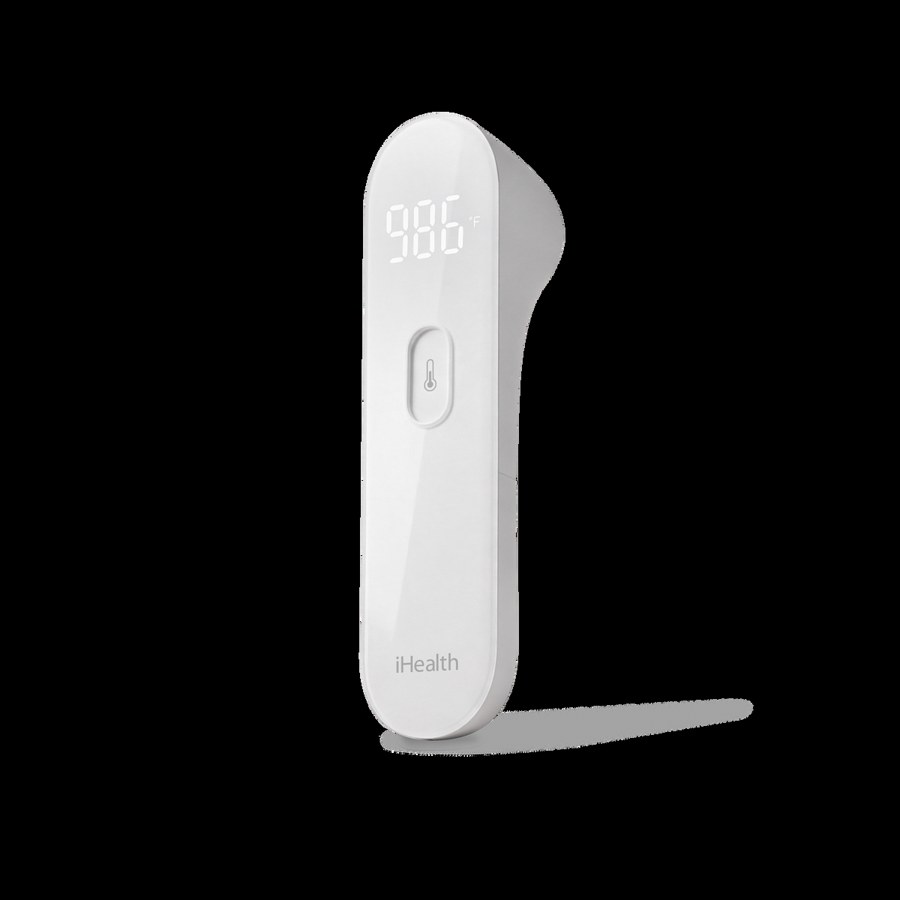
Who it is for: Parents who want to check a sleeping child without waking them, as a quick screen.
Hold it 1.18 inches (3 cm) from the center of the forehead and press once: it reads in a second and vibrates rather than beeps, so a sleeping child stays asleep. The extra-large display is readable in the dark.6,8
Non-contact thermometers need the right conditions: the FDA says to use them in a draft-free space, out of direct sun, after they have sat in the room for 10 to 30 minutes, and at the distance the maker gives.5 For a baby under 3 months, confirm a high reading rectally, the method the AAP trusts most at that age.2
What it does well
The spec that decides it: the distance. iHealth sets it at 1.18 inches from the forehead; held farther or closer, the reading is not the one the maker tested.5,8
5. Which thermometer is best for toddlers? Frida Baby 3-in-1 Ear, Forehead + Touchless
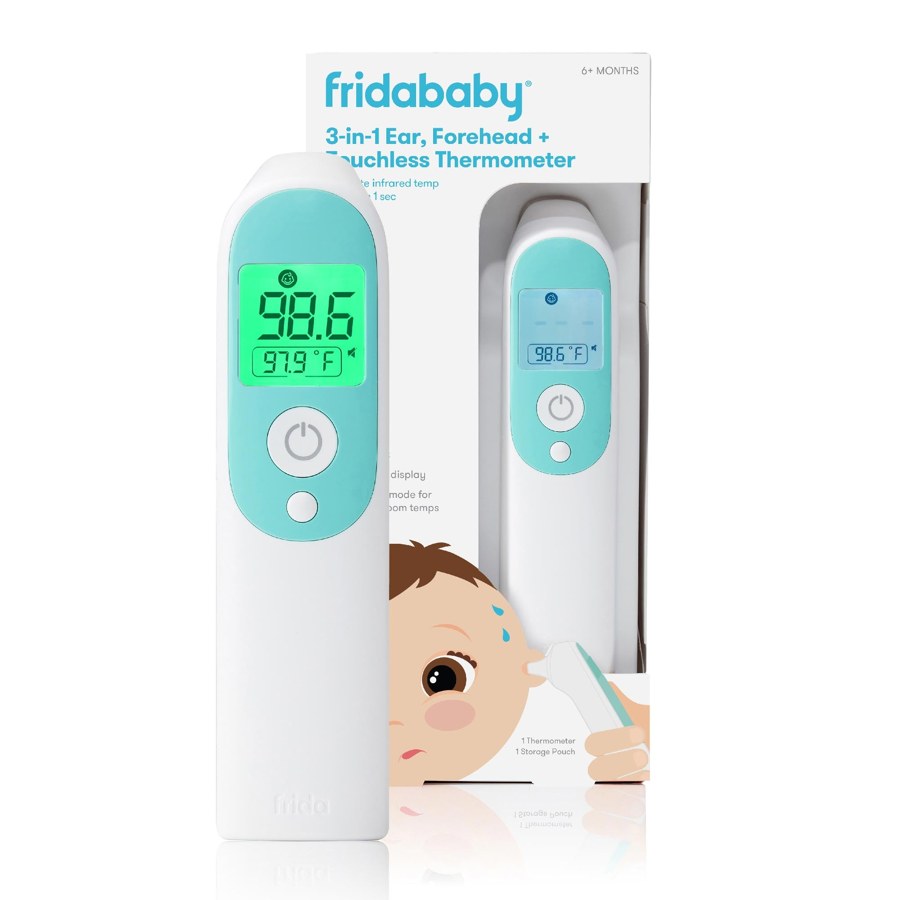
Who it is for: Families with a toddler who will not sit still: a reading in the ear while they are awake, on the forehead while they sleep.
One thermometer, used two ways on your child: in the ear or on the forehead, with a reading in one second. Frida suggests in-ear checks when your child is awake and forehead checks while they sleep. The screen is color-coded for a high temperature, the sound alert can be silenced, and it stores up to 40 readings, so you can follow a fever through the night.9
The third mode is touchless, and it is for things, not your child: Frida says it checks the temperature of a room or a surface, such as a bottle.9 The AAP says ear thermometers can be used from 6 months, because a younger baby’s ear canal is too narrow, and forehead thermometers at any age.2
What it does well
The spec that decides it: your child’s age. From 6 months the ear mode is an option; for a younger baby, use the forehead and confirm a fever rectally, the method the AAP trusts most under 3 months.2
6. Which thermometer is best for kids? Kinsa QuickCare Smart Thermometer
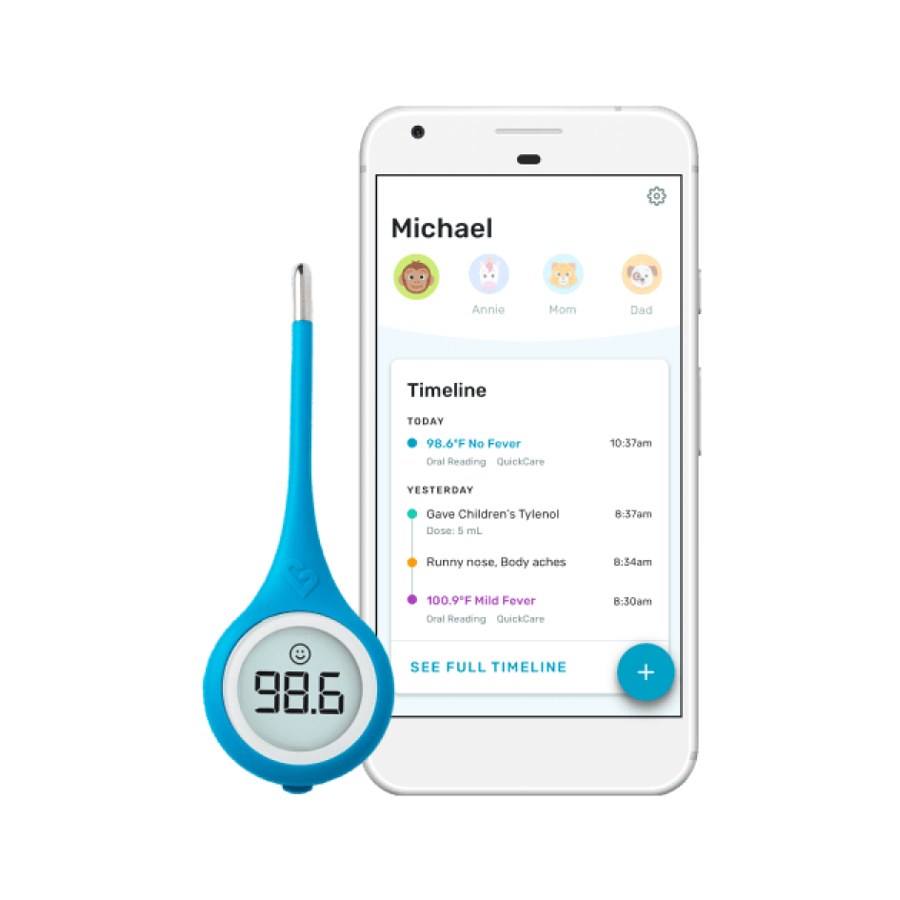
Who it is for: Families with a child of 4 or older who can hold a thermometer under the tongue, and parents who want to log a fever and its medicines in one place.
A digital stick with a comfort tip for oral, underarm or rectal use, an 8-second reading and a large backlit display. Kinsa says it is FDA cleared; it runs on a replaceable CR2032 battery and comes with a storage pouch.10
The free Kinsa app is optional. Paired over Bluetooth, it keeps a profile for each family member, tracks symptoms and medicines with reminders, gives guidance based on age, fever and symptoms, and builds an illness timeline you can share with health professionals. Kinsa also pools anonymous temperatures and symptoms to track illness in your area.10
The AAP recommends oral readings from age 4, and a separate thermometer for each use: label a rectal thermometer so it never ends up in a mouth.2 Kinsa says the QuickCare can be used rectally under 6 months; if you use it that way, keep it for that.10
What it does well
The spec that decides it: your child’s age. From 4, a reading under the tongue is accurate if done properly, the AAP says; for a baby, use a stick kept only for rectal readings.2
How do you take a baby's temperature accurately, by age?
- Under 3 months: a rectal digital stick is the one to own; any forehead reading is a screen.2
- 3 to 6 months: rectal for accuracy, a forehead thermometer for quick checks.2
- 6 months and older: add or switch to an ear thermometer such as the Braun, or the Frida 3-in-1, which also reads on the forehead.2,9
- 4 years and older: an oral stick, such as the Kinsa QuickCare, works once your child can keep their mouth closed around it.2,10
Follow the instructions that came with the thermometer, clean it before and after each use, and never use a mercury thermometer: the AAP says to remove one from the house if you have it.2
When does a baby's fever need a call to the pediatrician?
Right away if your baby is younger than 3 months (12 weeks) with a temperature of 100.4°F (38.0°C) or higher, or if a fever rises above 104°F (40°C) repeatedly at any age.4 Also call right away if a child with a fever looks very ill, is unusually drowsy or very fussy, has had a seizure, or has other symptoms such as a stiff neck, breathing difficulty, an unexplained rash, or repeated vomiting or diarrhea; and call if a fever lasts more than 24 hours under age 2, or more than 3 days from age 2.4
Before you call, have these ready:
- The number on the thermometer, and where you took it: rectum, forehead, ear or armpit.14
- Your child’s age, in weeks for a young baby, since a baby younger than 3 months (12 weeks) with 100.4°F (38.0°C) or higher needs a call right away.4
- When the fever started, since how long it lasts changes the advice: more than 24 hours under age 2, or more than 3 days from age 2.4
- Any other symptoms, such as a stiff neck, breathing difficulty, a rash, repeated vomiting or diarrhea, or unusual drowsiness.4,14
- Any fever medicine already given, and when; under age 2, ask before giving one.14
Frequently asked questions
What is the best baby thermometer?
Our top pick is the Braun ThermoScan 7, an ear thermometer whose Age Precision display color-codes the reading for your child’s age; it needs disposable lens filters, and the AAP advises ear readings from 6 months.1,2 For a younger baby, our pick is the Vicks Baby Rectal Thermometer.
What is the most accurate thermometer for a newborn?
A rectal digital thermometer: rectal temperatures are the most accurate, and the AAP says they give the best reading especially for babies under 3 months.2 Choose one with a short, flexible tip and insert it no more than 1/2 inch under 6 months.
What kind of baby thermometer should I buy?
Two, for most families with a young child: a digital stick for rectal readings and a forehead or ear thermometer for quick checks. An ear thermometer is for 6 months and older, because a younger baby’s ear canal is too narrow for a reliable reading; a forehead thermometer can be used at any age.2
Are forehead thermometers accurate for babies?
Forehead (temporal artery) readings are the next most accurate after rectal, and the AAP says they can be used at any age.2 For a baby under 3 months, confirm a fever with a rectal reading.
What is the best thermometer for a toddler?
Our pick is the Frida Baby 3-in-1, which reads in the ear while your toddler is awake and on the forehead while they sleep, in one second.9 An ear thermometer such as the Braun ThermoScan 7 or a forehead thermometer such as the Exergen suits a child who will not sit still too; ear readings are for children 6 months and older.1,2,7
What is the best thermometer for kids?
For a child of 4 or older, an oral digital stick is accurate if used properly; our pick is the Kinsa QuickCare ($29.99), which can also log fevers and medicines in an optional app.2,10 For a quick check on a child who will not hold still, an ear thermometer such as the Braun ThermoScan 7, or the Frida 3-in-1 in the ear or on the forehead, reads in seconds.1,9
What is the most accurate thermometer for kids?
A rectal reading is the most accurate at any age, the AAP says, and a forehead reading is next; oral and ear readings are accurate if done properly, and armpit readings are the least accurate.2 For an older child, that makes an oral stick from age 4, or an ear thermometer used as its maker directs, a reliable choice.2
What temperature is a fever in a baby?
A fever usually means 100.4°F (38°C) or higher.2 In a baby younger than 3 months, that temperature means calling the doctor right away.4
What is the best thermometer for a 1 or 2 year old?
From 6 months an ear reading is an option, so at 1 and 2 our pick is the Frida Baby 3-in-1, which reads in the ear while your child is awake and on the forehead while they sleep.2,9 A rectal reading is still the most accurate at any age, and oral readings wait until age 4.2 For an ear reading on a child over 1, pull the ear back and up first.2
Is a forehead or ear thermometer better for a baby?
For a baby under 3 months, neither: a rectal reading gives the best reading at that age, the AAP says. Between the two, a forehead thermometer can be used at any age, while an ear thermometer is not reliable before 6 months, because a younger baby's ear canal is too narrow. From 6 months either works; the AAP ranks forehead readings next most accurate after rectal, and ear readings accurate if done properly.2
When to ask a professional: Any fever of 100.4°F or higher in a baby under 3 months is a call to your pediatrician right away, day or night, and so is a child of any age who seems very ill.4 For everyday questions about your child’s development, DrSensory’s milestones guide is a good place to start.
Need more than an article?
Gear can only do so much. If something about how your child eats, moves, or talks has been on your mind, a pediatric therapist is the person who assesses it. Every state lets families go to a physical therapist without a referral, though some limit treatment without one;13 the rules for occupational and speech therapy vary by state, and some insurance plans ask for a referral before they pay, so check with yours when you call.
Find a therapist near youRelated DrParenting guides
All DrParenting guidesMore from DrSensory
DrParenting covers the gear. DrSensory covers the development behind it, written and reviewed by clinicians.
Sources
- Braun Healthcare. ThermoScan® 7 Ear Thermometer (model IRT6520). braunhealthcare.com. Age Precision color coding, what is in the box (21 lens filters), and Braun’s newborn-accuracy claim. Checked October 5, 2026.
- American Academy of Pediatrics. How to Take Your Child’s Temperature. HealthyChildren.org, last updated April 17, 2024. healthychildren.org. Checked October 5, 2026. Checked again November 20, 2026, for the ear and forehead steps and the less accurate screening methods.
- Kaz (Vicks). Vicks Baby Rectal Thermometer, model V934 — manufacturer specification, as listed by the Vicks store at amazon.com. Short, flexible tip; do not submerge the display; price. Checked October 5, 2026; the price again October 20, 2026.
- American Academy of Pediatrics. Fever: When to Call the Pediatrician. HealthyChildren.org, last updated December 2, 2022. healthychildren.org. Checked October 5, 2026.
- U.S. Food and Drug Administration. Non-contact Infrared Thermometers. fda.gov. Use instructions, and the June 18, 2025 exemption of certain clinical electronic thermometers from premarket notification. Checked October 5, 2026.
- iHealth Labs. Non-Contact Infrared Forehead Thermometer (PT3). ihealthlabs.com. One-second reading, silent vibration, large backlit display, ages, and the price. Checked October 5, 2026; the price again October 20, 2026.
- Exergen. TAT-2000C+ Temporal Artery Thermometer. exergen.com. Ages, what is in the box, and the price. Checked October 20, 2026.
- iHealth Labs. FAQ: Getting Started with the Non-Contact Infrared Forehead Thermometer PT3. ihealthlabs.com. Hold it 1.18 inches (3 cm) from the center of the forehead. Checked October 5, 2026.
- Frida. 3-in-1 Ear, Forehead + Touchless Infrared Thermometer. frida.com. Ear and forehead readings in one second, touchless mode for room or bottle temperatures, the color-coded screen and silenceable alert, 40-reading memory, what is in the box, and the price. Checked October 20, 2026.
- Kinsa Health. Kinsa QuickCare Smart Thermometer. kinsahealth.com. Oral, underarm or rectal use (rectal under 6 months), 8-second readings, FDA clearance, the backlit display, CR2032 battery and pouch, what the optional app does, the Kinsa Clinic subscription, the pooled anonymous data, and the price. Checked October 20, 2026.
- Braun Healthcare. ThermoScan® 7 Ear Thermometer, UK page for the same model. braunhealthcare.com. The pre-warmed tip and the three Age Precision bands (0–3 months, 3–36 months, 36 months and over). Checked October 5, 2026.
- Exergen. Frequently Asked Questions. exergen.com. The scan must touch the skin; when sweating, the reading behind the ear lobe takes over. Checked October 5, 2026.
- American Physical Therapy Association. Direct Access Advocacy. All 50 states, the District of Columbia and the U.S. Virgin Islands “have either provisional or unrestricted direct access to physical therapist services for evaluation and treatment,” though some states still attach provisions to treatment without a referral. Checked October 6, 2026.
- Johns Hopkins Medicine. Measuring a Baby’s Temperature. Health library, undated. hopkinsmedicine.org. Checked November 20, 2026.
Show the passageHide the passage
“Don’t use other types of fever ‘detectors.’ These are strips that you place on a child’s forehead or pacifiers that have a dot that changes color to show a fever. These aren’t as reliable as a standard thermometer”; “When you call your child’s healthcare provider, give them the actual reading on the thermometer and say where the temperature was taken”; “Be ready to tell the provider about any symptoms that your child may have”; and “If your child is under the age of 2 years, talk with their healthcare provider before giving medicine.”
Affiliate disclosure. Some links on this page are affiliate links. If you buy through one, DrSensory may earn a commission at no extra cost to you. As an Amazon Associate, DrSensory earns from qualifying purchases.
Medical disclaimer. This page is for general educational purposes and does not constitute medical advice, diagnosis, or treatment. Always consult a qualified healthcare provider about your child. Product information is checked against the manufacturer at the date shown and can change without notice — confirm weight and age limits on the product itself before you rely on them. Talk to your pediatrician about your own child.