
Sensory processing
The Palmar Grasp Reflex: Why Newborns Grip, and When It Fades
The grip on your finger is a reflex, not a choice. What it is for, and why letting go is the milestone that matters.
- Expert Reviewed
- Evidence Based
- Patient Focused
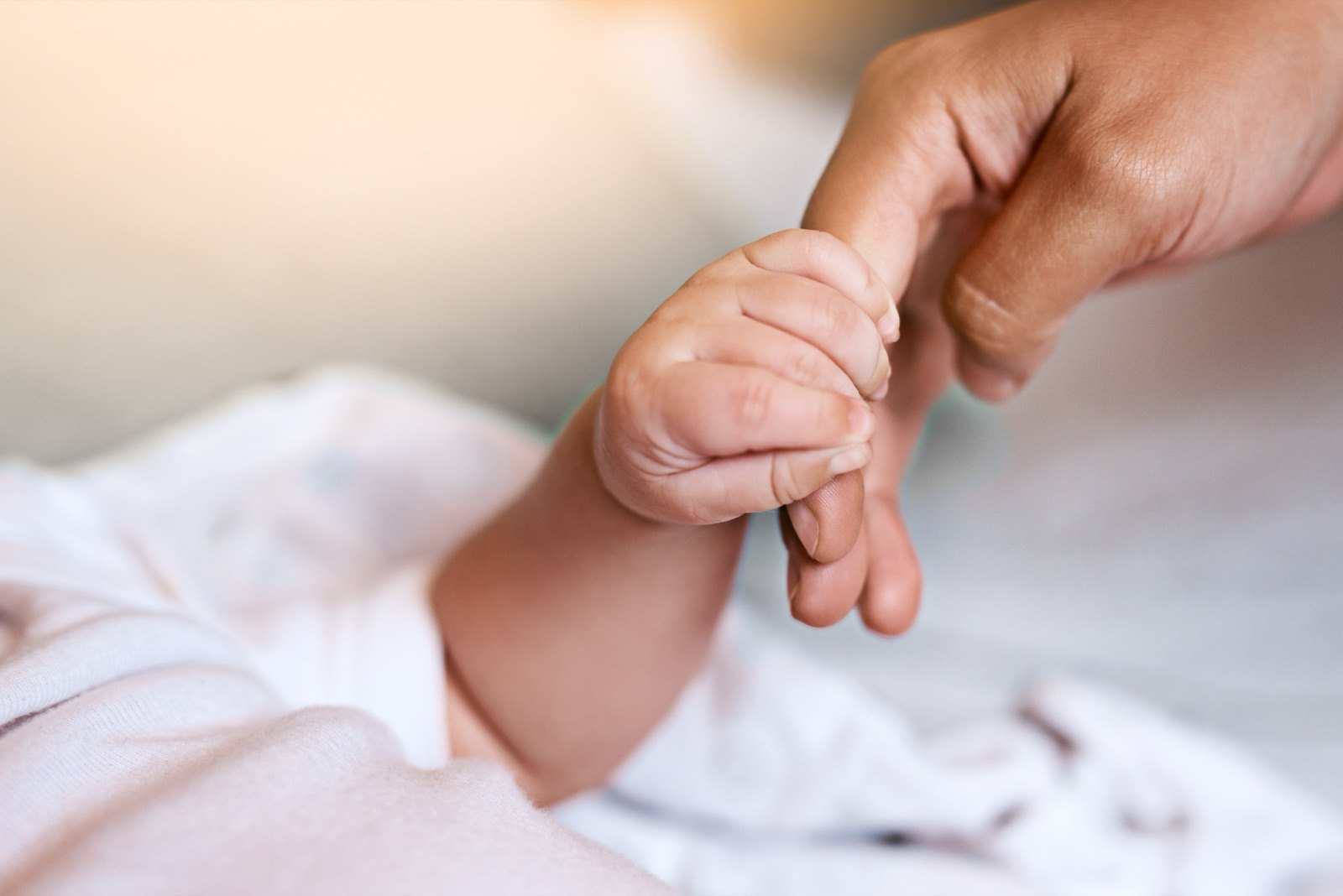
Press gently on a newborn's palm and every finger closes around whatever is there. That is the palmar grasp reflex. It appears by 28 weeks of gestation and typically disappears by 4 to 6 months, as voluntary reaching and grasping take over.1 The grip is strong — strong enough that an infant gripping with both hands could briefly support their own weight, which is precisely why that is never tested.1 The developmental point is not the grip. It is the RELEASE: voluntary hand opening is what a child needs for manipulative play, for feeding themselves, and eventually for writing, and a palmar grasp persisting beyond 6 months is what stands in the way of it.1
What is the palmar grasp reflex?
The palmar grasp reflex is the automatic closing of a newborn’s fingers around anything pressed into the palm. Gentle pressure on an infant’s palm produces flexion of all the fingers around the stimulus. The examiner applies it with a finger, moving from the little-finger side of the hand toward the thumb side.1
The grip is genuinely strong. An infant grasping with both hands simultaneously could briefly support their own weight — which is stated in the clinical literature alongside the instruction that it should never be tested, for obvious reasons.1
It is one of two grasp reflexes. The other, the plantar grasp, curls the toes when the sole of the foot is pressed.1 You will also see the hand reflex written as “palmer grasp”; the correct spelling is palmar, because it describes the palm.
The pathway. Touch receptors in the palm send signals along the median and ulnar nerves to spinal cord segments C8 to T1, and the finger flexors respond. As the frontal lobes mature, cortical inhibition gradually shuts the loop down.1
When does the palmar grasp reflex appear, and when does it disappear?
It appears by 28 weeks of gestation and typically disappears by 4 to 6 months, at the same time as a baby starts reaching and grasping on purpose.1
| Point | What is expected1 |
|---|---|
| By 28 weeks of gestation | The reflex appears. |
| By 4 to 6 months | Typically disappears, coinciding with the development of voluntary reaching and grasping. |
| Beyond 6 months | Persistence prevents voluntary hand release. |
The plantar grasp — the same response in the foot — appears at the same point but lasts longer, disappearing between 9 and 12 months.1
Palmar grasp vs palmar grip vs pincer grasp: what is the difference?
The palmar grasp is the reflex; “palmar grip” is the same whole-hand closing in plainer words; and the pincer grasp is the deliberate thumb-and-finger pick-up that arrives months after the reflex has gone. They are not three versions of one skill. The first is automatic, and the later grasps are learned once the hand can open on purpose.
| Term | What it is | When |
|---|---|---|
| Palmar grasp reflex | Automatic finger closing when the palm is pressed. The baby cannot choose to let go.1 | From 28 weeks of gestation until about 4 to 6 months1 |
| Palmar grip | A common name for the same whole-hand closing. | The same window |
| Pincer grasp | Picks things up between thumb and pointer finger, like small bits of food.4 | By 12 months4 |
The reflex has to give way first. An infant with a retained palmar grasp cannot voluntarily open the hand to drop an object, pass a toy from one hand to the other, or use a pincer grasp to manipulate something small.1 The steps in between, holding a toy on purpose and raking food closer, are in the month-by-month table below.
How does a clinician test the palmar grasp reflex?
A clinician presses a finger gently into the baby’s palm, moving from the little-finger side toward the thumb, and watches how the fingers close and how they let go.1 Testing happens when the infant is calm and alert; crying or sleeping can diminish the response.1 Three things get documented:1
What is recorded
- Release — a normal grasp lets go when the back of the hand is stroked, or when the infant’s attention moves elsewhere.
- Symmetry — whether both hands do the same thing.
- Strength — strong, moderate, weak, or absent.
A stimulus applied the wrong way can give a false result in either direction, which is why the finding is recorded by someone trained to elicit it.1 At home there is nothing to test: you see the reflex every time your baby closes a hand around your finger.
What does it mean if the palmar grasp reflex is absent or stays?
A grasp that stays past 6 months matters because it blocks voluntary release. A grasp that is weak, missing or one-sided in a newborn matters because it can point to an injury or a neurological problem.1
Persistence of the palmar grasp beyond 6 months prevents the development of voluntary hand release — and release is the prerequisite for manipulative play, for feeding skills, and eventually for writing.1
That is a sequence, not a claim about school performance. A child who cannot open their hand on purpose cannot put an object down where they want it, and everything built on that is delayed behind it.
Findings for a doctor, not a program
- One hand different from the other. An asymmetric palmar grasp in a newborn suggests a problem on one side: a brachial plexus injury (particularly Klumpke palsy, which affects the C8 to T1 roots), a peripheral nerve injury, or a brain injury on the opposite side causing weakness of that hand.1
- Weak or absent early on. Absent reflexes in early infancy are associated with adverse neurologic outcomes, which is why a missing grasp in a newborn is examined rather than watched.1
- Still strong well past 6 months. A retained palmar grasp is characteristic of cerebral palsy, particularly the spastic hemiplegic and quadriplegic types.1
Where this stops. A retained reflex does not automatically mean impairment,2 and the association between retained reflexes and later academic difficulty is correlational. A 2026 systematic review of 14 studies in children aged 3 to 11 without neurodevelopmental diagnoses found consistent negative associations with motor outcomes and with reading, spelling and mathematics, and concluded that the available evidence “remains limited and heterogeneous”.3
In adults it means something else. A grasp reflex that reappears in adulthood is a frontal release sign, linked to frontal lobe lesions and dementia.1
What grasp milestones come after it, month by month?
After the reflex fades, a baby’s hands move from holding what is put in them, to passing things between hands and raking food closer, to the thumb-and-finger pincer grasp around the first birthday.4
| By | What most children do4 |
|---|---|
| 2 months | Opens hands briefly |
| 4 months | Holds a toy when you put it in their hand; brings hands to mouth |
| 6 months | Puts things in their mouth to explore them; leans on hands to support themselves when sitting |
| 9 months | Moves things from one hand to the other; uses fingers to “rake” food toward themselves; bangs two things together |
| 12 months | Picks things up between thumb and pointer finger; puts something in a container, like a block in a cup |
| 15 months | Uses fingers to feed themselves some food |
| 18 months | Scribbles; tries to use a spoon |
Each age is the point by which most children — 75 percent or more — have the skill, chosen so that a parent and a doctor act when it is missing rather than wait and see.5 Our page on delayed motor milestones covers what happens after that conversation.
What if I have been told my child has a retained palmar grasp?
In an infant past six months who cannot deliberately let go of an object, that is worth raising with a doctor or a pediatric occupational therapist promptly. For an older child, the questions about any reflex-integration recommendation start from occupational therapy’s own guidance: a retained reflex does not necessarily mean functional impairment, and a program should be clearly linked to an everyday task.2 The full questions to ask a provider are on the parent article.
When should I ask the pediatrician about my baby’s hands?
Ask if one hand behaves differently from the other, if your baby cannot open a hand on purpose by about 6 months, or if a hand skill on the checklist has not appeared by its age.1,4
Worth raising with your baby’s doctor
You do not need to wait for the next checkup. CDC’s advice is to talk with your child’s doctor, share the concern, and ask about developmental screening; the American Academy of Pediatrics recommends general developmental screening at 9, 18 and 30 months in any case.4 If the hands seem weak along with the rest of the body, our page on low muscle tone covers what a doctor looks for; if a doctor raises cerebral palsy, that page is the place to start. You can also find a pediatric occupational therapist near you.
Frequently Asked Questions
Why do newborns grip your finger?
It is the palmar grasp reflex, not a choice. Pressure on the palm triggers touch receptors that signal along the median and ulnar nerves to spinal segments C8 to T1, and the finger flexors close the hand.
When does the palmar grasp reflex go away?
It appears by 28 weeks of gestation and typically disappears by 4 to 6 months, as voluntary reaching and grasping take over.
Can a baby really support their own weight gripping?
The grip is strong enough that an infant grasping with both hands could briefly do so. It should never be tested, for obvious safety reasons.
What happens if the palmar grasp does not fade?
Persistence beyond 6 months prevents the development of voluntary hand release, which is the prerequisite for manipulative play, feeding skills and eventually writing. It is worth raising with a doctor or a pediatric occupational therapist.
Is palmar grip the same as the palmar grasp reflex?
In everyday use, yes: palmar grip is a common name for the same whole-hand closing. The palmar grasp reflex is the clinical term, and it fades by 4 to 6 months.
When do babies develop a pincer grasp?
By 12 months, most babies pick up small things, such as bits of food, between the thumb and pointer finger. A palmar grasp that has not faded stands in the way.
Sources
- Chamarthi VS, Gunasekaran V, Daley SF. Primitive Reflexes: Comprehensive Neurological Assessment Across the Lifespan. In: StatPearls. StatPearls Publishing; updated 2026. ncbi.nlm.nih.gov/books/NBK554606 (PMID 32119493). Checked August 25, 2026.
- American Occupational Therapy Association. Don’t use reflex integration programs for individuals with delayed primary motor reflexes without clear links to occupational outcomes. Recommendation AOTA8, Choosing Wisely clinician list, July 27, 2021. archived recommendation. Checked October 5, 2026.
- Provazník A, Musálek M, Bob P, Větrovský T, Malambo C, Silva AF, Anderson D. Persisting primitive reflexes and motor and cognitive development in children: a systematic review. Acta Psychologica. 2026;266:106915. doi:10.1016/j.actpsy.2026.106915 (PMID 42061063).
- Centers for Disease Control and Prevention. CDC’s Developmental Milestones (Learn the Signs. Act Early.), milestone pages for 2 months to 5 years. cdc.gov/act-early/milestones. Checked October 5, 2026.
- Zubler JM, Wiggins LD, Macias MM, Whitaker TM, Shaw JS, Squires JK, et al. Evidence-informed milestones for developmental surveillance tools. Pediatrics. 2022;149(3):e2021052138. doi:10.1542/peds.2021-052138 (PMID 35132439).
Medical disclaimer. This page is for general educational purposes and does not constitute medical advice, diagnosis, or treatment. Always consult a qualified healthcare provider about your child. Sensory and motor concerns are best assessed by an occupational or physical therapist who can evaluate your individual child.