
Sensory processing
Do Sensory Toys Work for ADHD and Autism? The Evidence
What the research shows about sensory toys for ADHD, autism and sensory processing differences — and what it does not.
- Expert Reviewed
- Plain Language
- Patient Focused
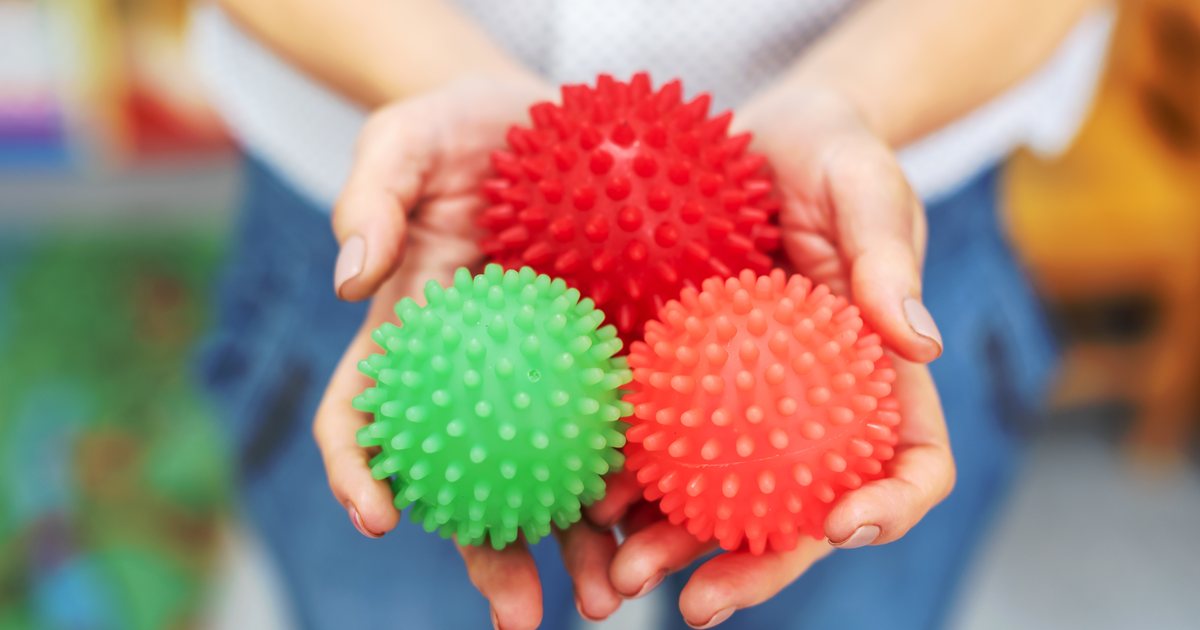
Quick answer. Mostly not in the way they're sold. Deep pressure input and a parent trained in sensory strategies have strong evidence behind them. Fidget toys, weighted vests, and wobble cushions do not, and in the one controlled trial of fidget spinners, attention got worse. Weighted blankets are well liked but did not improve sleep in a randomized trial. What helps is matching a strategy to your child's sensory profile — which often costs nothing — and judging the result yourself.
Key takeaways
- The two sensory strategies with strong evidence are deep pressure tactile input and caregiver training in sensory strategies. Neither requires buying anything.1
- Fidget toys lack sufficient evidence for classroom use, and fidget spinners were associated with worse attention in a controlled trial of young children with ADHD.2,3
- Weighted blankets did not improve sleep in a randomized trial of autistic children, though children and parents preferred them. Weighted vests are not supported.4,5
- Alternative seating — wobble cushions, therapy balls — has moderate evidence that it does not improve attention.1
- Across 30 studies and 856 children, insufficient evidence exists to support sensory-based interventions.6
- A child's preference for a tool is real and worth honoring. The problem is spending money and hope on tools sold as treatments.
Do sensory toys help with ADHD?
Not as advertised. There is no controlled study showing that a sensory toy improves attention, behavior, or learning in children with ADHD, and the one that tested the most popular fidget found the opposite.2 What the research does support is narrower and cheaper than a product: a particular kind of touch, and a parent who understands what their child is looking for.
A 2025 systematic review is the best current summary. It covered 21 controlled studies published between 2015 and 2024 in children and young people with sensory processing challenges, and rated the evidence for each kind of intervention.1 Two things came out with strong support: deep pressure tactile input — firm, sustained pressure on the body — and training caregivers to use sensory strategies. One thing came out with moderate evidence against it: alternative seating did not improve attention. And the review found too few studies to say anything about changing the environment.1
That is the whole field in three sentences. Here is how the common products line up against it.
| Tool or strategy | Best evidence | What it found |
|---|---|---|
| Deep pressure input (firm hugs, being wrapped, cushions) | 2025 systematic review, 21 controlled studies1 | Strong evidence of benefit |
| Caregiver training in sensory strategies | Same review1 | Strong evidence of benefit |
| Fidget toys | 2023 review of classroom studies3 | Not sufficient support for classroom use |
| Fidget spinners | Controlled trial, 60 children with ADHD2 | Attention worse with the spinner in use |
| Weighted blankets (sleep) | Randomized trial, 73 autistic children4 | No effect on sleep; preferred by children |
| Weighted vests | Two systematic reviews5,7 | Not supported; limited evidence at best |
| Wobble cushions, therapy balls | 2025 systematic review1 | Moderate evidence of no improvement in attention |
| Sensory swings, chew tubes, therapy balls | 2015 review, 30 studies, 856 children6 | Insufficient evidence to support use |
| Environmental changes (quieter, dimmer, fewer people) | 2018 review; 2025 review7,1 | Moderate in clinical settings; too few studies to rate overall |
If you came here to decide what to buy, the shopping half of this site has the honest version of that list: the DrParenting sensory toys buying guide. This page is about what the research can and can't tell you.
How do I compare calming toys against stimulating ones?
By what your child does, not by what the label says. "Calming" and "stimulating" describe the toy. What matters is the child's sensory profile, and the same toy is calming for one profile and escalating for another.8
A child who seeks input — crashes into furniture, chews collars and pencils, can't sit through dinner, asks to be squeezed — is usually under-responsive to sensation and is trying to get more of it. For this child, what a shop calls a "stimulating" toy is often the calming one: chewing, weight, and movement give the input they're hunting for. See sensory seeking and under-responsivity.
A child who avoids input — covers ears at hand dryers, hates tags and seams, melts down in busy rooms, gags at textures — is over-responsive and is trying to get less. For this child, the calming "tool" is usually a reduction: fewer people, less noise, a warning before a transition, a corner with a door. A stimulating toy makes things worse. See sensory over-responsivity.
Most children are a mix, and the mix moves with tiredness, hunger, and the day. That is why age-based lists and diagnosis-based lists fail: two children with ADHD, or two autistic children, can need opposite things from the same shelf. Types of sensory processing differences walks through the patterns; sensory diet strategies is how to build a plan around the one that fits.
The practical test: introduce one tool, decide in advance what you expect to change, and give it two weeks. If the child settles, you had the direction right. If the child winds up, you had it backwards — which is information, not failure.
What sensory tools help with ADHD concentration?
Honestly: the evidence for tools improving concentration is thin to negative. What has support is not a tool.
Movement before a seated task is the closest thing to a reliable strategy. Children who seek vestibular and proprioceptive input concentrate better after they've had it — running, jumping, climbing, carrying something heavy — and that input is free.8 A five-minute movement break before homework does more than any cushion under the chair during it.
Deep pressure input has strong evidence in the 2025 review.1 For concentration specifically, that looks like a firm shoulder squeeze before sitting down, a heavy blanket over the lap while awake and supervised, or a wall push. Again, no purchase required.
Reducing what competes for attention is the other lever. The 2025 review didn't find enough studies to rate environmental modification,1 and an earlier review rated it moderate in clinical settings.7 The evidence is thin. But the mechanism isn't in doubt — less noise reaching a child is less noise — and the cost and risk are close to zero. Turn off the screen in the next room, clear the table, close the door.
What does not help concentration, on the current evidence, is the category of small handheld tools sold for exactly that purpose. That is the next section.
Do fidget toys help kids with ADHD focus?
The research says no, and for spinners it says worse.
A 2023 review of the classroom fidget literature concluded that fidget toys have been marketed as universal educational supports without a scientific evidence base, and that there is not sufficient support for using them in the classroom.3 That is a review of the whole category — cubes, putty, squeeze balls, spinners.
The one controlled trial of fidget spinners is the study most people are thinking of when they say "there's research." There is, and it went the other way. Sixty children with ADHD, average age just under five, were observed with and without spinners across an A-B-A-B design inside a classroom program that was itself evidence-based. Spinner use was associated with poorer attention in both phases. The authors concluded that spinners negatively influence attention even within an effective intervention.2
None of this means a child can't have a fidget. It means a fidget is a preference, not a concentration aid, and if it's going to school the test is whether the teacher notices less disruption. A silent tool — putty, a plain stress ball — is closer to the deep-pressure input that does have evidence,1 and far less likely to become the thing everyone at the table is watching.
Do weighted blankets and weighted vests work?
Weighted blankets: liked, not effective for what they're sold for. Weighted vests: not supported.
The weighted blanket trial is the best-designed study on this page. Seventy-three autistic children aged 5 to 16, all with severe sleep problems, slept under a weighted blanket and under an identical-looking blanket of normal weight, in a crossover design, with sleep measured by movement monitors rather than parent recall. The weighted blanket did not increase total sleep time, did not shorten the time to fall asleep, and did not reduce night waking. There was no difference on any objective or subjective measure.4 A small later study in two four-year-olds found minimal change and the authors said the findings were not strong enough to recommend clinical use.9
What the trial did find is that children and parents preferred the weighted blanket, and it was well tolerated.4 That preference is worth something. A child who feels comforted is getting something real, and comfort at bedtime has its own value. It is a reason to keep a blanket your child likes. It is not a reason to buy one expecting it to fix sleep, and not a reason to buy a heavier one when the first doesn't.
Weighted vests have been reviewed more than once. A 2009 review of the studies in autistic children and children with other disabilities found the evidence did not support their use.5 A 2018 systematic review rated the evidence for weighted vests as limited.7
The thing to hold onto is that deep pressure — the input a weighted product is supposed to deliver — does have strong evidence.1 The gap is between the input and the product. Deep pressure is available from a firm hug, being rolled in a blanket while awake and watched, lying under sofa cushions, or a two-handed shoulder squeeze. None of that has a recall history, and the products do: children's weighted blankets were recalled in 2022 and again in 2023 after two children got inside a zippered cover and died.10 Never use a weighted product a child can't remove alone, never one with a cover a child can climb into, and never for an infant.
Do wobble cushions and sensory swings improve attention?
Alternative seating is the one category where the evidence is clear in the negative. The 2025 review found moderate strength of evidence that alternative seating — wobble cushions, therapy balls, ball chairs — did not improve attention.1 That is a stronger statement than "no evidence." It's evidence of no effect.
Sensory swings, therapy balls, and similar equipment were included in the 2015 review of 30 studies covering 856 children, alongside chewy tubes and weighted vests. The review concluded that insufficient evidence exists to support sensory-based interventions of this kind.6
If your child seeks movement, the useful response is more movement, not a device that lets them wobble in a chair: a playground, a trampoline, a climb, a movement break before the seated task rather than a cushion during it. If your child is over-responsive to movement, a swing can escalate rather than settle — another case where the profile matters more than the product.
Do sensory toys help autistic children?
Most autistic children have sensory processing differences, and the sensory toy market is largely built for them. The evidence is the same evidence as above, because most of the studies were done in autistic children: the weighted blanket trial,4 the weighted vest reviews,5,7 and a large share of the 2015 review.6 Nothing changes by diagnosis. What changes is the profile.
One thing worth saying plainly, because it affects how a parent reads product claims: sensory processing disorder is a useful clinical description, and this site uses it, but it is not a standalone diagnosis in the DSM-5-TR or ICD-11.8 The American Academy of Pediatrics has advised pediatricians not to use it as a diagnosis on its own, and to treat sensory differences as features of conditions like autism and ADHD rather than a condition to be treated separately.11 A product that claims to "treat SPD" is making a claim about a diagnosis that doesn't formally exist.
For autistic children specifically, the strongest-evidence strategies on this page — deep pressure, a parent who knows the profile, and environmental change — are also the ones that fit an approach built on the child's autonomy rather than on reducing behaviors that bother adults. The 2025 review deliberately measured functional outcomes and participation, not symptom reduction, for that reason.1
What works better than sensory toys?
Three things, in order of evidence.
Deep pressure input. Strong evidence.1 Firm, sustained pressure: a two-armed squeeze, being wrapped snugly in a blanket while awake and supervised, lying under sofa cushions, a lap pad, a heavy backpack for a short walk, wall pushes, carrying groceries. For seekers this is the thing they're already trying to get by crashing into furniture.
A parent who understands the profile. Strong evidence for caregiver training in sensory strategies.1 This is the finding that should reorganize how you spend: an hour with an occupational therapist learning to read your child's pattern has better support than anything on a shelf. The 2025 review also found moderate evidence that targeting several sensory systems works better than targeting one1 — which is what a parent who knows the profile does naturally, and what a single product can't.
Changing the environment. Thin evidence — a 2018 review rated it moderate in clinical settings,7 and the 2025 review found too few studies to rate it at all.1 It stays on this list because the mechanism is obvious, the risk is nil, and it's free: fewer people, less noise, dimmer light, a warning before a transition, a predictable order to the day. For over-responsive children this is the entire strategy.
Toys sit below all three. Not because they're harmful — most aren't — but because the evidence for them ranges from absent to negative, and the money and hope they absorb could go to the things above.
Do sensory tools help in the classroom?
The classroom is where fidget toys were tested and where they did worst.2,3 It's also where alternative seating was tested, with moderate evidence that it doesn't improve attention.1
What that leaves for a teacher is the same list as for a parent: movement breaks before seated work, a quieter or dimmer corner, advance warning before transitions, and — where a child seeks deep pressure — a heavy task like moving chairs or carrying books. The 2025 review's finding on caregiver training extends to any adult who spends the day with the child.1
If a fidget is going to school, it should be silent, the teacher should have agreed to it, and the test should be whether disruption goes down. If it doesn't within two weeks, the fidget hasn't earned its place. Teachers looking for a working set of strategies rather than a product list can start with the SPD teaching toolkit.
Are sensory toys good for anxiety?
There is no controlled evidence that a sensory toy reduces anxiety in children, and this page is reviewed by a physical therapist, so it stays on the sensory side of that line. What can be said is that sensory overload and anxiety look alike from the outside and are often confused, and the strategies differ. A child melting down in a supermarket because of noise needs less noise; a child melting down because of worry needs something else, and a sensory toy doesn't address either well. If anxiety is the question, a pediatrician or a mental health professional is the right person to ask, and DrSensory's behavioral health content is reviewed separately by a licensed counselor.
Should I stop using sensory toys my child likes?
No. Nothing on this page is a reason to take away a lap pad, a chew tool, or a lump of putty that your child reaches for. Preference is real. The weighted blanket trial is the clearest example: it found no effect on sleep and a clear preference from children and parents, and both findings are true at once.4
What changes is what you expect from the tool and what you spend on it. A cheap thing your child likes is worth keeping. An expensive thing sold as a treatment, bought in the hope it will fix attention or sleep or behavior, is the purchase this page is trying to save you from. And if a tool becomes the only way your child can settle, that's a dependency rather than a skill, and the plan needs a therapist rather than another tool.
When should I see an occupational therapist?
Sooner than most parents do, and for a different reason than most expect. The strongest evidence on this page is for a caregiver who understands the child's profile,1 and that is what a pediatric occupational therapist teaches in the first session or two. Most families don't need a referral to ask.
See one if your child's sensory pattern is getting in the way of eating, sleeping, school, or leaving the house; if you can't tell whether your child is seeking or avoiding; if a tool you've tried seems to make things worse; or if you're about to spend real money on equipment. An OT will usually suggest things you already own before things you'd have to buy. Find a pediatric occupational therapist.
ADHD itself — its diagnosis and treatment — is a separate conversation with your pediatrician, and outside what this page covers. The CDC's overview of ADHD treatment is a reasonable starting point.12
Frequently asked questions
Do kids with ADHD need sensory toys?
No. There's no evidence that children with ADHD need sensory toys, and the one controlled trial of fidget spinners found attention got worse. What has strong evidence is deep pressure input and a parent trained in sensory strategies, neither of which requires a product. A tool your child likes is fine to keep; it isn't a treatment.
Do fidget toys help with ADHD?
The research says no. A 2023 review found insufficient support for fidget toys in classrooms, and a controlled trial in 60 young children with ADHD found fidget spinners were associated with poorer attention. If a child wants something in their hands, a silent tool like putty is less disruptive, but don't expect it to improve focus.
Do weighted blankets help kids with ADHD or autism sleep?
A randomized trial in 73 autistic children with severe sleep problems found the weighted blanket did not increase sleep time, shorten sleep onset, or reduce night waking, compared with an identical-looking light blanket. Children and parents preferred it. Keep one your child likes; don't buy one expecting it to fix sleep, and never use one a child can't remove alone.
Are weighted vests effective for autism?
No. A 2009 review found the evidence did not support weighted vests, and a 2018 systematic review rated the evidence as limited. Deep pressure itself has strong evidence — but it's available from a firm hug or a cushion, not only from a vest.
Do wobble cushions help kids with ADHD focus?
A 2025 systematic review found moderate evidence that alternative seating, including wobble cushions and therapy balls, did not improve attention. A movement break before the seated task has better support than a cushion during it.
How do I compare calming toys against stimulating ones for a child with ADHD or autism?
By your child's sensory profile. A child who seeks input is calmed by more input — chewing, weight, movement — so the "stimulating" toy is the calming one. A child who avoids input is calmed by less: fewer people, less noise, a warning before a transition. Try one thing for two weeks and watch which direction settles your child.
Are sensory toys good for anxiety?
There's no controlled evidence that they reduce anxiety. Sensory overload and anxiety can look the same but need different responses, and neither is well served by a toy. If anxiety is the concern, ask a pediatrician or a mental health professional.
Is sensory processing disorder a real diagnosis?
It's a useful clinical description, but it isn't a standalone diagnosis in the DSM-5-TR or ICD-11, and the American Academy of Pediatrics has advised against using it as one. Sensory differences are usually understood as features of conditions like autism and ADHD. Any product claiming to "treat SPD" is treating something that isn't formally diagnosed.
What actually helps a child with sensory processing challenges?
The strongest evidence is for deep pressure input and for parents learning to use sensory strategies. Both are free. Changing the environment — quieter, dimmer, more predictable — has thinner evidence but no downside. Products come after all three.
Sources
- Piller A, McHugh Conlin J, Glennon TJ, et al. Systematic review of sensory-based interventions for children and youth (2015–2024). Frontiers in Pediatrics. 2025;13:1720179. PMID 41321460. Twenty-one level I and II studies, May 2015–January 2024, PRISMA-guided, functional and participation outcomes. Strong evidence for deep pressure tactile input and caregiver training in sensory strategies; moderate evidence that alternative seating did not improve attention; moderate evidence that targeting several sensory systems beats targeting one; lack of evidence on sensory environmental modifications. doi:10.3389/fped.2025.1720179 · PMC12658592
- Graziano PA, Garcia AM, Landis TD. To Fidget or Not to Fidget, That Is the Question: A Systematic Classroom Evaluation of Fidget Spinners Among Young Children With ADHD. Journal of Attention Disorders. 2020;24(1):163–171. A-B-A-B design, 60 children with ADHD, mean age 4.86; spinner use associated with poorer attention across phases, within an evidence-based classroom intervention. doi:10.1177/1087054718770009
- Kriescher SL, Hulac DM, Ryan AM, King BL. Evaluating the Evidence for Fidget Toys in the Classroom. Intervention in School and Clinic. 2023;58(5). Concludes fidget toys have been marketed as universal educational supports in the absence of a scientific evidence base, and that there is not sufficient support for their implementation in the classroom. doi:10.1177/10534512221130070
- Gringras P, Green D, Wright B, et al. Weighted Blankets and Sleep in Autistic Children — A Randomized Controlled Trial. Pediatrics. 2014;134(2):298–306. Phase III placebo-controlled crossover trial, 73 children aged 5–16 with ASD and severe sleep problems, measured by actigraphy; no difference in total sleep time, sleep onset, or night waking; preferred by children and parents and well tolerated. doi:10.1542/peds.2013-4285
- Stephenson J, Carter M. The use of weighted vests with children with autism spectrum disorders and other disabilities. Journal of Autism and Developmental Disorders. 2009;39(1):105–114. Evidence does not support use. doi:10.1007/s10803-008-0605-3
- Barton EE, Reichow B, Schnitz A, Smith IC, Sherlock D. A systematic review of sensory-based treatments for children with disabilities. Research in Developmental Disabilities. 2015;37:64–80. Thirty studies, 856 children; interventions included therapy balls, swings, chewy tubes, and weighted vests; conclusion: insufficient evidence exists to support their use. doi:10.1016/j.ridd.2014.11.006 · PMID 25460221. The abstract also states that "insufficient evidence exists to support their use." (Phrasing verified against the abstract by Warp, 2 Sep 2026.)
- Bodison SC, Parham LD. Specific Sensory Techniques and Sensory Environmental Modifications for Children and Youth With Sensory Integration Difficulties: A Systematic Review. American Journal of Occupational Therapy. 2018;72(1). Moderate evidence for sensory modifications to a clinical setting; limited evidence for weighted vests. doi:10.5014/ajot.2018.029413
- Miller LJ, Anzalone ME, Lane SJ, Cermak SA, Osten ET. Concept evolution in sensory integration: a proposed nosology for diagnosis. American Journal of Occupational Therapy. 2007;61(2):135–140. Source of the modulation / discrimination / sensory-based motor framework used on this site. doi:10.5014/ajot.61.2.135
- Gee BM, Lloyd K, Sutton J, McOmber T. Weighted Blankets and Sleep Quality in Children with Autism Spectrum Disorders: A Single-Subject Design. Children. 2020;8(1):10. Two 4-year-olds; minimal changes in sleep patterns overall, though the authors report enhanced morning mood and significantly decreased time to fall asleep; they state the findings were not strong enough to recommend clinical use. doi:10.3390/children8010010
- U.S. Consumer Product Safety Commission. Recall 23078 (December 22, 2022) and Recall 24702 (October 12, 2023). Children's weighted blankets recalled after two children became entrapped inside a zippered cover and died of asphyxia; a second brand recalled for the same hazard. cpsc.gov recall 23078 · cpsc.gov recall 24702. Checked September 3, 2026.
- Zimmer M, Desch L; American Academy of Pediatrics Section on Complementary and Integrative Medicine and Council on Children with Disabilities. Sensory Integration Therapies for Children With Developmental and Behavioral Disorders. Pediatrics. 2012;129(6):1186–1189. Policy statement advising that sensory processing disorder not be used as a stand-alone diagnosis. doi:10.1542/peds.2012-0876
- Centers for Disease Control and Prevention. Treatment of ADHD. cdc.gov. Checked September 3, 2026.
Medical disclaimer. This page is for general educational purposes and does not constitute medical advice, diagnosis, or treatment.